Churchill in the Second World War: What He Did as Leader
Churchill in the Second World War was first a minister and then, from May 1940 to 1945, Britain's Prime Minister and Minister of Defence. Four moments show what he did as leader and what it cost: the escape from Dunkirk, the order to attack the French fleet, the Battle of Britain, and the bargaining with Roosevelt and Stalin at Yalta. At each one his words travelled as far as his decisions, and at the last one many people later judged that he gave away too much.
If you want to set Churchill beside Roosevelt, Stalin and Hitler, Learn 100 Influential People puts him in its Twentieth Century course, in short hands-on lessons with questions that check what you remember and sources you can read next.
From the Admiralty to Downing Street
Churchill was born in 1874, the son of Lord Randolph Churchill and his American wife Jennie Jerome, and was educated at Harrow and Sandhurst. After a short army career he entered Parliament as a Conservative in 1900 and held many high posts over the next three decades.
When the war began in September 1939 he was made First Lord of the Admiralty, the minister in charge of the navy, a post he had already held from 1911 to 1915. In May 1940 he became Prime Minister and Minister of Defence. He stayed in office until 1945.
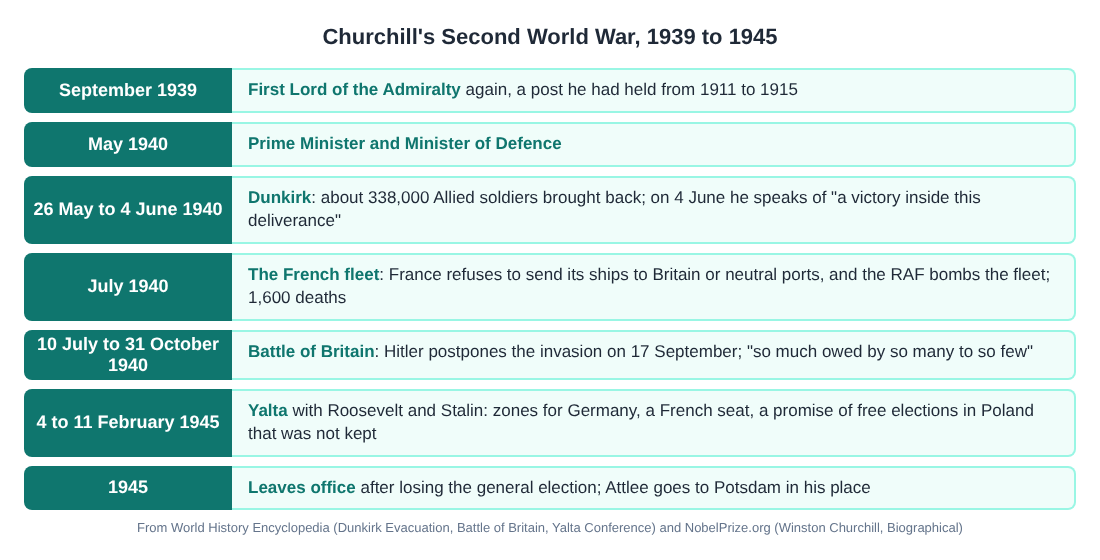
Churchill's war in seven dates, from the Admiralty to the 1945 election.
Dunkirk: a defeat told as a deliverance
Within weeks of taking office he faced disaster in France. The German army had cut off the British Expeditionary Force, and from 26 May to 4 June 1940 Operation Dynamo brought it home. Vice Admiral Bertram Ramsey coordinated the effort from Dover, and somewhere between 850 and 950 vessels of all kinds took part. The Admiralty counted 338,226 men evacuated, about 220,000 British and 120,000 French.
World History Encyclopedia is clear that the losses were enormous. The British force had lost 68,111 men in action, the RAF lost 106 fighters over the beaches, around 200 civilian vessels went down, all the army's transport and heavy equipment was left behind, and 30,000 French troops were left at Dunkirk.
Churchill's job was to say what it meant. On 4 June he said that "there was a victory inside this deliverance". The encyclopedia says the feeling in Britain, as Churchill had put it, was that a defeat had turned into a victory, or at least a victory of morale, and the "Dunkirk Spirit" helped carry people through what came next.
What came next included one of his hardest orders. France surrendered on 22 June. Churchill was anxious that the French Navy, then in North Africa, should not fall into German hands, and asked that its ships sail to Britain or to neutral ports. The French refused. In July the RAF bombed the fleet, and 1,600 people died.
The Battle of Britain and "the few"
With France gone, Hitler was expected to invade Britain in Operation Sea Lion, and for that he needed control of the air. The Air Ministry dates the battle that followed from 10 July to 31 October 1940. On 15 September, often called Battle of Britain Day, the RAF shot down around 60 aircraft, and two days later Hitler postponed the invasion.
The RAF lost 788 aircraft against the Luftwaffe's 1,294. Of 2,927 RAF pilots who took part, 554 were killed. Churchill's tribute to them became famous: "Never in the field of human conflict was so much owed by so many to so few."
Notice what his role was here. The fighting was run by the RAF; the encyclopedia quotes Hugh Dowding, the head of Fighter Command, as knowing he was "the one man who could easily lose" the war. Churchill's part was to lead the government and to give the country words for what the pilots were doing.
Churchill in the Second World War's endgame: Yalta
From 4 to 11 February 1945 Churchill met Roosevelt and Stalin, the "Big Three", at the Livadia Palace in Crimea to settle what would happen after a victory that now looked close. He and Roosevelt had met in Malta a few weeks before to agree some of their strategy first.
- Germany: Germany and Austria would each be divided into four zones of occupation, with Berlin and Vienna divided too.
- France: thanks to lobbying by Roosevelt and Churchill, France became one of the occupying powers and gained a permanent seat on the United Nations Security Council.
- Poland: Churchill extracted a promise from Stalin that Poland would have free elections. World History Encyclopedia says simply: "This never happened."
- Japan: Roosevelt and Stalin made a secret deal over Japan that Churchill was not directly part of, though he signed it.
Churchill himself did not leave happy. The encyclopedia records him asking an aide at the end to take him away from this "Riviera of Hades". Later that year he lost the general election, and Clement Attlee went to the Potsdam Conference in his place.
How Churchill's war leadership has been judged
There is no single verdict, and the sources opened for this post set out more than one view.
- Dunkirk: one reading stresses the escape that let Britain carry on fighting. Another stresses the defeat itself and the men, ships and equipment lost. Churchill framed it as a deliverance, and the encyclopedia says that became the feeling in Britain.
- The French fleet: the order kept the ships from Germany, as Churchill intended. It also killed 1,600 people from a country that had been an ally weeks before.
- Yalta: once its details were made public in March 1947, many in Britain and the United States felt Roosevelt and Churchill had given away control of Eastern Europe to the Soviet Union. Others point to what the West did gain, such as France's raised position and the defence of democracy in Greece. The encyclopedia also notes that the deal to return deserters and those considered traitors very likely sent many Russians to their deaths.
- His own account: keep in mind how much of the record Churchill wrote himself. His war memoirs ran to six volumes between 1948 and 1954, his speeches fill a dozen volumes, and in 1953 he won the Nobel Prize in Literature.
A fair essay sets these side by side and says which evidence each view rests on. For a model of that, see how to compare two historical figures in an essay, and for another war leader judged on the same terms, Abraham Lincoln and the Civil War.
Worked example: reading "so much owed by so many to so few"
Take Churchill's best-known line and read it as a primary source, in four steps. You can use the same steps on any speech.
- Date and setting. It belongs to the Battle of Britain, 10 July to 31 October 1940, when an invasion still looked possible.
- Who is speaking, and why. The Prime Minister, at a time when losing the air war could mean invasion. Ask what the line is for: honouring the pilots, and keeping up the nerve of everyone else.
- Check it against the numbers. "The few" were 2,927 RAF pilots, of whom 554 were killed. "The many" were everyone they defended. The figures in World History Encyclopedia let you test the line: a small number of pilots, a heavy death rate, and a whole country defended.
- Ask what it leaves out. The line is about the pilots, but the encyclopedia also weighs the machines: Spitfires shot down 529 enemy aircraft, and Hurricanes destroyed more enemy aircraft than all other defences, air or ground, combined. Note what a speech chooses to praise and what it leaves to others.
Write down one sentence for each step and you have the core of a source paragraph. The full method is in how to analyze a primary source in history.
Frequently asked questions
When did Churchill become Prime Minister?
In May 1940, as Prime Minister and Minister of Defence. He held office until 1945 and was Prime Minister again from 1951 to 1955.
What did Churchill say about Dunkirk?
On 4 June 1940 he said "there was a victory inside this deliverance". The evacuation brought home 338,226 men, but at a heavy cost in men, ships and equipment.
Who were "the few"?
The RAF pilots of the Battle of Britain. 2,927 took part and 554 were killed.
Why is Churchill criticised over Yalta?
Many in Britain and the United States later felt that he and Roosevelt had given away control of Eastern Europe to the Soviet Union. Stalin's promise of free elections in Poland was never kept.
Get started
Churchill makes more sense beside the people he fought with and against. Learn 100 Influential People is a web app of short hands-on lessons on the 100 people who most shaped human history. Its Twentieth Century course covers Churchill with Lenin, Stalin, Hitler, Roosevelt, Mao, Deng, Gandhi, King and Mandela. Each lesson takes about 9 minutes, where researchers disagree the site sets out each side, and every lesson lists its sources so you can read further. You sign in with your email and an emailed sign-in code. You can read more on the about page.
Start Learn 100 Influential People: short lessons on the people who shaped history, with every side of the debate and the sources to read next.
100 people who shaped history, from Moses to the web.
Visit influentialpeople.vlvd.net↗
Comments
No comments yet.