Cognitive science and AI: how the two fields grew together
Cognitive science and AI grew up together. Cognitive science is the scientific study of the mind, and from its start in the 1950s it used the computer both as a picture of how thinking might work and as a tool to test that picture. AI, in turn, borrowed its first ideas about intelligence from the study of people. This post explains how the two fields meet, where they split, and how to think about a mind on more than one level.
If you want to explore what happens when artificial minds outgrow their makers, as a story, Contain ASI is a browser story strategy game for 1 to 4 players in which you try to keep four fictional AI labs from crossing into recursive self-improvement before 2027.
What cognitive science is, and where AI fits
Wikipedia's article on cognitive science calls it the interdisciplinary, scientific study of the mind and its processes. It looks at perception, memory, attention, reasoning, language and emotion, and it borrows from psychology, philosophy, artificial intelligence, neuroscience, linguistics and anthropology.
One idea sits near its center: that "thinking can best be understood in terms of representational structures in the mind and computational procedures that operate on those structures." In plain words, the mind holds things that stand for other things, and it works on them step by step.
That is where AI fits. The article describes AI as the study of cognitive phenomena in machines, with one practical goal of building aspects of human intelligence into computers. Computers are also used the other way round, as tools: a computational model simulates how human intelligence might be structured, and its results are compared with what people actually do.
The field is broad enough that some doubt there is one unified cognitive science, and some researchers prefer to say "cognitive sciences", in the plural.
How the two fields were born together
The article traces the modern field back to the cyberneticists of the 1930s and 1940s, such as Warren McCulloch and Walter Pitts. They built the first versions of what are now called artificial neural networks, models of computation inspired by networks of neurons in the brain.
At the same time, Kurt Gödel, Alonzo Church, Claude Shannon, Alan Turing and John von Neumann were laying down the theory of computation and the digital computer. The computer became both a metaphor for the mind and a tool for studying it. At MIT, J.C.R. Licklider ran early experiments that used computer memory as a model of human memory.
The other push came from linguistics. In 1959 Noam Chomsky published a scathing review of B. F. Skinner's book Verbal Behavior. Psychology in the United States was then dominated by behaviorism, which studied stimulus and response without talking about anything inside the head. Chomsky argued that language could only be explained by a theory that posits internal representations. This return to mental processes became known as the cognitive revolution.
The name came later, and from an AI debate. Christopher Longuet-Higgins coined the term cognitive science in his 1973 commentary on the Lighthill report, a review of the state of AI research. The Cognitive Science Society held its founding meeting at the University of California, San Diego in 1979, and the first cognitive science department was founded there in 1986.
Symbols or networks: two pictures of the mind
In the 1970s and early 1980s, as computers became easier to get, AI research grew. Researchers such as Marvin Minsky wrote programs in languages such as LISP that tried to spell out the steps people go through when they decide or solve problems. The hope was double: to understand human thought, and to build artificial minds. This approach is symbolic AI.
Its limits showed. It seemed unrealistic to list all of human knowledge in a form a symbolic program could use. The late 1980s and 1990s saw the rise of neural networks and connectionism, often credited to James McClelland and David Rumelhart, in which the mind is a set of complex associations held in a layered network. That revival answered an earlier argument told in our post on the Perceptrons book.
Each side has its critics. Some argue that symbolic models capture certain things better, and that connectionist models are often so complex that they explain little. The article adds that neither kind of model is biologically realistic. More recently the two have been combined, an approach covered in neurosymbolic AI. The article puts the whole debate in one question: can you accurately simulate a human brain on a computer without accurately simulating the neurons that make it up?
Marr's three levels: one task, three questions
A central idea of cognitive science is that you cannot understand the mind by studying only one level. The article's example is remembering a phone number. You could test how well people recall it after a delay, or record neurons firing while they try. Neither experiment alone explains how the remembering works.
Marr gave a well-known way to split the work into three levels:
- The computational theory: what the goal of the computation is.
- Representation and algorithm: how the inputs and outputs are represented, and the steps that turn one into the other.
- The hardware implementation: how that representation and those steps are physically realized.
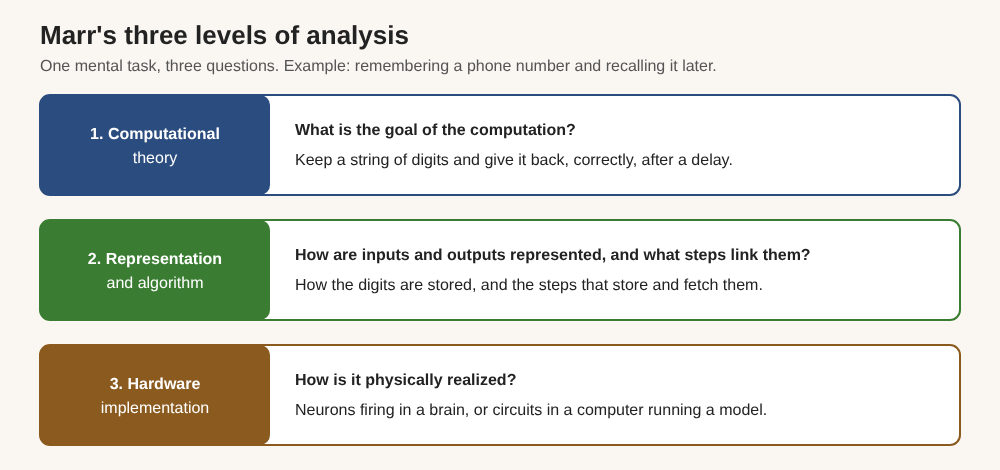
The levels matter for AI because they let you ask whether a machine and a brain could share the first two levels while differing in the third. That question leads to the next idea.
Can a computer have a mind? Functionalism and its critics
Many, though not all, cognitive scientists hold a functionalist view: mental states are explained by what they do, not by what they are made of. On one version of that view, called multiple realizability, even robots and computers can be said to have cognitive states.
Others push back. The article's list of notable researchers includes John Searle, known for the Chinese room argument of 1980, and David Chalmers, known for the hard problem of consciousness. Classical cognitive science also tended to leave out the body, emotion and consciousness; theories of embodied cognition bring the body and the world back in.
Try it: analyse one mental task at three levels
Pick something your mind does every day, such as finding your keys, reading a street sign or choosing what to cook. Then take ten minutes and a sheet of paper.
- Level 1, the goal. Write one sentence on what the task computes. For finding keys: from where I am and what I remember, output a place to look.
- Level 2, the steps. Write what information you use and in what order. Do you recall the last place you saw them, retrace your steps, or check the usual spots first?
- Level 3, the machine. Note what physically does it: your eyes, your memory, your hands. Then ask how a robot would do the same steps with cameras and motors.
- Compare the pictures. Is your level 2 more like a list of rules, a symbolic picture, or more like a feeling of where things usually are, closer to the network picture?
- Find the gap. Mark one thing you could not write down at any level. That gap is where much of the field's open debate sits.
Cognitive science and AI in debates about advanced AI
Cognitive science gives the debate about powerful AI some of its basic vocabulary: representation, computation, levels and function. If functionalism is right, a machine running the right steps could have real cognitive states. If its critics are right, something may be missing however well a machine behaves. The field holds both views, and the article gives no final answer.
Frequently asked questions
Is AI part of cognitive science?
AI is one of the fields cognitive science draws on, alongside psychology, philosophy, neuroscience, linguistics and anthropology. The two overlap but are not the same: AI builds intelligent machines, while cognitive science studies minds, using machines as one tool.
Who coined the term cognitive science?
Christopher Longuet-Higgins, in his 1973 commentary on the Lighthill report about the state of AI research.
What is the difference between symbolic and connectionist models?
Symbolic models treat the mind as rules working on symbols. Connectionist models treat it as many simple connected units, like a neural network, whose abilities come from the connections between them.
What are Marr's three levels?
The computational theory, which states the goal; representation and algorithm, which state the steps; and the hardware implementation, which states how it is physically built.
Get started with Contain ASI
Whether a machine can truly think is still debated, and so is how anyone would steer one that outgrows its makers. Contain ASI lets you explore the second question as fiction: as a researcher, research manager, CEO or government, you try for three years to keep four fictional AI labs from reaching recursive self-improvement before 2027. Its Chapter 1, Before ASI, starts in January 2024, and the game says it is inspired by the AI 2027 scenario by Daniel Kokotajlo, Scott Alexander, Thomas Larsen, Eli Lifland and Romeo Dean. It needs a browser with WebGL 2.
Play Contain ASI: a story strategy game for 1 to 4 players that runs in your browser. Its labs, people and events are all fictional.
January 2024. Four AI labs. One race.
Visit containasi.vlvd.net↗

Comments
No comments yet.