Embodied cognition in AI: why a body may matter for minds
Embodied cognition is the idea that thinking is shaped by the body that does it and the world that body moves through, not only by a brain working on symbols. In AI, it is the claim that a mind may need sensors, movement and a place in the world before it can be truly intelligent. This post explains where the idea came from, the six claims it rests on, what it changed in robotics, and where it falls short.
If you want to explore questions about minds and machines as a story, Contain ASI is a browser story strategy game for 1 to 4 players in which you try to keep four fictional AI labs from crossing into recursive self-improvement before 2027.
What embodied cognition means
Wikipedia's article on embodied cognition describes it as a diverse group of theories that investigate how cognition is shaped by the bodily state and capacities of the organism. Those bodily factors include the motor system, the perceptual system, the body's interactions with the environment, and the assumptions about the world that shape the structure of the organism's brain and body.
The article quotes a definition from the Stanford Encyclopedia of Philosophy by R. A. Wilson and L. Foglia: many features of cognition are embodied in that they depend deeply on an agent's physical body, so that the body beyond the brain plays a significant causal role, or a physically constitutive role, in its thinking. Perception, attention, memory and reasoning all depend, on this view, on the kind of body an agent has.
The idea pushes against three older views: cognitivism, computationalism and Cartesian dualism. It sits close to the extended mind thesis, situated cognition and enactivism. Together these are often called 4E cognition: embodied, embedded, enacted and extended.
Where the idea came from
The article frames embodied cognition as a reaction to René Descartes. In Cartesian dualism, from the 17th century, the mind is entirely distinct from the body and can be explained without any reference to it.
In the 20th century, phenomenologists such as Edmund Husserl, Martin Heidegger and Maurice Merleau-Ponty argued that some parts of human experience cannot be explained by a model of the mind as computation over inner symbols. Psychologist J. J. Gibson built his ecological psychology against the information processing view: he saw perception as a product of the relation between a moving agent and its particular environment, not as guesswork from unreliable inputs. Francisco Varela and colleagues, authors with Evan Thompson and Eleanor Rosch of The Embodied Mind, argue that neither cognition nor the environment is given in advance: both are enacted, brought forth by the agent's history of activity.
Cognitive scientist George Lakoff added language. He holds that reasoning and language arise from bodily experience, so even our metaphors point back to the body. The article's example is how people describe thought in terms of hands, as when we speak of grasping an idea.
Wilson's six claims, and which ones hold
In 2002 the psychologist Margaret Wilson set out what the embodiment view actually claims. She found six separate claims bundled together, and she did not accept them all equally.
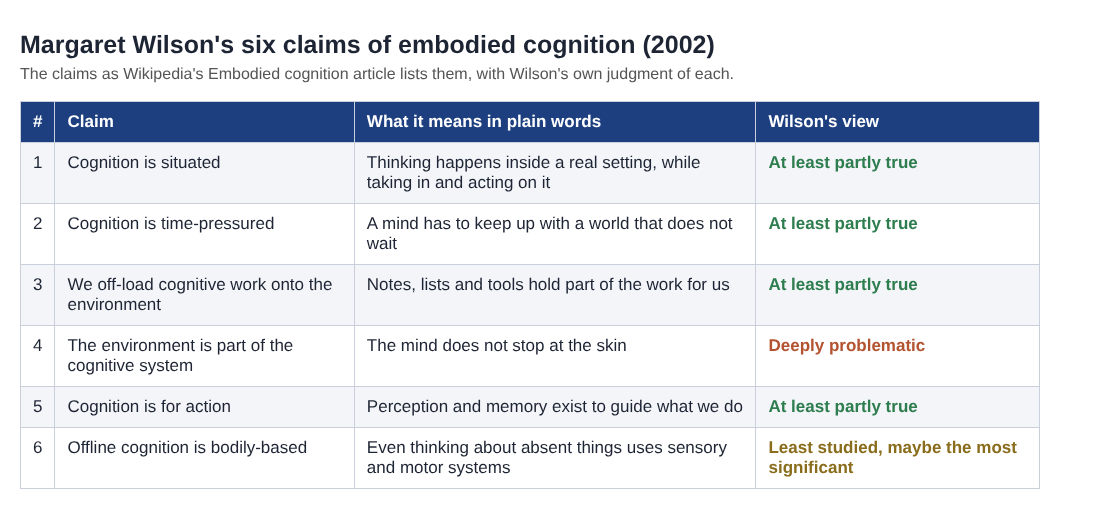
Wilson judged the first three and the fifth to be at least partly true. She called the fourth deeply problematic: not everything that affects a system is part of that system. The sixth, that even offline thinking rests on the body, has had the least attention, yet she suggested it might be the most significant, because it reaches abilities once thought to be purely abstract.
The article also reports experiments that fit the sixth claim. People judge an object to be heavier when they are told it holds important information, and people holding heavier clipboards give more importance to decision procedures.
Embodied cognition in AI and robotics
This is where the idea meets AI. According to the article, robotics researchers Rodney Brooks, Hans Moravec and Rolf Pfeifer argued that true artificial intelligence can only be achieved by machines that have sensory and motor skills and are connected to the world through a body. Their work in turn inspired philosophers such as Andy Clark.
The article uses Shakey the robot to show the older approach. Shakey was one of the first mobile robots able to reason about its own actions, melding logical reasoning with physical movement to navigate a room. But its architecture relied heavily on symbolic computation, so it had to work through long command sequences. Shakey was slow, could take days to finish a task, and worked only in a highly controlled environment.
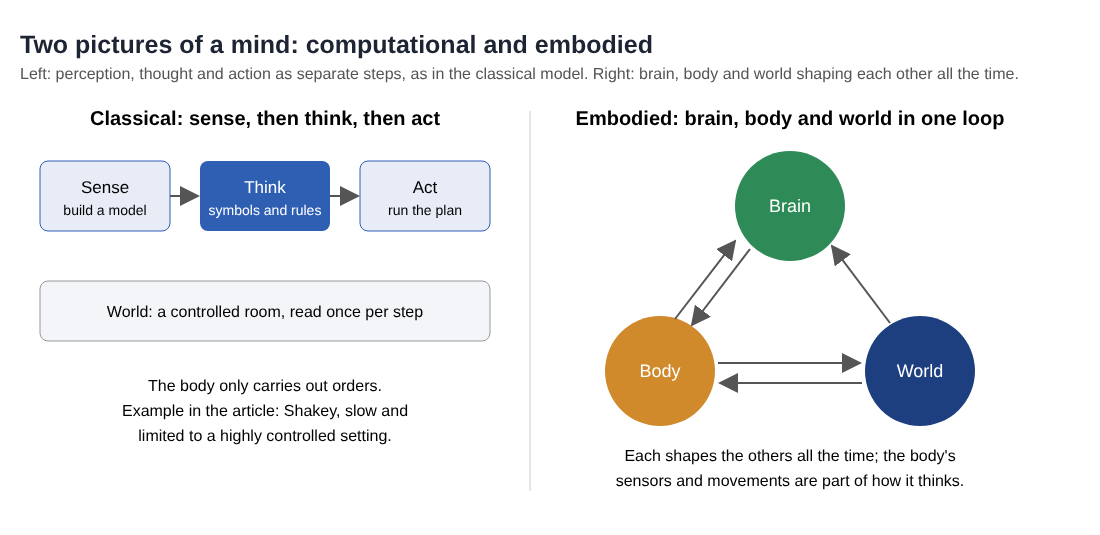
Embodied AI tries not to overlook the body when building AI systems. The article quotes the view that "intelligence is fundamentally a result of embodied interaction which exploits structure in the world". This gave rise to situated robotics: robots built up step by step from parallel behaviors that link action and perception directly. The article says such robots perform better than traditional ones in complex, changing settings, because their behavior shifts with their surroundings.
If this sounds familiar, it is the thinking behind subsumption architecture, and it echoes Moravec's paradox: the things a body does without effort are the hardest for a disembodied program. Today, the article says, most embodied AI work focuses on robot training and self-driving vehicles.
Try it: find the six claims in one ordinary task
You can test the idea on yourself in about fifteen minutes. Pick a small physical task you do often: making tea in a friend's kitchen, packing a bag for a trip, or putting together a shelf.
- Write the classical plan first. Before you start, write every step you will take, in order, as if a robot had to follow it with no eyes. Count the steps.
- Do the task for real, and keep a pen nearby. Each time you do something that was not in your plan, mark it.
- Sort your marks by Wilson's claims. Did you look for a cup and find it by seeing the shelf (situated)? Did the kettle boil before you were ready (time-pressured)? Did you leave the tea box open as a reminder (off-loading)? Did you reach for something before you consciously decided to (cognition for action)?
- Ask about claim 4. Was the open tea box part of your thinking, or only something that helped it? Notice that the answer is not obvious. That is the disagreement Wilson pointed to.
- Compare. How many marks did the written plan miss? A plan that ignores the room is the Shakey approach. The marks are what a body in the world handled for you.
Most people find the plan missed a lot. That gap is the core of the embodied argument, and also why building robots that act in open, untidy places has been so hard.
Limits and open questions
Embodied cognition is not settled, and the article records several challenges. The broad definition is one: because it stresses body, experience, culture and context at once, distinct views overlap, and the article suggests it is better seen "as a research program rather than a well-defined unified theory". Wilson's own verdict shows the claims do not stand or fall together.
The article also notes a problem the embodied approach does not solve. Young organisms face a flood of sensory input and cannot, on their own, pick out which stimuli matter. The article says even the embodied dynamical systems approach cannot get around this cue to noise problem, which requires sorting the world into objects through perception and intention.
For AI, the question remains open. The robotics view holds that a body is essential for intelligence, while the computational view it pushes against treats thinking as something that can be studied apart from any body. Related puzzles, such as how words get their meaning, are covered in the posts on the symbol grounding problem and Hubert Dreyfus's critique of AI.
Frequently asked questions
What is embodied cognition in simple terms?
It is the idea that how you think depends on your body and the world around you, not only on your brain. Perception, memory and reasoning are shaped by the kind of body doing them.
What is embodied AI?
Embodied AI builds systems that learn and act through a physical body, such as a robot with sensors and motors. It holds that intelligence comes from interaction with the world, not from symbols alone.
Who argued that AI needs a body?
Wikipedia's article names robotics researchers Rodney Brooks, Hans Moravec and Rolf Pfeifer, who argued that true artificial intelligence needs sensory and motor skills and a body connected to the world.
What are the 4Es of cognition?
Embodied, embedded, enacted and extended. Together they describe cognition as shaped by the brain, the body, and the physical and social environment.
Is embodied cognition proven?
Parts of it are well supported and parts are disputed. Margaret Wilson found most of its six claims at least partly true, but called the claim that the environment is part of the mind deeply problematic.
Get started with Contain ASI
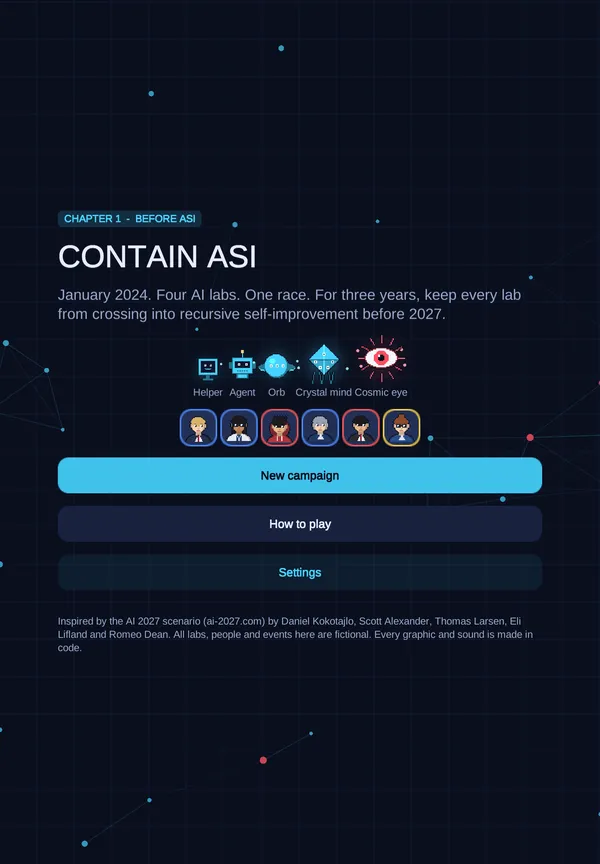
Whether a mind needs a body is still an open question, and so is how anyone would steer a mind that outgrows its makers. Contain ASI lets you explore the second question as fiction: as a researcher, research manager, CEO or government, you try for three years to keep four fictional AI labs from reaching recursive self-improvement before 2027. Its Chapter 1, Before ASI, starts in January 2024, and the game says it is inspired by the AI 2027 scenario by Daniel Kokotajlo, Scott Alexander, Thomas Larsen, Eli Lifland and Romeo Dean. It needs a browser with WebGL 2.
Play Contain ASI: a story strategy game for 1 to 4 players that runs in your browser. Its labs, people and events are all fictional.
January 2024. Four AI labs. One race.
Visit containasi.vlvd.net↗

Comments
No comments yet.