Computational creativity explained: machines that make art
Computational creativity is the field that asks whether a computer can be creative, and builds programs to find out. It sits, in Wikipedia's words, where artificial intelligence, cognitive psychology, philosophy and the arts meet. Its other names include artificial creativity, mechanical creativity and creative computation.
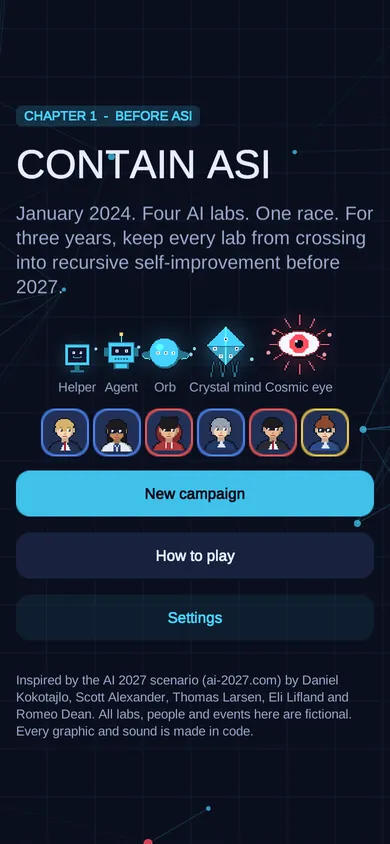
If you like thinking about what machines might do as a story rather than a lecture, Contain ASI is a browser story strategy game for 1 to 4 players where you try to keep four fictional AI labs from crossing into recursive self-improvement before 2027.
What computational creativity tries to do
The field has three goals, and a given project usually picks one. The first is a program capable of human-level creativity. The second is a better understanding of human creativity, written as steps a computer could follow. The third is software that makes people more creative without being creative itself.
Theory and practice run side by side. Some researchers argue about what creativity is and how to define it. Others build systems that write, compose or draw. The article says each strand informs the other. The applied side, programs that produce media, is also called media synthesis.
The old objection: a machine only does what it is told
The field starts with a doubt. If eminent creativity is about breaking rules, can a rule-following machine ever count as creative? The article calls this a variant of Ada Lovelace's objection to machine intelligence, restated by modern theorists such as Teresa Amabile. If a machine can do only what it was programmed to do, how can its behaviour be creative?
Not everyone accepts the premise. The article notes that not all computer theorists agree that computers can only do what they are programmed to do, and calls that a key point in favour of the field. For how the question was first argued about computers, see our post on Turing's paper Computing Machinery and Intelligence.
How researchers define creativity
No single definition covers it, so the field uses several. Newell, Shaw and Simon, early AI researchers, used four tests to call an answer creative:
- It is novel and useful, for the person or for society.
- It demands that we reject ideas we had accepted before.
- It comes from intense motivation and persistence.
- It comes from making a vague problem clear.
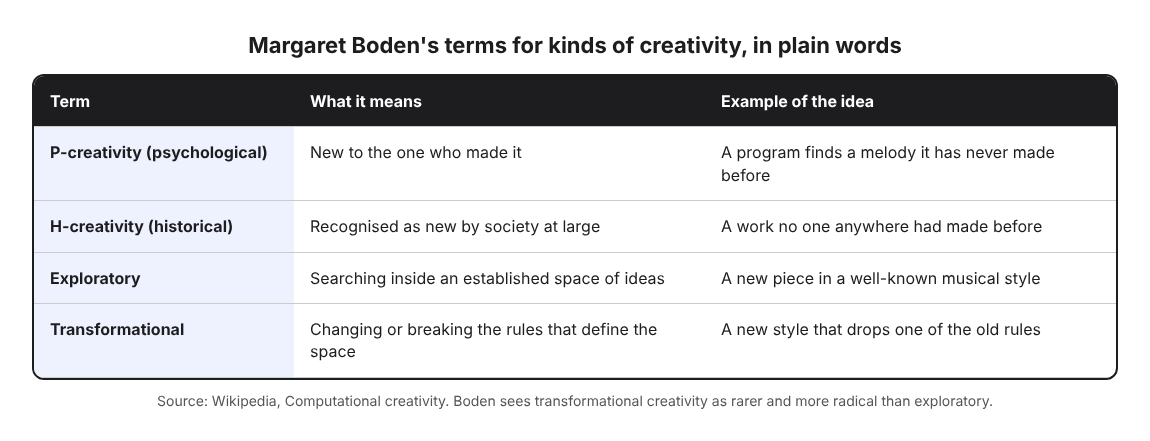
Margaret Boden kept the first two and defined creativity as "the ability to come up with ideas or artifacts that are new, surprising, and valuable". She also gave the field its most used terms. Something new only to the one who made it is P-creativity, for psychological. Something recognised as new by society is H-creativity, for historical. And she split exploring an established space of ideas from transforming that space, which she sees as rarer and more radical. Geraint Wiggins later turned her ideas into a formal framework.
Mihaly Csikszentmihalyi argued that creativity has to be judged in a social setting. In his DIFI framework (Domain, Individual, Field Interaction), a person makes a work, other people in the field judge its novelty and value, and the accepted work joins the domain that later people learn from.
A short history of creative programs
The idea is older than computers. The article mentions music composed by combining set pieces, a method explored with names like Mozart, Bach and Haydn. In the early days of AI, the 1956 Dartmouth conference listed creativity, invention and discovery as key goals.
The 1970s and 1980s brought rule-based systems, in the style described in our post on symbolic AI:
- TALE-SPIN (1977), by Meehan, made stories by simulating what characters wanted.
- AUTHOR (1981), by Dehn, simulated the way an author builds a story.
- AARON, by Harold Cohen, made drawings from a large set of rules about visual composition.
- BACON was said to rediscover laws such as Boyle's law and Kepler's law by testing hypotheses.
In the 1990s came MINSTREL (1993), which reused earlier material to tell new stories, MEXICA (1999), which modelled writing as cycles of engagement and reflection, and JAPE (1994), which made pun riddles. David Cope's EMI, or Emmy, composed new pieces in the styles of Bach, Beethoven or Chopin. Workshops on the subject began in the 1990s, and by the early 2000s the field had its own yearly meeting, the International Conference on Computational Creativity.
Machine learning changed the tools. In 1989 Peter Todd trained a neural network on a set of melodies, then changed its inputs so it produced new music. Today's language models write stories and scripts, and sometimes state false things as facts. The article reports that some creators use that habit on purpose, and that one proposal, from Jiang and colleagues, lets a model diverge freely and then filters the useful results.
Generation and evaluation: how creative systems work
If a creative product has to be new and useful, a system needs two steps. First it generates candidates, dropping any it already knows. Then it evaluates what is left, keeping what is meaningful and useful. The article says this matches the Geneplore model of Finke, Ward and Smith, a model of human creativity drawn from experiments.
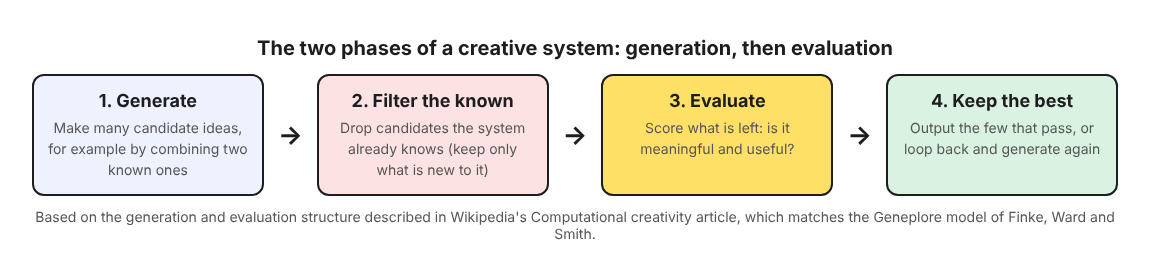
Evaluation is the hard part. Jordanous and Keller collected 694 words about creativity from 60 years of studies and grouped them into 14 components. These became SPECS, a standard procedure for evaluating creative systems. The components include dealing with uncertainty, independence and freedom, social interaction and communication, and spontaneity.
Generation often works by combination. The article says a great deal, perhaps all, of human creativity can be seen as a new combination of existing ideas: a familiar object in an unfamiliar setting, two genres blended, a comparison with a distant idea ("A zoo is a gallery with living exhibits"), or an unexpected feature added to a known thing. Seen this way, creativity becomes a search through the space of possible combinations.
Try it: a generate-and-evaluate exercise
You can run the loop yourself with a pen in about ten minutes. It shows why evaluation, not generation, is the bottleneck.
- Pick two lists. Write five everyday places (library, kitchen, bus, garden, hospital) and five unrelated things (a clock, a river, a chess board, a choir, a map).
- Generate. Pair each place with each thing, as in "A zoo is a gallery with living exhibits". That gives 25 comparisons, such as "A library is a river of borrowed voices".
- Filter the known. Cross out any pair you have heard before. What remains is new to you, which is P-creativity in Boden's terms.
- Evaluate. Score each survivor from 0 to 2 on Boden's three tests: new, surprising and valuable. Valuable here means it helps someone see the place differently.
- Keep the best. Keep the two or three with the highest score. Then ask: did your rule for scoring change while you worked?
Generating 25 pairs took a minute. Scoring them took judgement you could not fully write down, and that is the part a program finds hardest to copy.
The case against computational creativity
The field has serious critics, and the article sets out their case. One argument says a computer turns a limited set of inputs into outputs using a limited set of functions, so everything in the output was already in the input or the program. On this view a system may look creative, but nothing new is made, only transformed. The article links similar arguments to Chaitin and to model theory.
Others point to what is missing. Mark Riedl names the moral, teaching side of stories as a challenge for story-writing AI, and says a lack of intention stops a model making morally responsible choices. Michele Loi and Eleonora Vigano warn of a risk to human creativity: if society leans on algorithms for decisions, people may explore fewer risky ideas, drawing on John Stuart Mill's call for "experiments of life".
Supporters reply with the point above: not everyone agrees a computer can only do what it was told. This post takes no side. For the wider debate on what machines can and cannot be said to do, see the philosophy of artificial intelligence.
Frequently asked questions
What is computational creativity?
It is the study and building of computer systems that model, simulate or support creativity, at the meeting point of AI, psychology, philosophy and the arts.
Can AI be creative?
It depends on the definition. By Boden's test of new, surprising and valuable, some argue programs can be; critics say a program only transforms what was already in its input.
What is the difference between P-creativity and H-creativity?
P-creativity is an idea new to the one who had it. H-creativity is an idea recognised as new by society as a whole.
What was an early creative program?
TALE-SPIN (1977) generated stories from characters' goals, and Harold Cohen's AARON made drawings from rules about composition.
Get started with Contain ASI
Computational creativity asks what a machine can make. Contain ASI asks a different question, as fiction: what happens if fictional labs race toward a machine that improves itself. It runs in your browser and needs WebGL 2, so use a recent Chrome, Edge, Firefox or Safari. The game is not a course and does not teach this topic.
Play Contain ASI: a story strategy game for 1 to 4 players that runs in your browser. Its labs, people and events are all fictional.
January 2024. Four AI labs. One race.
Visit containasi.vlvd.net↗
Comments
No comments yet.