Dartmouth Workshop 1956: Where the Term AI Began
The Dartmouth workshop of 1956 was a summer research project that Wikipedia's article on it calls "widely considered to be the founding event of artificial intelligence as a field". The proposal for it, written in 1955, is credited with introducing the term "artificial intelligence". This post explains the Dartmouth workshop 1956 in plain words: who planned it, what the proposal asked for, who really came, and what the summer did and did not settle.
Contain ASI is a story strategy game for 1 to 4 players that runs in your browser: as a researcher, research manager, CEO or government, you try to keep four AI labs from crossing into recursive self-improvement before 2027. Its labs, people and events are all fictional.
Dartmouth workshop 1956: what it was
The full name was the Dartmouth Summer Research Project on Artificial Intelligence. It ran in the summer of 1956 at Dartmouth College in Hanover, New Hampshire. The article describes it as lasting about six to eight weeks and consisting largely of brainstorming sessions. It also says one plain thing that is easy to miss: it was not the first conference about what we would now call AI. It came after meetings such as the 1951 Paris cybernetics conference and the Macy meetings.
So Dartmouth did not start the idea of thinking machines. What it did was give a scattered set of efforts one name and one meeting place.
Many names before one: cybernetics, automata and the 1955 proposal
In the early 1950s, the article says, the field of "thinking machines" went by several names: cybernetics, automata theory and complex information processing. It adds that the variety of names suggests the variety of ideas behind them.
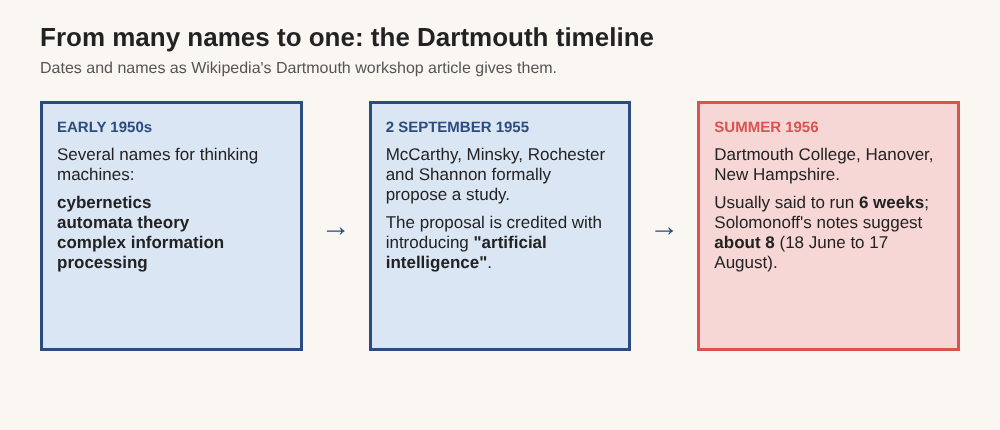
In 1955 John McCarthy, then a young assistant professor of mathematics at Dartmouth, decided to organize a group to clarify and develop those ideas. He picked the name "artificial intelligence" for the new field. The article gives his reason: he chose it partly for its neutrality. It avoided a narrow focus on automata theory, and it avoided cybernetics, which was heavily focused on analog feedback. It also spared him from possibly having to accept the "assertive" Norbert Wiener as guru, or having to argue with him.
The money came into it early. In early 1955 McCarthy approached the Rockefeller Foundation for a summer seminar of about 10 people. In June he and Claude Shannon, a founder of information theory then at Bell Labs, met Robert Morison, the foundation's Director of Biological and Medical Research. Morison, the article says, was unsure whether money would be made available for such a visionary project. On 2 September 1955 the project was formally proposed by McCarthy, Marvin Minsky, Nathaniel Rochester and Claude Shannon.
What the founding proposal said
The proposal asked for "a 2-month, 10-man study of artificial intelligence" in the summer of 1956. Its core sentence is still quoted:
The study is to proceed on the basis of the conjecture that every aspect of learning or any other feature of intelligence can in principle be so precisely described that a machine can be made to simulate it.
Read it as a bet, not a result. It does not say machines already think. It says intelligence can be described precisely enough to be copied. The next lines list what the group would try: to find how to make machines use language, form abstractions and concepts, solve kinds of problems then reserved for humans, "and improve themselves". The article adds that the proposal goes on to discuss computers, natural language processing, neural networks, the theory of computation, abstraction and creativity, and that these areas are still considered relevant to the field.
The phrase "improve themselves" is worth a pause. A machine that improves itself was on the founding wish list in 1955, as a problem to work on. Today the same idea is discussed as a risk, in our posts on recursive self-improvement and the intelligence explosion. The proposal itself, as the article quotes it, does not frame it as a danger.
Who was invited, who came and how long it ran
On 26 May 1956 McCarthy told Morison of the planned 11 attendees. For the full period: Marvin Minsky, Julian Bigelow, D. M. MacKay, Ray Solomonoff, John Holland and McCarthy himself. For four weeks: Claude Shannon, Nathaniel Rochester and Oliver Selfridge. For the first two weeks: Allen Newell and Herbert Simon.
Real life changed the list. The article says the actual participants came at different times, mostly for much shorter times. Trenchard More replaced Rochester for three weeks, and MacKay and Holland did not attend. McCarthy even lost his list of attendees at first, and afterwards sent Solomonoff a preliminary list of 47 people who were participants, visitors or simply interested. Solomonoff made his own list from his notes, which also names W. Ross Ashby, W. S. McCulloch, Abraham Robinson, John Nash, Arthur Samuel and others.
Only Solomonoff, Minsky and McCarthy stayed the full time. The article says that from three to about eight people attended the daily sessions. The picture of a packed hall of founders is not what the record shows. It was a small, shifting group in a math department.
How long it lasted, and how we know
The workshop is usually said to have run for six weeks. Ray Solomonoff's notes, however, indicate it ran for roughly eight weeks, from about 18 June to 17 August. His notes start on 22 June, and on 17 August he gave a final talk. The article uses these notes to correct the common figure.
This is a small example of how history gets written. A round number gets repeated, and one person's dated notes later show it was off. It is a good habit to ask what a date or a duration rests on, whether you meet it in a history of AI or in a forecast about next year.
What the summer produced
The workshop was, the article says, "not a directed group research project". The group had the entire top floor of the Dartmouth Math Department. Most weekdays they met in the main math classroom, where someone might lead a discussion on their own ideas, or, more often, a general discussion was held.
The article lists several directions it considers started or encouraged by the workshop:
- the rise of symbolic methods;
- systems focused on limited domains, which it calls early expert systems;
- deductive systems versus inductive systems.
It also quotes one participant, Arthur Samuel: "It was very interesting, very stimulating, very exciting." Those directions connect to later posts here: symbolic AI and expert systems. For the people involved, see Marvin Minsky, and for what came next, the history of AI timeline.
A worked example: read a founding claim like a historian
Here is a short exercise you can do with the proposal's sentence. It works on any big claim about AI.
- Split it. "Every aspect of learning or any other feature of intelligence" is the scope. "Can in principle be so precisely described" is the method. "A machine can be made to simulate it" is the goal.
- Find the hedge. The words "in principle" and "conjecture" mark a bet, not a finding. Write down what evidence would count for or against it.
- Check the schedule. The request was for a two-month study. Note the gap between that and a field that is still working on the same list of problems decades later.
- Check who was there. Compare the planned 11 with the people who really came. Plans and records can differ.
Do the same with any forecast you read today: what is the scope, what is the hedge, what is the schedule, and who is actually in the room?
The workshop and Contain ASI
The 1955 proposal was about making machines more capable. Contain ASI looks at the other end of that story, as fiction. Its page reads "January 2024. Four AI labs. One race." and gives you three years to keep every lab from crossing into recursive self-improvement before 2027. You play as a researcher, research manager, CEO or government. The page says it is inspired by the AI 2027 scenario, and that all its labs, people and events are fictional. It is a story, not a forecast, and it does not claim to show what real organizations will do.
Frequently asked questions
When was the Dartmouth workshop held?
In the summer of 1956 at Dartmouth College in Hanover, New Hampshire. The project was formally proposed on 2 September 1955.
Who coined the term artificial intelligence?
John McCarthy picked the name, and the 1955 proposal is credited with introducing it. The article says he chose it partly for its neutrality.
Who organized the Dartmouth workshop?
Four people: Claude Shannon, John McCarthy, Nathaniel Rochester and Marvin Minsky. The article calls them some of the "founding fathers" of AI.
How long did the Dartmouth workshop last?
It is usually said to have run six weeks. Ray Solomonoff's notes suggest roughly eight weeks, from about 18 June to 17 August 1956.
Was the Dartmouth workshop the first AI meeting?
No. The article says it came after meetings such as the 1951 Paris cybernetics conference and the Macy meetings.
Get started
Dartmouth shows how a field can begin with a name, a bet and a few people in a room. If you would rather explore where that bet might lead as a story, play Contain ASI: a story strategy game for 1 to 4 players that runs in your browser. Its labs, people and events are all fictional. You will need a recent browser, because it runs on WebGL 2.
January 2024. Four AI labs. One race.
Visit containasi.vlvd.net↗


Comments
No comments yet.
Sign in or make an account to comment.