Constantine the Great and Christianity: What Changed After 312
Constantine the Great and Christianity: what changed after 312? In that year Constantine won a battle he later credited to the Christian God, and over the next 25 years the church went from a persecuted movement to a favoured partner of the emperor. World History Encyclopedia calls his conversion "a turning point in history, a fusion of church and state". Historians still argue about how much of that was faith and how much was politics.
If you would rather learn this as a short lesson, Learn 100 Influential People puts Constantine in its Empire Builders course next to Cyrus, Alexander, Caesar and Genghis Khan, in lessons of about 9 minutes with questions that check what you remember. You sign in with your email and an emailed code.
Constantine the Great and Christianity: what changed after 312, in short
The change came in steps, not in one decree. Here is the sequence as World History Encyclopedia gives it:
- 312: at the Milvian Bridge, Constantine defeats Maxentius, after a sign he is said to have seen.
- 313: the Edict of Milan grants Christians toleration and says confiscated church property must be returned or paid for.
- After 313: money, buildings, offices and tax exemptions flow to the church.
- 325: the Council of Nicaea produces a creed and fixes the date of Easter.
- 330: a new capital, Constantinople, is dedicated.
- 337: he dies after ruling for 31 years.
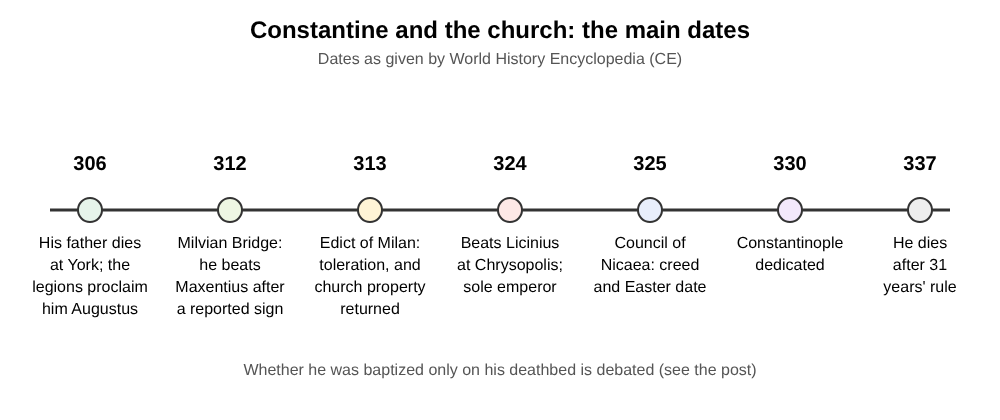
Some background first. The empire Constantine inherited was split on purpose. The World History Encyclopedia article on Constantine says Emperor Diocletian divided it into a rule of four, with two senior emperors (augusti) and two juniors (caesars). Constantine's father, Constantius, ruled in the west. When Constantius died at York in July 306, after campaigning against the Picts in Britain, Constantine's soldiers declared him augustus, although the official choice had been someone else.
Over the next years several men claimed the west. One was Maxentius, who had also felt passed over and who held Rome with the support of the city and the Praetorian Guard. The article says Constantine waited while the west tore itself apart, then gathered an army of forty thousand, crossed the Alps and invaded Italy.
The Milvian Bridge: what Constantine reportedly saw
Maxentius left Rome to meet Constantine at the Milvian Bridge in 312. The article says that the day before, Constantine reportedly saw a cross of light in the sky with the words In Hoc Signo Vinces, "in this sign, conquer". That night a dream explained it: he was to carry the sign of the cross into battle. The next day his banners were replaced with new ones showing the Christian symbol. Outnumbered, he still won, and Maxentius fell into the river and drowned.
Do not take that story as a single clean record. A second World History Encyclopedia article, on Constantine's conversion, says there are only two sources for it, and both wrote years after the event. Eusebius, his court bishop, reported the sign of the cross. Lactantius, a court adviser and tutor to his sons, said it was the Greek letters chi and rho, the first two letters of "Christ", laid over each other. The article adds that it is still unclear whether Constantine saw a vision or dreamed it, and that controversy "still swirls" around both the event and the image. What all accounts share is the result: whatever he saw, he credited his victory to the Christian God.
The Edict of Milan: toleration, not a Christian state
Constantine was not technically the first emperor to legalize Christianity. The second article notes that Galerius, who had persecuted Christians, reversed course with an Edict of Toleration in 311, and that Licinius took it as a model when he met Constantine in Milan. The Edict of Milan followed in 313, with the extra rule that confiscated or destroyed Christian property was to be returned or paid for.
Read what it did and did not do. It gave Christians toleration and permission to meet, so it legalized the movement. But the article says it left all the native cults in place, so Christianity became one more cult among thousands. It was a change of status, not a ban on anyone else.
Money, offices and a new capital
After 313 the emperor moved from tolerating the church to backing it. According to the article, Constantine gave Christians funds to build basilicas and buy property, returned what had been taken, named Christians to high offices and exempted their clergy from taxes. In Rome he built the first basilicas of St. Peter and St. John in Lateran. His mother Helena went on a pilgrimage to Jerusalem in 325, and he then built the Church of the Nativity in Bethlehem and the Church of the Holy Sepulcher in Jerusalem.
He also built a new capital. After defeating Licinius at Chrysopolis in 324, who had by then turned on Christians with executions and the destruction of churches, Constantine was sole emperor. He chose Byzantium on the Bosporus, and the city was dedicated in 330. The first article says it had Christian churches such as Hagia Irene and pagan temples as well, "a Christian capital that remained classical at the same time". He later asked to be buried in its Church of the Holy Apostles, which the second article says he wanted as "the thirteenth apostle".
Nicaea and the push for one church
A united church mattered to a ruler who wanted a united empire. The second article describes two disputes. First, the Donatist schism: some bishops had handed over sacred texts during Diocletian's persecution, and a group led by Bishop Donatus held them defiled. The bishops asked Constantine to mediate, and he ordered a policy of "forgive and forget". Donatus refused, and his followers settled in North Africa, where they clashed with Augustine a hundred years later.
Second, Arius, a priest in Alexandria, was teaching that at some point God had created Christ. Riots broke out in several cities, so in 325 Constantine brought the bishops together at Nicaea. The council condemned Arianism and produced the Nicene Creed, and it also set the date of Easter as the first Sunday after the first full moon following the spring equinox. The article points out that a creed was a Christian innovation, since the old cults had no central authority to say what everyone must believe. Under the creed, dissent was not only heresy but also treason.
Was Constantine really a Christian? What historians debate
This is the question most readers want answered, and the sources set out the evidence on both sides. These are the main positions:
- A committed convert. He claimed to be a Christian from 312, wrote openly about his convictions in letters and speeches, and spent heavily on the church.
- A political calculation. The second article reports estimates of about 3 million Christians in an empire of 60 million around 300, and says some think he saw the winds of change. It also notes he and his father belonged to the cult of Sol Invictus, the unconquered sun.
- A careful ruler. He inherited a vast empire and expected loyalty from all citizens, so he could not abruptly end the old Roman religion.
The evidence against full commitment is real. The article lists the Edict of Milan leaving the native cults in place, the Arch of Constantine, built in 315, with no Christian symbols and sculptures of offerings to Apollo, Diana and Hercules, coins showing him as Sol Invictus and Helios, and baptism only on his deathbed. It says whether these show a lack of commitment is debated, and that waiting for baptism made sense for an emperor who knew he would have blood on his hands. The two articles also weigh the state's religion differently. The first says many historians credit Constantine with making Christianity the empire's official religion while others credit Theodosius, and the second says the native cults were not outlawed until Theodosius I's edict of 381. When a writer says "official religion", ask which law they mean.
A worked example: weigh two accounts of the sign
You can test this skill on one episode. Use the Milvian Bridge story:
- Write down what each source says: Eusebius says a cross, Lactantius says the chi-rho letters.
- Note when and why each wrote. Both wrote years later, one as his court bishop and one as a court adviser.
- List what they agree on: Constantine credited his victory to the Christian God.
- Decide what you can claim: that he credited the God, not that you know what he saw.
Our posts on analyzing a primary source and on Julius Caesar give more practice with the same habit.
Frequently asked questions
Did Constantine make Christianity the official religion of Rome?
Historians disagree. World History Encyclopedia says many credit Constantine, while others credit Theodosius, and its second article says the native cults were not outlawed until Theodosius I's edict of 381.
What was the Edict of Milan?
It was issued in 313 after Constantine and Licinius met in Milan. It gave Christians toleration and permission to meet, and said confiscated Christian property must be returned or paid for.
What did Constantine see at the Milvian Bridge?
Eusebius reported a sign of the cross, and Lactantius reported the Greek letters chi and rho. Both wrote years later, and it is unclear whether it was a vision or a dream.
Why did Constantine call the Council of Nicaea?
Arius was teaching that God had at some point created Christ, and riots had broken out in several cities. In 325 Constantine brought the bishops together, and they produced the Nicene Creed.
When was Constantine baptized?
World History Encyclopedia says he was not baptized until his deathbed, and calls the baptism the most debated topic of his conversion. It explains that waiting suited an emperor who knew he would have blood on his hands.
Get started
Reading gives you the story, and answering questions shows what stuck. Learn 100 Influential People offers short hands-on lessons on the people who shaped history, with 272 questions where you choose, put in order, match, sort and estimate a number. Every attempt is graded and you can retake a lesson, and questions from lessons you finish come back as spaced review, up to 5 a day. Every lesson lists its sources, and the about page explains the project.
100 people who shaped history, from Moses to the web.
Visit influentialpeople.vlvd.net↗

Comments
No comments yet.
Sign in or make an account to comment.