Contribution Margin: Formula and an AI Product Example
Contribution margin is what each sale leaves over after the costs that grow with that sale. Take the price of one unit, subtract the variable cost of serving it, and what remains is the money that goes toward rent, salaries and every other fixed cost, and then profit. For an AI product, where every request costs money, it is the number that tells you whether a customer helps your business or quietly drains it.
The Business Basics for Builders course on Age of AI Entrepreneur walks through revenue, costs and unit economics in short lessons with their sources; sign in with your email and an emailed code to open it. This post covers the contribution margin formula, how it differs from gross margin, and a worked example for an AI tool.
The contribution margin formula
There are two versions, and you will use both.
- Per unit, in money: contribution margin = price per unit minus variable cost per unit.
- As a ratio: contribution margin ratio = contribution margin divided by price.
A unit is whatever you sell: one customer for one month, one seat, one report, one task. Variable costs are the ones that go up when you sell one more unit and disappear when you sell one less. Fixed costs stay the same whether you have 10 customers or 100 this month.
The word "contribution" is the point. Each unit contributes its margin to a pot. Once the pot covers your fixed costs, every further unit's contribution is profit. That is why contribution margin is a building block of break even analysis: fixed costs divided by contribution per unit gives the number of units you need to sell.
Variable costs in an AI product
Classic examples of variable costs are materials and shipping. In an AI product the list looks different:
- Model usage. Every request is billed by the tokens in and out, as the guide to LLM token pricing explains. A customer who uses the product twice as much costs about twice as much.
- Other per-use services. Transcription, image generation, search or data lookups billed per call.
- Payment fees. Usually a share of each charge.
- Support time. If heavy users send more tickets, part of support grows with usage.
Fixed costs are the rest: your own salary, a base hosting plan, design tools, the domain. Some costs sit in between. Be honest about which way each one moves when you add a customer, because a cost placed on the wrong side changes the answer.
A worked example: an AI meeting notes tool
Say you sell an AI tool that turns meeting recordings into notes, at $30 per customer per month. These numbers are made up for the example. For an average customer, one month costs you:
- Model usage: $6.00
- Payment fee: $1.20
- Support time: $2.80
Total variable cost is $10.00. Contribution margin is $30 minus $10, or $20 per customer per month. The ratio is $20 divided by $30, about 67 percent.
Now add fixed costs of $4,000 a month for hosting, tools and a part-time contractor. Divide $4,000 by $20 and you need 200 paying customers to break even. Customer 201 adds $20 of profit a month.
But an average hides a lot. Split the same customers by how much they use the tool:
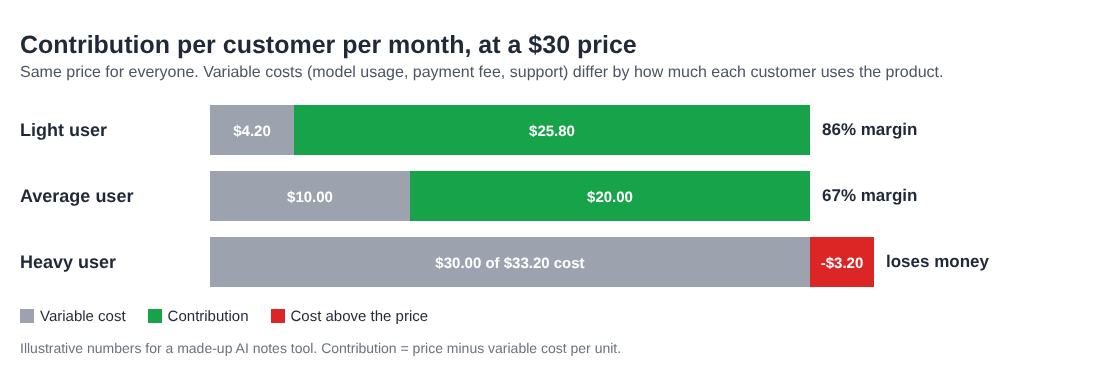
- Light user: $2.00 of model usage, $1.20 fee, $1.00 support. Variable cost $4.20, contribution $25.80.
- Average user: variable cost $10.00, contribution $20.00.
- Heavy user: $28.00 of model usage, $1.20 fee, $4.00 support. Variable cost $33.20, contribution minus $3.20.
The heavy user pays the same $30 and costs you money every month. More heavy users do not move you toward break even. They move you away from it.
Contribution margin vs gross margin
The two numbers look alike, and many founders use them as if they were the same. They are built differently.
Gross margin follows accounting rules: revenue minus cost of goods sold. Which costs count as cost of goods sold is set by accounting standards, and support or payment fees may sit below that line as operating expenses. Contribution margin sorts costs by economics instead: does this cost move with each unit or not?
In the example, if your accounts count only model usage and payment fees as cost of goods sold, gross margin is $30 minus $7.20, or 76 percent. Contribution margin, which also counts the support that grows with use, is 67 percent. Neither number is wrong. Gross margin is what investors compare across companies, as the posts on gross margin vs net margin and AI startup gross margin explain. Contribution margin is what you use for decisions about pricing, plans and which customers to chase.
Decisions contribution margin helps you make
Once you know contribution per customer, or per plan, several choices get clearer:
- Keep or drop a plan. A plan with a positive contribution margin can be worth keeping even when the business as a whole is not yet profitable, because it still helps pay fixed costs. A plan with a negative one loses more the more it sells.
- Fix pricing for heavy users. Usage limits, a higher tier, or billing by usage can turn the heavy user positive. The trade-offs are in usage-based pricing vs subscription.
- Cut the right costs. A cheaper model for simple requests or caching repeated answers raises contribution on every unit. Cutting a fixed cost does not change it.
- Set a ceiling on paid growth. Spending more to win a customer than that customer will contribute over their lifetime loses money, however fast you grow. The guide to unit economics for an AI product adds acquisition cost and payback to the picture.
Mistakes that make the number wrong
- Using list prices for model usage. Take the real cost from your provider's bill divided by real usage, not a guess from a price page. Retries, long prompts and failed requests all cost money.
- Averaging everyone together. As the example shows, one average can hide a group of customers who lose money. Work it out per plan and per usage band.
- Forgetting discounts and refunds. The price in the formula is what you actually collect, after annual discounts, coupons and refunds.
- Calling a fixed cost variable. A base hosting plan you pay whatever happens is fixed. Counting it per customer makes each unit look worse than it is.
Frequently asked questions
What is a good contribution margin?
It depends on your fixed costs and how many units you can sell. A lower margin needs more volume to cover the same fixed costs, so compare the margin with the volume you can realistically reach.
Is contribution margin the same as gross margin?
No. Gross margin follows accounting rules for cost of goods sold, while contribution margin subtracts every cost that moves with each unit. The two can differ when costs such as support or fees sit outside cost of goods sold.
Can contribution margin be negative?
Yes. If a unit costs more to serve than it brings in, as a heavy user on a flat plan can, its contribution is negative and each extra sale makes losses larger.
How do I calculate the contribution margin ratio?
Divide contribution margin per unit by the price per unit. A $20 contribution on a $30 price is a ratio of about 67 percent.
Get started
Open Age of AI Entrepreneur, sign in with your email and an emailed code, and take the Business Basics for Builders course: problems worth paying for, revenue, costs and unit economics, and growth, in lessons of about 9 minutes that list their sources.
Building a business in the age of AI, from a first project to a company.
Visit aientrepreneur.vlvd.net↗


Comments
No comments yet.