Cumulative Culture: How Humans Build on What Came Before
Cumulative culture is the way skills, tools and ideas are learned from other people, changed a little and passed on, so that each generation starts from where the last one stopped. It is why you use things no single person could invent in a lifetime, and researchers still argue over what drives it and whether any other animal has it.
How to Find Your Meaning is a free web app of short hands-on lessons on Stoic philosophy, healthy habits and the story of who you are, and its Culture course begins with a lesson called Culture Builds on Itself, so you can work through this idea with questions and an activity instead of only reading about it.
What cumulative culture means
The process is a loop with three steps. You learn something from another person. You change it, by accident or on purpose. Your version becomes what the next learner copies. Run the loop for enough generations and the result is something nobody in the chain could have made alone.
The Stanford Encyclopedia of Philosophy's entry on cultural evolution gives Joseph Henrich's example from 2016: manioc, also called cassava. It is a good source of starch, but without processing it can release poisonous hydrogen cyanide. The bitter taste is no guide, because bitterness disappears before the root is safe to eat, and the symptoms of poisoning appear well after the meal. Henrich argues it is hard to see how any single insightful person could have invented the processing. A slower process, spread across a population, did.
The ratchet effect: how changes stick
The usual picture is a ratchet, a wheel that turns one way because a catch stops it slipping back. The Stanford entry traces it to Michael Tomasello, in a 1993 paper with Ann Kruger and Hilary Ratner and again in 1999: traditions must be built upon and must not slip back.
The wheel has two parts. The turn is a new idea. The catch is copying that is faithful enough to keep it. In a 2009 paper, Claudio Tennie, Josep Call and Tomasello name what they think makes the human catch hold. Human learners copy the process, how a thing is done, more than the product, what it achieves. And human cooperation adds active teaching, a wish to do things the way others do, and disapproval of those who do not.
Where do the turns come from? Michael Muthukrishna and Henrich argued in 2016 that innovation is not the work of a talented few. They name three sources, serendipity, recombination and incremental improvement, and say the rate depends on how connected people are, how faithfully they copy and how much variety there is to copy from. They call the result a collective brain.
Culture versus cumulative culture: the distinction people miss
Having culture is not the same as having cumulative culture. The Stanford entry says culture is widespread among non-human animals, while the evidence for cumulative culture in them is contentious.
Tennie and his colleagues draw the line with one question: could an individual come up with this alone? They describe chimpanzee traditions as differences between populations that stay inside what the species can already do, which they call the zone of latent solutions. Watching others makes a behaviour more likely to appear. It does not carry the group beyond what one animal might discover by itself. Manioc processing, on Henrich's account, is something no single person could have worked out.
The second mistake is reading "cumulative" as "better". The entry reports Andrew Buskell's 2022 point that keeping modifications is one thing and improvement is another. A ratchet holds whatever is put on it, so harmful and neutral habits can pile up as well as useful ones.
What turns the ratchet: three experiments
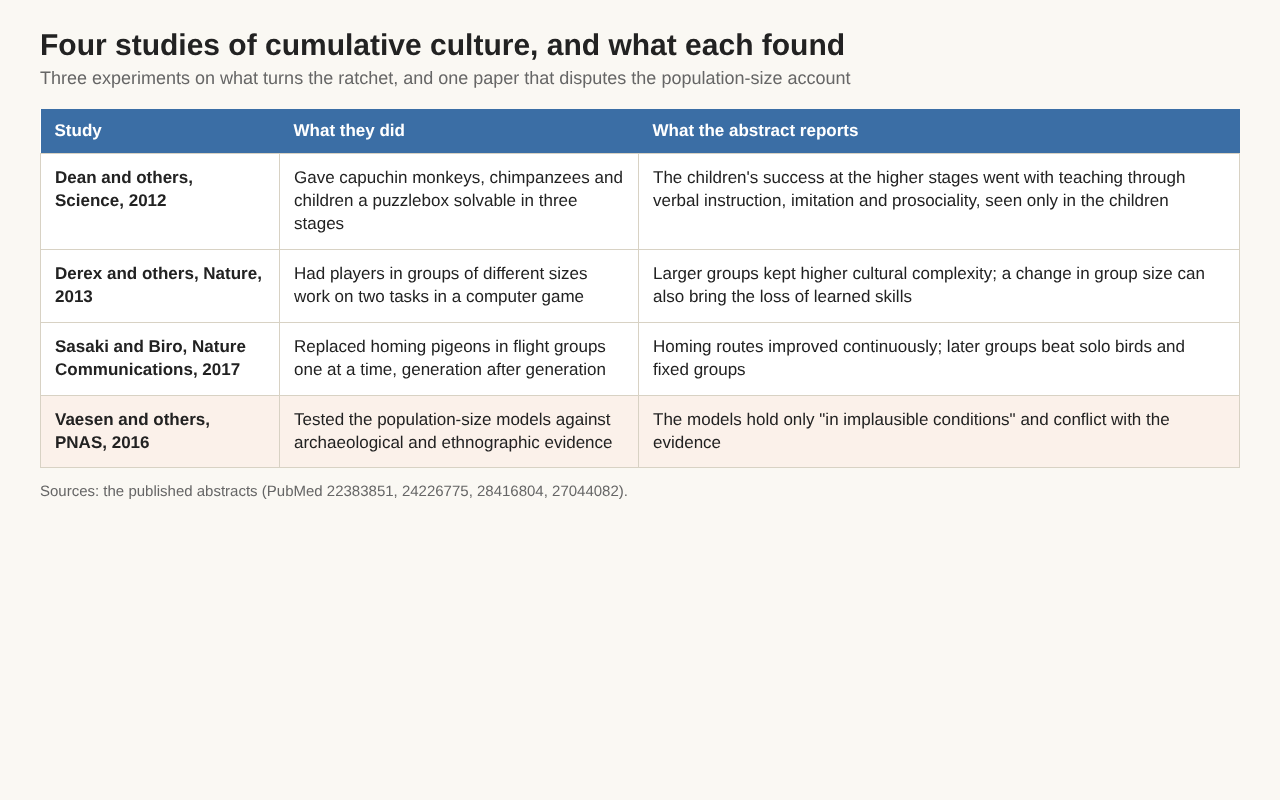
Three experiments and one critique. Sources: the published abstracts.
- Children, chimpanzees and capuchins. In 2012 Lewis Dean and colleagues gave groups of each a puzzlebox that could be solved in three stages, each with a better reward. The children's success in reaching the higher stages, unlike the other two species', went with teaching through verbal instruction, imitation and sharing, a package seen only in the children.
- Group size. In 2013 Maxime Derex and colleagues had people play a two-task computer game in groups of different sizes. Players in larger groups kept higher cultural complexity. In larger groups knowledge deteriorated less and improvements were more frequent, and the authors conclude that a change in group size can also bring the loss of learned skills.
- Homing pigeons. In 2017 Takao Sasaki and Dora Biro kept removing and replacing birds in flight groups. Homing performance improved continuously over these generations, and later groups outperformed solo birds and groups whose members never changed.
Read together, they point at three ingredients: how learners copy, how many people are connected, and turnover that hands a route or a skill to someone new. The pigeons matter most for the argument, because the authors say their result suggests mechanisms "that do not rely on complex cognition".
The ratchet in stone: a worked timeline
You can check the pace of the ratchet with four dates from the Smithsonian's page on stone tools.
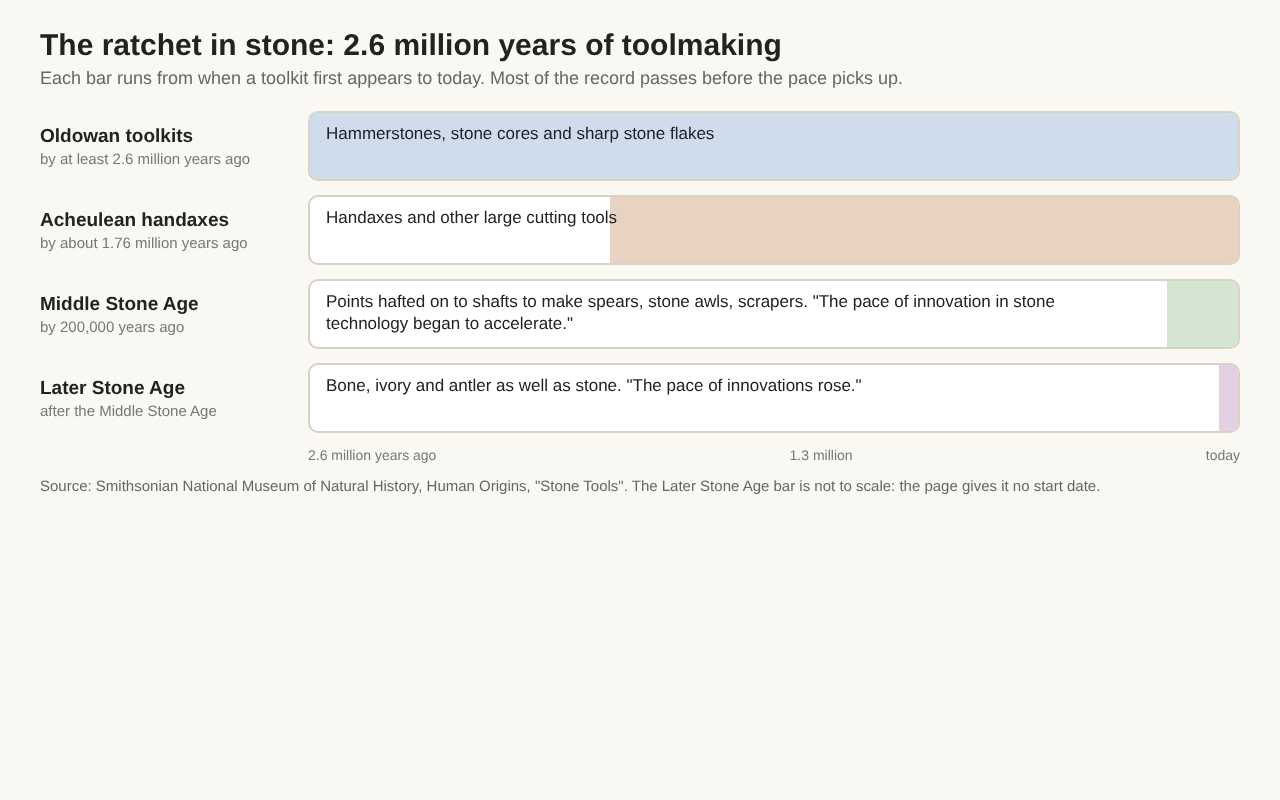
Stone toolkits by first appearance. Source: Smithsonian Human Origins, "Stone Tools".
- The earliest toolmaking, Oldowan hammerstones, cores and sharp flakes, dates to at least 2.6 million years ago.
- Acheulean handaxes appear by about 1.76 million years ago. That is roughly 840,000 years between the two dates.
- By 200,000 years ago the pace of innovation "began to accelerate", with points fixed to shafts to make spears, awls and scrapers. That is another 1.56 million years.
- In the Later Stone Age the pace rose again, with bone, ivory and antler as well as stone.
Add it up: 2.4 of the 2.6 million years, about 92 percent of the record, passed before the acceleration began. The consequence is that the ratchet is not automatic. For most of the time our ancestors made tools, change was slow. Whatever speeds it up arrived late, and researchers do not agree on what it was.
The strongest objections and what is still unsettled
Is it uniquely human? Tennie and colleagues say chimpanzee traditions do not seem to ratchet. Sasaki and Biro say their pigeons meet the main criteria. Alex Mesoudi and Alex Thornton argued in 2018 that the debate is hampered by multiple and often ambiguous definitions. Their answer is a core set of criteria that may be found in other species, and an extended set seen so far only in humans.
Does population size drive it? The group-size experiment says yes in the lab. But Krist Vaesen and colleagues argued in 2016 that the population models of Henrich (2004) and Powell and others (2009), often used to explain cases such as the loss of culture in Tasmania, work only "in implausible conditions" and conflict with the archaeological and ethnographic evidence.
What counts as a faithful copy? The Stanford entry asks you to picture one person copying a line of a song. Must the copy keep the melody, the key, the words, the feeling? There is no agreed answer.
Trace one inherited practice yourself
Your values reached you through the same loop. Marcus Aurelius opens his notebook with a list of debts: "From my grandfather Verus I learned good morals and the government of my temper." The post on Marcus Aurelius's Meditations covers the rest.
- Sextius. Seneca reports that when the day was over Sextius would ask his spirit: "What bad habit of yours have you cured to-day? what vice have you checked? in what respect are you better?"
- Seneca. He copies it and changes it. In On Anger, book 3, he writes that he passes the whole day in review and repeats all that he has said and done.
- The app. The daily practice in How to Find Your Meaning ends with the three questions in shorter words: What bad habit did I cure today? What fault did I resist? In what way am I better?
- You. Tonight you can ask them as written, or change one. Either way you are a link.
Now do it for your own life. Take 15 minutes and write down five things you do or believe. Beside each, answer three questions: who did I get this from, what did I change, and who gets it from me? The evening reflection questions post has more on the nightly review, and humans are social animals covers why we learn from each other at all.
Frequently asked questions
What is cumulative culture in simple terms?
It is culture that builds on itself: each generation learns what the last one knew, changes it, and passes the changed version on. Over time the result goes beyond what one person could invent alone.
What is the ratchet effect?
It is the image, credited to Michael Tomasello and colleagues, of a wheel that turns one way. New ideas are the turn, and faithful copying is the catch that stops a tradition slipping back.
Do animals have cumulative culture?
That is disputed. Many animals have culture, and a 2017 experiment found homing pigeon groups improved their routes over generations. Other researchers argue chimpanzee traditions stay within what one animal could discover alone.
Does cumulative culture always mean progress?
No. Cumulative describes how changes are kept, not whether they are good. Harmful and neutral habits can accumulate too, and a 2013 experiment showed how a change in group size can bring the loss of skills.
Get started
The Culture course in How to Find Your Meaning has three lessons: Culture Builds on Itself, Many Answers to How to Live, and How Culture Shapes What You Value. Each lesson takes about 9 minutes and lists its sources, and the about page shows all 15 courses. The lessons are free with an account: you sign in with your email and an emailed code, and you can install the app from the site on your phone or computer.
Start How to Find Your Meaning: free, short hands-on lessons on Stoicism, healthy habits and your own meaning, with a daily Stoic practice to live it.
Find what your life is for.
Visit findyourmeaning.vlvd.net↗


Comments
No comments yet.