Humans Are Social Animals: Why We Need Each Other
Humans are social animals: that is the short answer to why you feel the pull of other people, and it is one of the oldest claims in philosophy. Aristotle made it about 2,300 years ago, the Stoics built their ethics on it, and today the evidence comes from the remains of early human camps and from studies of health and belonging. This post walks through each kind of evidence, says plainly what it does and does not show, and ends with a one-week plan you can follow.
If you want to study this step by step, How to Find Your Meaning is a free web app of short hands-on lessons that includes one called The Social Animal, in its course on evolutionary and ancient times.
Why humans are social animals: the short answer
Three different kinds of evidence point the same way.
- Philosophy. Aristotle argued that people are made to live in a community, and the Stoics argued that nature makes us cooperate and care for others.
- Human origins. For close to two million years our ancestors shared food, gathered at fires and built wider and wider networks of contact.
- Psychology and health. Researchers describe a basic need to belong, and people with stronger social ties tend to live longer.
None of these proves you need a busy social life to live well. Together they say being with others is part of what a human life is built around.
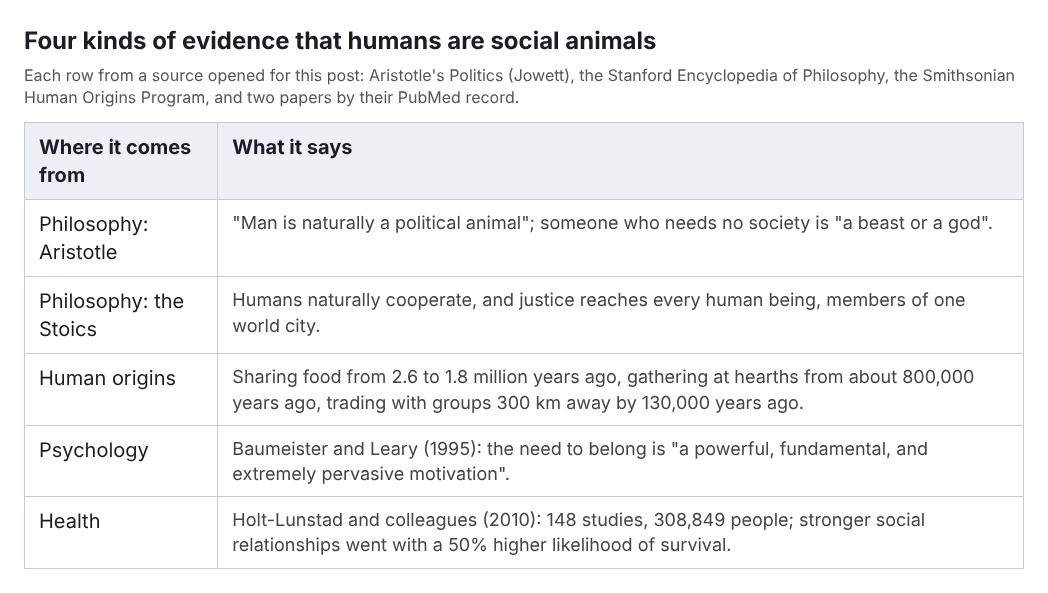
Each row comes from a source opened for this post.
Aristotle: the political animal
The phrase most people half remember comes from the first book of Aristotle's Politics. In Benjamin Jowett's translation, on Project Gutenberg, he says that "a city is a natural production, and that man is naturally a political animal." "Political" here means living in a polis, a city community, not taking part in party politics.
Aristotle gives two reasons. First, a person alone is not self-sufficient, so he is to the city "as other parts are to a whole." Someone who is "incapable of society, or so complete in himself as not to want it," he writes, "makes no part of a city, as a beast or a god." Second, speech. Many animals can signal pleasure and pain, but by speech "we are enabled to express what is useful for us, and what is hurtful, and of course what is just and what is unjust." Sharing those ideas, he says, "forms a family and a city."
The Stoics: made for cooperation
The Stoics took the idea further. Marcus Aurelius opens Book 2 of his Meditations by reminding himself that the people who will annoy him that day share the same reason he has. In George Long's translation (Book 2 at the MIT Internet Classics Archive), he writes: "we are made for co-operation, like feet, like hands, like eyelids, like the rows of the upper and lower teeth. To act against one another then is contrary to nature."
The Stanford Encyclopedia of Philosophy entry on Stoicism explains the theory behind this. The Stoic idea of oikeiosis, often translated "appropriation," starts with each creature caring for its own survival. Then the Stoics add a social side: "humans, like members of certain animal species (bees, ants, etc.), naturally cooperate with one another." From there they argued that justice reaches every human being, since all people share reason and so make up "the citizenry of one universal city or cosmopolis."
The same entry is honest that scholars still debate how well this works. It is "not exactly clear," it says, how observations about what creatures naturally do can tell us what we ought to do. That is a fair question to keep in mind about every argument from nature, including the ones below. For more on how the Stoics used nature as a guide, see our post on living according to nature.
What human origins show
The Smithsonian's Human Origins Program has a page on social life that sets out the evidence in time order. It starts plainly: "Social bonds helped ensure humans' survival." Then it gives the steps:
- Sharing resources, from 2.6 to 1.8 million years ago. Some groups of early humans brought tools and food to favored spots. "Sharing vital resources with other members of the group led to stronger social bonds and enhanced the group's chances of survival." At Kanjera in Kenya, about 2 million years ago, they carried stone up to 12 km to make tools there.
- Gathering at the hearth, from about 800,000 years ago. At Gesher Benot Ya'aqov in Israel, more than a dozen hearths about 790,000 years old have been found. The page asks why people came together around them and suggests: "Perhaps to socialize, to find comfort and warmth, to share food and information, and to find safety from predators."
- A long childhood. Humans are unique among primates in having long, distinct periods of childhood and adolescence, which need more care from adults and give time to learn and socialize.
- Wider networks. By 130,000 years ago, groups who lived 300 km apart were exchanging resources.
Note the "perhaps": burned flint cannot tell us what people felt, only that they lived, ate and raised children together.
What psychology and health research show
In 1995 the psychologists Roy Baumeister and Mark Leary reviewed the research on what they called the need to belong: a need for "frequent, nonaversive interactions within an ongoing relational bond." Their abstract says a lack of attachments "is linked to a variety of ill effects on health, adjustment, and well-being." They conclude that the need to belong is "a powerful, fundamental, and extremely pervasive motivation."
In 2010 Julianne Holt-Lunstad and colleagues pooled 148 studies of social relationships and mortality, covering 308,849 people. They found a "50% increased likelihood of survival for participants with stronger social relationships," and the link held across age, sex, initial health and cause of death. It was strongest for measures of how well people were woven into a social life, and weakest for the simple question of whether someone lived alone.
Two cautions. These studies find links, and a link is not proof that friends alone make you live longer. And living alone is not the same as being cut off: the weakest result in that review was for living alone. Our post on loneliness and meaning looks at the feeling of being alone, which is a different question from the one here.
A one-week plan: put the social animal to work
Knowing that humans are social animals helps only if it changes what you do. Here is a plan for one week, about ten minutes a day. You need a notebook or a notes app.
- Day 1: draw four rings. Write the people you live with in the center, then close friends, then a group you see on a regular rhythm (work, a class, a club), then the wider community you share streets and services with. An empty ring is useful to know about.
- Day 2: one message to the second ring. Ask a close friend one real question about their week. Do not ask for anything.
- Day 3: one act for the center. Do one small thing for someone you live with that they did not ask for.
- Day 4: the third ring. Talk to one person from your regular group about something other than the task you share.
- Day 5: the outer ring. Learn the name of someone you see often but do not know, or help someone in your neighborhood.
- Day 6: read Marcus Aurelius's line. "We are made for co-operation." Write down one person you have been acting against, even quietly, and one way to stop.
- Day 7: look back. Which ring was thinnest on day 1? Plan one regular habit, weekly or monthly, that keeps it fed.
If you want this to become a habit, the daily Stoic practice in How to Find Your Meaning takes about ten minutes in three short steps, and its morning step gives you one of the four Stoic virtues to practise, justice among them. You can keep notes on each day of the practice, so your rings and acts stay in one place. Its Modern Life course also has a lesson called Alone Together. Our post on building a sense of meaning in life shows where these acts fit in a wider plan.
Frequently asked questions
Who said humans are social animals?
The best known source is Aristotle's Politics, Book 1, which says "man is naturally a political animal" and calls humans "a more social animal than the bees." The Stoics, including Marcus Aurelius, made a similar claim: that we are made for cooperation.
What does "political animal" mean?
For Aristotle it means an animal made to live in a polis, a city community, sharing ideas of what is useful, harmful, just and unjust. It is not about party politics.
Is there scientific evidence that humans are social animals?
Yes, of several kinds. The Smithsonian's Human Origins Program describes nearly two million years of food sharing, shared hearths and growing networks, and a 2010 review of 148 studies linked stronger social relationships to a 50% higher likelihood of survival.
Does being a social animal mean I need lots of friends?
No source here says so. The research measures ties and belonging, not a number of friends, and the weakest link in the 2010 review was for simply living alone.
Get started
How to Find Your Meaning has 15 courses and 46 lessons of about 9 minutes, from Stoicism to health to the story of who you are, and every lesson lists its sources. The lesson The Social Animal sits in its course on evolutionary and ancient times. The lessons are free with an account: you sign in with your email and an emailed code, and you can install it from the site on the get the app page. The about page says what the app covers.
Start How to Find Your Meaning and take the lesson on the social animal.
Find what your life is for.
Visit findyourmeaning.vlvd.net↗


Comments
No comments yet.