Cyrus the Great and the Persian Empire: what he built
Cyrus the Great and the Persian Empire go together because he was the first king of the Achaemenid Empire. He began as the fourth king of Anshan, and by his death in 530 BCE he ruled much of the Middle East. He did it with a string of conquests and a habit of keeping the people he beat in their jobs.
If you would rather learn this as a short lesson, Learn 100 Influential People puts Cyrus in its Empire Builders course next to Alexander, Caesar and Genghis Khan, in lessons of about 9 minutes with questions that check what you remember. You sign in with your email and an emailed code.
Cyrus the Great and the Persian Empire: what do we really know?
Less than the legends suggest. The World History Encyclopedia article on Cyrus says his birth and youth survive only in the works of Greek writers, whose accounts contradict each other and are mostly legendary.
Herodotus makes him the son of the Persian king Cambyses and a Median princess, Mandane, whose father was the Median king Astyages. Ctesias says the opposite: Cyrus was the son of a Persian brigand and a goatherd, and served at Astyages' court as his chief cupbearer. The article adds that Achaemenid inscriptions never mention any blood tie between Cyrus and Astyages. Cyrus may simply have claimed one to look like a rightful heir.
That is a good first lesson in reading ancient history. The later and more colourful the story, the more you should ask who told it and why. Our post on primary and secondary sources gives a simple way to sort them.
How Cyrus took Media
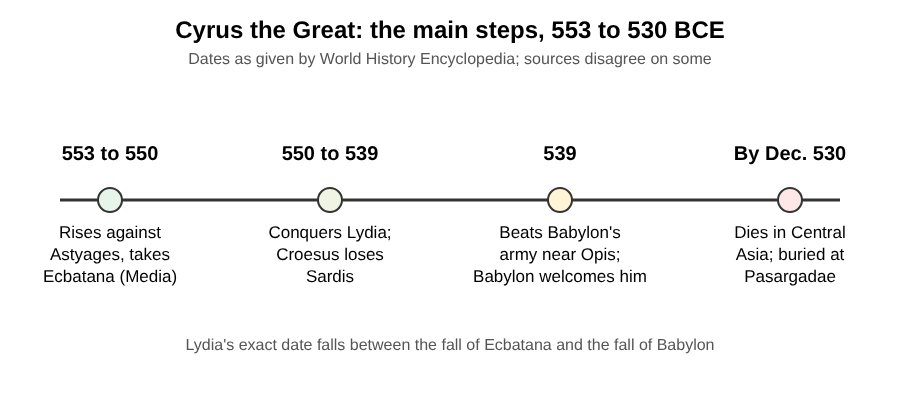
His first great success was against Astyages, the Median king. Two Babylonian sources report it, and they do not agree on the date. The Nabonidus Cylinder of Sippar says Cyrus rose against his overlord in 553 BCE and beat "vast Median hordes" with a "small army". The Nabonidus Chronicle says that in 550 BCE Astyages marched on Cyrus, his own army rebelled, and they handed him over. Then Cyrus took the Median capital, Ecbatana.
All the sources agree on one thing: Cyrus spared Astyages' life. That fits a pattern. He tended to take over a ruling class rather than destroy it. The article also notes that recent research thinks the Median lands were much smaller than Herodotus claims, or that there was no Median empire at all, so how much Cyrus gained is itself debated.
Lydia, Babylon and the fall of two kingdoms
The article puts the conquest of Lydia somewhere between the fall of Ecbatana in 550 BCE and the fall of Babylon in 539 BCE. In the story it gives, Cyrus fought King Croesus near Pteria and neither side won. Croesus went home for the winter, Cyrus followed him into Lydia, and they fought again near Thymbra. Cyrus used dromedaries to scatter the Lydian cavalry, and Croesus fell back into his capital, Sardis.
What happened to Croesus is disputed. Herodotus, Ctesias and Xenophon all say Cyrus threatened him, then took pity and made him an adviser. The article says some scholars find that legendary and think Cyrus executed him.
Babylon came in 539 BCE. Cyrus beat the Babylonian army near Opis, where the Diyala river meets the Tigris. The people of Sippar opened their gates, the king Nabonidus fled, and his servant Ugbaru, a governor, took the outer districts of Babylon. After two weeks Cyrus himself was welcomed into the city with festivities and took the title king of Babylon.
What the Cyrus Cylinder says, and how to read it
Soon after the conquest, Cyrus had a building inscription written, the Cyrus Cylinder. The article says its purpose was to explain and justify the conquest to a Babylonian audience. It calls Nabonidus an incompetent, godless king and Cyrus a divinely appointed saviour whom the god Marduk chose. Cyrus says he did not pillage the city, freed the people from heavy labour, and sent the idols Nabonidus had gathered back to their temples.
Is it true? Partly. Nabonidus did prefer the moon god Sin to Marduk, so there may be something in the complaint. But the article says the neglect of Marduk was probably exaggerated. Treat the Cylinder as a winner's message, written for readers who needed persuading, and weigh it as you would any one-sided document.
How Cyrus ruled: loyalty before uniformity
This is the part that gives the empire its name in history books. According to the article, Cyrus usually let local officials keep their posts after a conquest, so the administration kept working. He also accepted the cultural and religious practice of each land, which won him the loyalty of elites such as the Median nobility and the Babylonian priesthood.
The article is careful about how much to claim. In Cyrus's time the empire was little more than a personal collection of kingdoms held together by loyalty to the king. A more standardized imperial structure came later, so the full system should not be credited to him. What he built was the foundation: the conquests and the trust of the people who already ran things.
His religion is another place where the popular picture runs ahead of the evidence. He is often called a Zoroastrian, but the article says no contemporary source describes him as one, and Zoroastrianism as we know it may not have existed yet. It thinks he was probably a polytheist who offered sacrifice to Babylonian gods such as Marduk, a way of keeping the peace in the lands he took. For the other side of that question, see our post on Zoroaster.
Pasargadae and the end of his life
The place most tied to Cyrus himself is Pasargadae. The article describes it as a ceremonial capital that was never meant to house a large population: monuments spread across a plain, including a stone citadel on a hill, a columned audience hall and the tombs of Cyrus and his son Cambyses. Its sculpture and masonry show Assyrian and Ionian influences.
His death is told three ways, which makes a handy exercise you can follow:
- Step 1, list the claims. Herodotus says Cyrus died fighting the Massagetae, and that Queen Tomyris beheaded him to avenge her son. Ctesias says he died putting down a revolt of the Derbices. Berossus says he died fighting the Dahae.
- Step 2, find the overlap. All three place the fighting among nomadic peoples of Central Asia. The article concludes he probably did die there while trying to extend his influence.
- Step 3, find the hard fact. Babylonian letters show he was dead before December 530 BCE. That date is firmer than any of the stories.
- Step 4, write what you can defend. "Cyrus died on campaign in Central Asia before December 530 BCE; the ancient accounts disagree on the enemy."
He was buried at Pasargadae with his cloak, weapons and jewels, and his son Cambyses succeeded him. For a later empire built on conquest and a very different ending, read about Alexander the Great's legacy.
Frequently asked questions
Who was Cyrus the Great?
He was the first king of the Achaemenid Empire, the fourth king of Anshan, and he died in 530 BCE. He conquered Media, Lydia and Babylon and united much of the Middle East under Persian rule.
How did Cyrus conquer Babylon?
He beat the Babylonian army near Opis in 539 BCE. Sippar then opened its gates and the king Nabonidus fled. Cyrus was welcomed into Babylon about two weeks after Ugbaru took its outer districts.
What is the Cyrus Cylinder?
It is a building inscription that justifies his conquest of Babylon to a Babylonian audience. It portrays him as chosen by Marduk and says he returned captured idols to their temples. It is a one-sided source.
Was Cyrus a Zoroastrian?
Often assumed, but no contemporary source says so. World History Encyclopedia thinks he was probably a polytheist who also sacrificed to Babylonian gods.
How did Cyrus die?
Accounts differ: Herodotus names the Massagetae, Ctesias the Derbices and Berossus the Dahae. Babylonian letters show he died before December 530 BCE.
Get started with Learn 100 Influential People
Reading about Cyrus gives you the story, and answering questions shows what stuck. Learn 100 Influential People offers short hands-on lessons on the people who shaped history, with 272 questions across its courses where you choose, put in order, match, sort and estimate a number. Every attempt is graded and you can retake a lesson, and questions from lessons you finish come back as spaced review, up to 5 a day. Every lesson lists its sources, and the about page explains the project.
100 people who shaped history, from Moses to the web.
Visit influentialpeople.vlvd.net↗


Comments
No comments yet.
Sign in or make an account to comment.