Dartmouth Castle history: Britain's first coastal gun fort
Dartmouth Castle stands where the River Dart meets the English Channel in Devon, and its history is the story of one narrow river mouth defended for about 550 years. This Dartmouth Castle history follows it from a small fort of 1388 to the gun tower that English Heritage calls the first purpose-built coastal artillery fort in Britain, and then to guns that were still being manned in 1943.
If you like asking where a defence should stand, Two Towers is a free browser tower defense game where you pick the two towers that guard a city gate and spend gold to hold it against stronger attackers every stage.
Dartmouth Castle history begins: the fortalice of 1388
The lifeblood of Dartmouth was always the river. English Heritage says the long estuary, sheltered by a steep valley with a narrow exit to the sea, made a safe port, and by the middle of the 12th century the town was thriving on trade, notably Bordeaux wine, and on fishing.
Then came the Hundred Years War. Open conflict between England and France began in 1336, and the entrance to the Dart was thought vital to defend against French invasion. In 1388 Richard II ordered the mayor of Dartmouth, the merchant and privateer John Hawley, to compel the townsmen to pay towards a "fortalice", which was built shortly afterwards.
This small fort was Dartmouth's first castle. It was only used in times of danger, so it had few permanent buildings. A circular corner tower and a length of stone wall survive. For the officer who held a castle when trouble came, see the castle constable post.
The chain and the gun tower
By the middle of the 15th century gunpowder was having more and more effect on war on land and at sea, and England was still fighting the French. Almost a century after the fortalice, the townsmen thought of strengthening the river defences with a new tower containing guns.
In 1462 Edward IV gave them 30 pounds a year for 20 years towards Dartmouth's defences, including a massive iron chain laid across the Dart to stop marauding ships from getting through. Work on the tower took far longer than the grant. In 1486 Henry VII demanded that it be finished "with all godly haste", and the defences were complete around 1493. The gun tower became the heart of the castle. It held the winding mechanism for the chain, which was secured close to a defensive tower at Godmerock on the opposite bank.
English Heritage describes the gun tower, begun around 1481, as the oldest known purpose-built coast artillery fort in Britain. It adds that the mix of square and round parts was probably the result of a design change during the long years of building. For a king's own gun fort on the south coast, compare the Portland Castle post.
Reading the river's layers
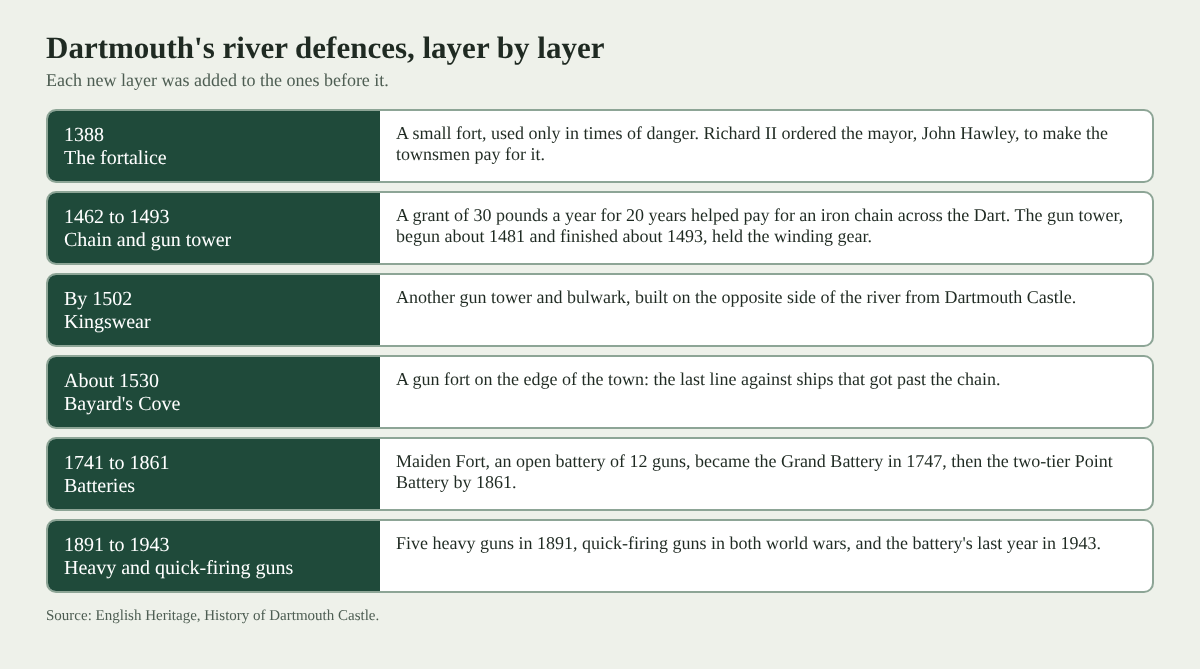
The picture shows a pattern. By 1502 a second gun tower and bulwark stood across the river at Kingswear. By about 1530 a gun fort on the bank at Bayard's Cove, right on the edge of the town, was meant as the last line of defence against any enemy ship that had slipped past Dartmouth and Kingswear castles and broken the chain.
So a hostile ship coming upriver had to pass several things in turn: a chain to stop it, guns on both banks to hit it while it was stopped, and a last fort beside the town in case it got through. That is a reading, not English Heritage's wording: it comes from putting the dates side by side.
Carew, the Armada and the Civil War
Although the town built the castle, it was taken by force in 1552 by Sir Peter Carew, a powerful soldier and courtier whose family had long owned the nearby manor of Stoke Fleming. He claimed the castle stood on his land, and although the town took him to court, he probably held it until his death in 1575.
The 16th century brought invasion scares in 1538 to 1540 and the threat of the Armada in 1588, when the Spanish warships sailed past Dartmouth on their way to meet the English fleet. Sir Francis Drake captured one of them, Nuestra Senora del Rosario, and brought her into Dartmouth as a prize.
In the First Civil War (1642 to 1646) the prosperous town changed hands twice. It repaired and manned its defences for Parliament, but in September 1643 a Royalist force under Prince Maurice, the king's nephew, attacked. The Parliamentarians resisted for another month before surrendering.
For two and a half years Dartmouth stayed Royalist, under blockade by Parliamentarian warships, while the king's men built new forts high above the river. Then on 18 January 1646 Sir Thomas Fairfax's forces stormed the town at night and the defenders were quickly overrun. The castle, cut off by the river, had no effective land defences, and it surrendered after just two days. The Civil War castle sieges post follows other castles through the same war.
From ruin to Victorian battery
After 1646 the government usually controlled Dartmouth's defences, rather than the town. In 1715 the military engineer Colonel Christian Lilly surveyed the defences of south-west England and found Dartmouth Castle in a "ruinous condition", with "not one gun well mounted". Only 20 feet (6 metres) of the chain remained.
By 1741 most of the guns stood in Maiden Fort, an open battery of 12 guns on the site of the old bulwark. It was enlarged in 1747, probably against a French invasion, and renamed the Grand Battery, with room for guns on two levels.
The War Office rebuilt the Grand Battery as the two-tier Dartmouth Point Battery by February 1861. At about that time a Royal Commission reported that rifled guns, with far greater range and accuracy, and the new ironclad warships made coastal forts vulnerable. A national programme of fort building followed, but Dartmouth Point Battery did not benefit and was almost at once out of date. In 1891 five heavy guns, firing shells of 64 pounds up to two and a quarter miles, replaced the old ones, and local volunteers were trained to fire them.
Two world wars, and the last guns in 1943
In 1909 the War Office handed the gun tower and battery to the Office of Works as a historic monument, but the castle's military role was not over. In the First World War two quick-firing guns were put on Dartmouth Point Battery to keep fast gunboats and torpedo boats out of the harbour. In the Second World War the harbour became a haven for merchant convoys, and two quick-firing guns were installed to engage enemy ships up to three miles out to sea, each protected from air attack by a concrete gun house. Dartmouth Battery operated until 1943, when Brownstone Battery on the cliffs east of the river mouth took over its role. Upstream, in an echo of the old chain, the Royal Navy laid a floating boom across the river, with steel mesh nets hanging to the river bed.
A worked example: layer your own defence
Here is the Dartmouth idea turned into a plan you can follow in Two Towers, using only what the game says. Dartmouth had a stopper (the chain), guns to hit what it stopped, and a last line by the town. In the game, the last line is the gate, and the first tower choices are the ones that hit attackers before they get there.
- Pick two towers that cover each other. On the title screen you choose a tower for each side of the gate from Archer Tower, Trebuchet, Ballista and Fire Tower. The game's tips say a Trebuchet stone hurts a whole crowd, and a Ballista bolt goes through armor, so two different towers answer more attackers than two of a kind.
- Buy range early. The game's tip for archers is "Archers shoot the gate from the road: buy Range so your towers reach them before they stop." That is the chain's job: hit them while they are still moving.
- Add the hill towers. You can buy a tower for West Hill at 150 gold and one for East Hill at 300. The tip for mangonels says "a hill tower with Range reaches them", so a hill tower is your Kingswear: a second position that sees what the first cannot.
- Keep the gate as the last line. The tip for rams reads "Reinforce the gate, and use Ballista bolts that ignore armor." Bayard's Cove was built for the ship that got through; reinforcing the gate is yours.
- Re-spend between stages. The general tip is "Spend your gold on Damage between stages, and Reinforce the gate."
Gold in the game is in-game gold, never money. The game is free, with no ads, and plays in your browser on a computer or a phone. Signing in is optional.
Frequently asked questions
When was Dartmouth Castle built?
The first small fort, a fortalice, was ordered by Richard II in 1388 and built shortly afterwards. The gun tower that is the heart of the castle was begun around 1481 and finished around 1493.
Why is Dartmouth Castle important?
English Heritage calls its gun tower the oldest known purpose-built coast artillery fort in Britain. It also guarded the Dart and its harbour from the Hundred Years War to the Second World War.
What was the chain across the River Dart?
It was a massive iron chain laid across the river to stop marauding ships. The gun tower held the winding mechanism that kept it in position, and it was secured close to a defensive tower at Godmerock on the opposite bank.
Did Dartmouth Castle take part in the Civil War?
Yes. The town changed hands twice. Royalists took it in 1643, and on 18 January 1646 Sir Thomas Fairfax stormed the town at night. The castle, cut off by the river, surrendered after two days.
Get started
Dartmouth shows that a good defence is a series of answers, not one wall. Try it in Two Towers, free in your browser. Choose your two towers, read the tip for each attacker, and spend your gold where the next stage will hit.
Defend the castle gate, stage after stage.
Visit twotowers.vlvd.net↗

Comments
No comments yet.
Sign in or make an account to comment.