Descartes' cogito explained: I think, therefore I am
Descartes' cogito is the claim "I think, therefore I am" (in Latin, cogito ergo sum; in French, je pense, donc je suis). Descartes calls it the "first and most certain" thing for anyone who "philosophizes in an orderly way": however much you doubt, you cannot doubt that you, the one doubting, exist while you think. This guide explains where the idea comes from, what exactly it claims, and where philosophers still disagree about it, using the Stanford Encyclopedia of Philosophy entry on Descartes' epistemology by Lex Newman.
If you want to study Descartes beside the thinkers he argued with, Learn 100 Influential People teaches him in its Power, Reason and Rights course with Hobbes, Locke, Rousseau and Kant, in short lessons that list their sources and set out where researchers disagree.
What does Descartes' cogito actually say?
René Descartes (1596 to 1650) wanted a foundation for knowledge that no doubt could shake. The cogito is his candidate for the first piece of it. In the Third Meditation he calls it the "first item of knowledge".
The claim has three parts: I think, therefore, I exist. The Stanford entry asks where the certainty is supposed to sit: in the "I think", in the "I am", or in the "therefore" that joins them. Its answer is that it must attach to all three if the cogito is to do the job Descartes gives it.
One surprise for first-time readers: the famous formula "I think, therefore I am" does not appear in so many words in the Meditations, the book where Descartes argues for it most fully. There, the conclusion is put as "I am, I exist".
Where the cogito comes from: methodical doubt
Descartes reaches the cogito by doubting everything he can. He sets out this method of doubt in the First Meditation, with two main arguments.
- Dreaming. Dreams can feel like waking life. The meditator remembers sitting by the fire in a dressing-gown, "when in fact I am lying undressed in bed". So any sensory experience, including the feeling of having a body, could be a dream.
- The evil genius. Even simple truths of arithmetic seem safe in a dream: "two and three added together are five". So Descartes raises a stronger doubt: an all-powerful deceiver who might be fooling him even about those.
The entry calls the dreaming doubts "light-duty bulldozers" next to the deceiver. Once both are in place, almost nothing seems left. The cogito is what survives.
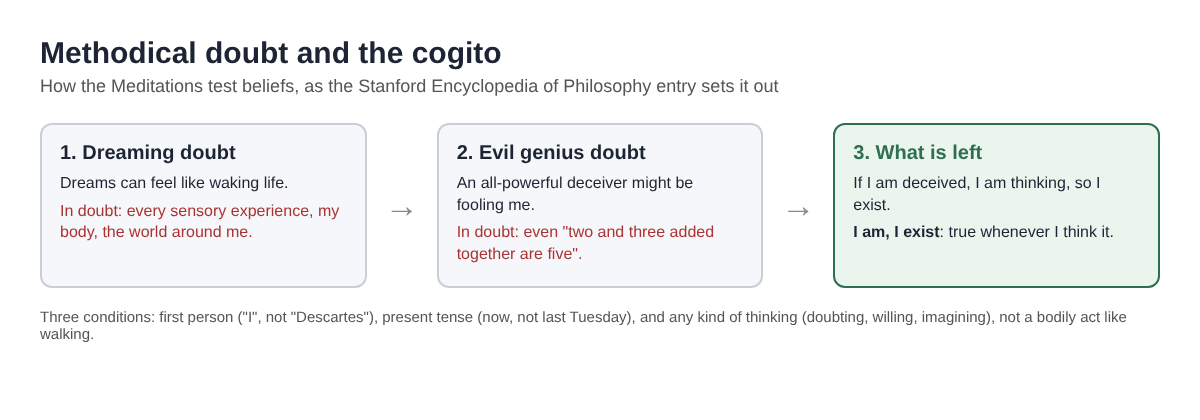
The two doubts and what survives them, as the Stanford entry sets them out.
The Second Meditation passage, line by line
Here is the core of the passage, in the English translation the entry quotes:
"But there is a deceiver of supreme power and cunning who is deliberately and constantly deceiving me. In that case I too undoubtedly exist, if he is deceiving me; and let him deceive me as much as he can, he will never bring it about that I am nothing so long as I think that I am something."
Notice the move. The deceiver was meant to make everything doubtful. But being deceived is itself a kind of thinking, and something that thinks must exist. So the meditator concludes that "I am, I exist" is "necessarily true whenever it is put forward by me or conceived in my mind".
The entry's summary is short: trying to think away your own thinking defeats itself. You can doubt your body. You cannot doubt that you are doubting.
Three conditions that make it certain
The Stanford entry sets out conditions the cogito needs. Change any one of them and the certainty goes.
- First person. "Descartes thinks" is not certain for me. Only my own thinking resists the doubt. The cogito proves that a particular thinker exists, not the general rule that whatever thinks exists.
- Present tense. "I existed last Tuesday, since I recall that I was thinking on that day" fails, because I could be dreaming the memory. "I'll continue to exist" fails too: the meditator admits that if he stopped thinking he might stop existing.
- Thinking, not a bodily act. Any kind of thinking works: doubting, affirming, denying, willing, understanding, imagining. But "I exist, since I am walking" fails, because the doubt already covers my legs. "I exist, since it seems I'm walking" works again, because seeming is thinking.
The entry adds a caveat. At this point the cogito proves only that I exist as a thinking thing, "whatever that turns out to be". In the very next sentence the meditator says he does not yet understand what this "I" is. So the cogito alone does not make mind and body two separate substances: the entry calls the distinction it draws epistemic, not (yet) ontological.
Inference or intuition? The main debate
The entry calls this the most significant ongoing debate about the cogito. Is "I think, therefore I am" an argument, or something you simply see?
The intuition reading. In an influential 1962 paper, Jaakko Hintikka argued that "I exist" does not follow logically from "I think". The point, on his view, is that thinking "I do not exist" is self-defeating: you cannot think it and believe it at the same time. Descartes himself seems to support a non-inferential reading in his replies to objections, where he says the thinker "does not deduce existence from thought by means of a syllogism, but recognizes it as something self-evident by a simple intuition of the mind".
The inference reading. Margaret Wilson observed that calling the cogito an inference "is not equivalent to the claim that it is a syllogism". So Descartes' reply rules out a syllogism, not every inference. Edwin Curley notes that Descartes "consistently blurs the distinction" by calling the formula a truth, a principle and a conclusion. The entry also points out that the Second Meditation is the one place where Descartes spells out the line of reasoning that leads up to "I am, I exist".
Both sides can grant something to the other. As the entry puts it, a statement can contain an inference and still be grasped as self-evident.
Russell's objection: who is the "I"?
A second line of criticism asks whether Descartes slips in what he wants to prove. Bertrand Russell, following Georg Lichtenberg, objected that "the word 'I' is really illegitimate". Descartes, he wrote, should have stated his premise as "there are thoughts".
The reply the entry describes is that introspection shows more than bare thoughts: it shows that the experience is had from a point of view. "There is pain" and "I am in pain" are not the same. On this reply the "I" is part of what you are aware of, not an extra assumption. The entry presents this as one effort at a reply, not the last word.
For a later thinker who also asked what experience can and cannot prove, read Kant vs Hume on cause and habit. For how Descartes' trust in reason compares with an empiricist, read Descartes vs Locke: reason or experience?
Try it yourself: a 15-minute reading of the cogito
Here is one way to work through the idea instead of memorising the slogan.
- Read the passage (3 minutes). Read the blockquote above twice. Mark the word "deceiving" and the phrase "so long as I think".
- Test three rewrites (5 minutes). For each, ask whether the deceiver could fool you about it: "Descartes thinks, so Descartes exists"; "I was thinking yesterday, so I existed yesterday"; "I am walking, so I exist". Each fails one of the three conditions above. Name which one.
- Fix one (2 minutes). Rewrite the walking version so it survives: "It seems to me that I am walking, so I exist".
- Take both sides (5 minutes). Write one sentence for Hintikka's reading and one for Wilson's. Do not pick a winner yet. This is the same method as in how to analyze a primary source: read closely, then ask what the text can and cannot prove.
Frequently asked questions
What does "cogito ergo sum" mean?
It is Latin for "I think, therefore I am". Descartes treats it as the first thing anyone can know for certain, because doubting your own existence is itself a kind of thinking.
Is "I think, therefore I am" in the Meditations?
Not in those words. The Second Meditation gives the conclusion as "I am, I exist", and the Stanford entry notes the famous formula does not expressly appear in the book.
Does the cogito prove the mind is separate from the body?
Not by itself. The Stanford entry says it gives only an epistemic distinction between mind and body; the meditator admits he does not yet know what the "I" is.
Is the cogito an argument?
Philosophers disagree. Hintikka read it as a self-verifying act of thought, not a logical inference; Wilson argued that it can still contain an inference, and Curley notes that Descartes blurs the line.
Get started
Descartes is in Power, Reason and Rights, one of the Advanced courses, with Machiavelli, Hobbes, Locke, Rousseau, Kant and Wollstonecraft. The questions ask you to choose, put in order, match, sort and estimate a number, and questions from lessons you finish come back later, up to 5 a day. 38 cards set out where researchers disagree, and every lesson lists its sources. You sign in with your email and an emailed sign-in code, and accounts are for people aged 13 and over.
Start Learn 100 Influential People: short hands-on lessons on the people who shaped history, with every side of the debate and the sources to read next.
100 people who shaped history, from Moses to the web.
Visit influentialpeople.vlvd.net↗


Comments
No comments yet.