Kant vs Hume: Cause, Habit and the Limits of Knowledge
Kant vs Hume is one of the great arguments in philosophy, and it starts with a simple question: when one thing always follows another, what makes it a cause? This post sets out what David Hume said, how Immanuel Kant answered, and where scholars still disagree about how far they differ. It follows the Stanford Encyclopedia of Philosophy's entry on Kant and Hume on causality, which is the source for every claim about the two thinkers below.
Learn 100 Influential People has short hands-on lessons on the 100 people who most shaped human history, with every side of the debate and the sources for every lesson.
Kant vs Hume in one paragraph
Hume argued that reason alone cannot show that one event makes another happen. What we have is events that keep coming together, and a habit of mind that expects the second after the first. Kant said Hume's argument was a turning point for him. He agreed that cause and necessity are not given in our senses, but he said they come from the understanding itself, so they hold for all possible experience. Hume put the necessity in the habit of the mind. Kant put it in the structure of the mind.
What Hume argued about cause and effect
The Stanford entry quotes Hume's Enquiry Concerning Human Understanding (first published in 1748). Hume divides what we can know into two kinds. Relations of ideas can be settled by reasoning alone. Matters of fact cannot, because "the contrary of every matter of fact is still possible", since it never implies a contradiction. All reasoning about matters of fact seems to rest on cause and effect, and Hume says we know that relation not by reasoning in advance but from experience, "when we find that any particular objects are constantly conjoined with each other".
His example is a billiard ball moving towards another. You may think the second ball will move, but you can just as easily conceive "a hundred different events" following. The effect is "a quite distinct event" from the cause, and nothing in the first motion contains the second. The entry calls all these suppositions, in Hume's words, "consistent and conceivable".
Hume's problem of induction and his answer: habit
Hume then asks what the foundation is for concluding from what we have observed to what we have not. All such inferences, he says, suppose that the future will resemble the past. To prove that supposition by arguments about matters of fact would be "going in a circle", because those arguments already rest on cause and effect. He finds an unbridgeable gap between "such an object has always been attended with such an effect" and "other objects, which are, in appearance, similar, will be attended with similar effects".
He does not tell us to stop expecting things. In the next section of the Enquiry he gives what he calls a skeptical solution: we proceed this way because of "custom or habit", a principle of human nature "well known by its effects". The idea of necessary connection, he adds, comes from the same place. After many similar cases, "the mind is carried by habit" to expect the usual follower, and that felt transition is the impression from which the idea of necessary connexion is formed. In that sense the idea is subjective. For the same problem in more depth, see Hume's problem of induction.
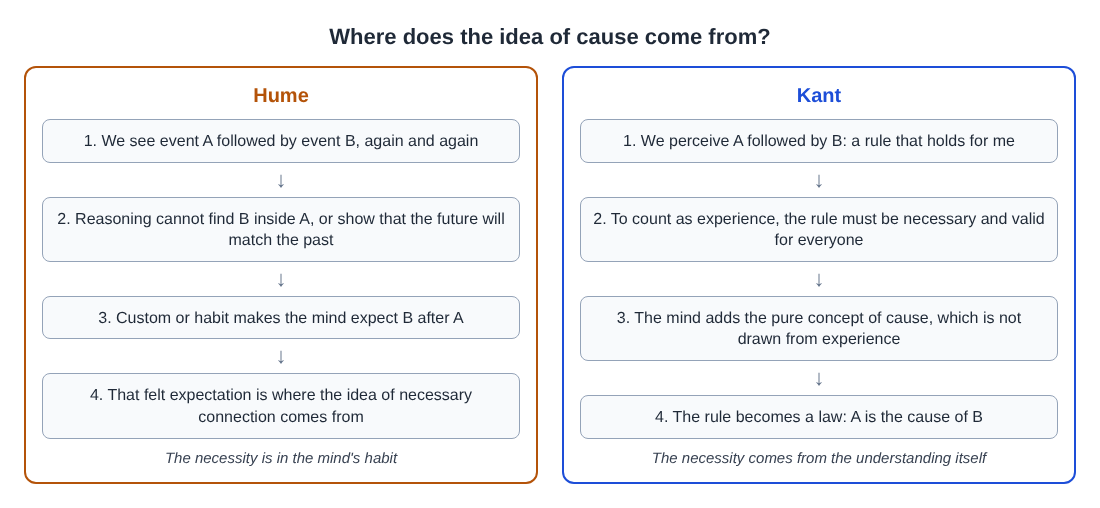
Where the idea of cause comes from, step by step, for Hume and for Kant.
Kant's reply: waking from the dogmatic slumber
In the Preface to his Prolegomena, Kant wrote that no event had been "more decisive for the fate" of metaphysics than Hume's attack on it, and that the remembrance of Hume "first interrupted my dogmatic slumber and gave my investigations in the field of speculative philosophy a completely different direction". Kant could read Hume only in German translation. A translation of the Enquiry appeared in 1755.
Kant also saw that the problem was wider than cause. In the Critique of Pure Reason (first edition 1781, second edition 1787) he turns it into a general question: how are synthetic a priori judgments possible? A synthetic judgment adds to the subject something that no analysis of the subject would find. An a priori judgment does not come from experience. Cause and effect is a case: the effect is not contained in the cause, so the link is not analytic, yet we think it necessary. Kant says Hume, "among all philosophers, came closest to this problem".
How Kant answered: the sun and the stone
Kant agrees with Hume on one point: neither the relation of cause and effect nor the idea of necessary connection is given in our sensory perceptions. Both, the entry says, are contributed by the mind. Where he parts ways is on where they come from. For Kant they arise entirely a priori, as pure concepts of the understanding, which he calls categories. He rejects the idea that cause could be derived from frequent association and custom, a "merely subjective necessity".
The entry follows Kant's own example in section 29 of the Prolegomena. A body is lit by the sun for long enough and becomes warm. That, taken alone, is only a rule found in perception, with no necessity in it yet. To become a judgment of experience, which is valid for everyone, it must be viewed as necessary and universally valid: the sun is through its light the cause of the heat. The step from one to the other is made by adding the concept of cause. Kant's summary is that the categories are not derived from experience; rather, "experience is derived from them", a reversed connection "which never occurred to Hume".
A worked example you can try
Take your own case and run both accounts on it. This is an exercise built on Kant's example, not a quotation from either philosopher.
- Pick a pair of events you have seen many times, such as a kettle switched on and then boiling.
- Hume's account: write down only what you have observed, the two events and how often they came together. Then ask whether anything in the first event contains the second. On his account nothing does, and the sense that the kettle must boil comes from your habit of expecting it.
- Kant's account: ask what it takes to treat this as experience of a kettle and not just a private run of sensations. It must be a rule that holds for anyone who watches, so you apply the concept of cause and say the heating makes the water boil.
- Compare. Both accounts agree that the necessity is not seen. They differ on whether it is a habit that grows in the mind or a concept the mind brings to every experience.
Where scholars differ
The entry flags two real disagreements. The first is about timing. Which period does Kant mean by the dogmatic slumber? It may be the late 1750s to mid 1760s, after he read the Enquiry in translation, or the mid 1770s, after he met passages from Hume's Treatise in a German translation of James Beattie's essay. The entry's authors prefer the first.
The second is about substance. Kant does not say that each particular causal law, such as the sun warming the stone, is itself known a priori, and he raises that difficulty himself. On that basis, the entry reports, the majority of twentieth-century English-language commentators deny that Kant truly disagrees with Hume about particular causal laws: the general principle that every alteration has a cause is synthetic a priori, while particular laws are reached by induction alone. The entry's authors reply that it does not follow that Kant agrees with Hume, because Kant separates a mere empirical rule from an objective law that is "necessary and universally valid". This post sets out both readings and picks neither.
If you want a moral-philosophy contrast, Kant's categorical imperative shows the same thinker on a different question. For the older split between reason and experience, see Descartes vs Locke.
Frequently asked questions
What did Hume say about cause and effect?
That we never perceive the link itself. We observe events constantly conjoined, and custom or habit makes the mind expect the second after the first. The idea of necessary connection comes from that felt expectation.
What does "dogmatic slumber" mean?
It is Kant's phrase, from the Prolegomena, for the state Hume's argument woke him from. The remembrance of Hume, he wrote, interrupted it and gave his work in speculative philosophy a completely different direction.
How did Kant answer Hume on causality?
He kept Hume's point that cause is not given in perception, but said it is a pure concept of the understanding. Adding that concept turns a subjective rule, such as heat following the sun, into an objective and necessary law.
Does Kant disagree with Hume about particular causal laws?
Scholars differ. Many twentieth-century commentators say not much, since particular laws rest on induction for Kant too. The Stanford entry's authors say Kant still separates a mere empirical rule from a law that is necessary and universally valid.
Get started
Learn 100 Influential People puts Kant in context in its Advanced course Power, Reason and Rights, with Descartes, Locke and the thinkers around them. Lessons last about 9 minutes, list their sources and set out where researchers disagree. You sign in with your email and an emailed sign-in code, and accounts are for people aged 13 and over.
Start Learn 100 Influential People: short hands-on lessons on the people who shaped history, with the sources to read next.
100 people who shaped history, from Moses to the web.
Visit influentialpeople.vlvd.net↗


Comments
No comments yet.
Sign in or make an account to comment.