Dorm floor problems: a shared list for floor mates
Dorm floor problems come back because nobody keeps track of them. The kitchen gets messy, someone complains, a rule is agreed, and three weeks later the same fight starts again. A shared list fixes that: you write each problem down once, record what the floor tried and what happened, and every floor mate can see it.
Problem Graph is built for this: you write a problem in one line, attach the solutions you try with an outcome of worked, partly or failed, and share it with a private network of people you choose.
Why dorm floor problems keep coming back
Floor life has a few built-in weaknesses. You live close to people you did not choose. Rules are vague. Residents move rooms. And what the floor already tried lives in a few heads that are rarely in the same room together.
Here is a made-up example of the loop. In September someone suggests a cleaning rota for the shared kitchen. It fades after a few weeks. In October someone suggests a cleaning rota, because nobody remembers it was tried. Nobody remembers why it fell apart either: was it unclear who checked, or was one person away? The floor repeats the attempt because the lesson was never written down.
A written record breaks the loop. It does not make anyone more polite. It means the second conversation starts where the first one ended.
What a shared list for floor mates is
A shared list is a short set of problems your floor cares about, each with the fixes people tried. Problem Graph draws it as a map instead of a flat list, but you do not need to think about graphs to use it. Four pieces are enough:
- Problem: one line, such as "Shared kitchen is left dirty on weekends."
- Solution: something you try, such as "Sign-up sheet for weekend cleanup."
- Outcome: worked, partly, or failed.
- Requirement: something a solution needs, such as "Someone owns the sheet and checks it Monday."
One feature matters most for a floor. You mark one problem as a main node, and only a main node can be shared. When you share it, its solutions, their outcomes and the requirements they need go along with it. A problem you only linked to it stays on your own graph. So a private note about a conflict with one person stays private even when the kitchen problem is shared.
Dorm floor problems worth putting on the list
Do not list everything. Pick problems that affect more than two people and that you have already discussed at least once. Good candidates:
- Noise after quiet hours in hallways and common rooms.
- A dirty shared kitchen, bathroom or lounge.
- Trash and recycling piling up.
- Shared supplies that run out, like soap or paper towels.
- Guests staying over without asking.
- Who uses the lounge TV or the study room, and when.
- Broken things nobody reports, like a bathroom light or a jammed dryer.
Problem Graph asks you to put each problem in a lane: personal, work, expert or scientific. Most floor problems fit the personal lane. If one links to another, such as a study group's schedule clashing with quiet hours, you can link the two even across lanes.
How to set up your floor's list in five steps
- Look around first. The public network can be browsed without an account. On an empty graph, the app offers a "Load example network" button if you want to see what a network looks like.
- Create an account. To add a problem you need a username and a password. The app also asks for an email, for password resets.
- Write the first problem and mark it as a main node. One line, pick a lane, press Enter. It lands on the graph right away. The main node mark is what makes it shareable.
- Create a private network. Give a few floor mates the invite code, then share your main node into the network. Members see it and nobody else does.
- Agree on one habit. For example: after each floor meeting, whoever keeps the list adds what was decided and, two weeks later, records the outcome.
One warning: the app says anyone with the invite code can join. Send the code in your floor group chat, not on a corridor poster.
The pages describe one person sharing a main node and the others seeing it, so treat one floor mate as the keeper of the list. Everyone else tells the keeper what to add. If your floor lives in the same building as the rest of a housing group, the same set-up works for a tenant association.
What to write for each problem so it can be solved
A vague problem gets a vague fix. "People are loud" is a complaint. "Hallway noise above normal talking after 11 pm on weeknights" is something you can test. Use this pattern for the one-line problem: what happens, where, and when.
Then attach solutions as separate ideas. Do not bundle three fixes into one note, or you will not know which one helped. Mark the one you are trying, and record what happened. Here is a worked example for a kitchen problem:
- Problem: "Kitchen has dirty dishes in the sink most Sunday mornings."
- Solution 1: "Weekly cleanup rota by room number." Outcome: partly. It worked for three weeks, then people swapped rooms and nobody updated it.
- Solution 2: "Everyone washes their own dishes within 24 hours, with a note on the fridge." Outcome: failed. Nobody checked.
- Solution 3: "Two-person rota, rotating monthly, with a check on Monday." This is the one the floor is trying, with no outcome yet. Requirement: "One named person checks on Monday."
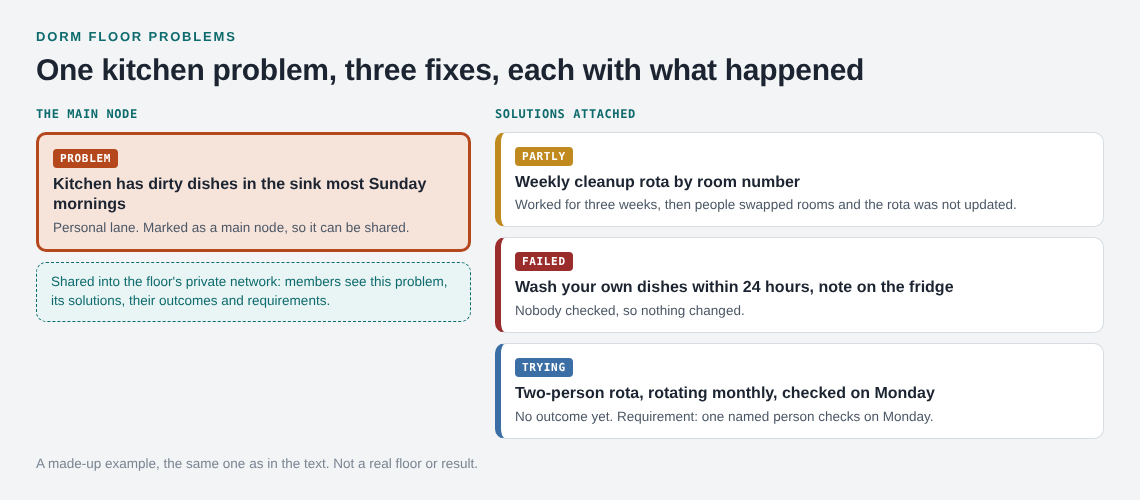
The failed note is useful. When a new resident suggests the fridge note in November, you can point to the record. The home page puts it this way: a solution that failed stays on the map as a failed solution, and that is exactly what the next person needs to know.
If a problem keeps returning in a new form, try the questions in this root cause analysis template for personal problems. A dirty kitchen that keeps coming back may really be a "nobody owns the check" problem, which is why the third solution above carries a named checker.
Handling noise, cleanliness and shared space disputes
These three cause many floor arguments, and they need slightly different handling.
Noise
Write down the specific hours and places. Try the smallest fix first, like an agreed quiet time on weeknights, and record the result. If it partly works, say what is left, for example "Quiet on weekdays, still loud Friday nights." That tells the floor what to tackle next instead of reopening the whole subject.
Cleanliness
In the example above, the rota that lost track of who was in which room and the note nobody checked both lacked an owner. For each cleanliness solution, add a requirement that names who does the check. If no name fits, expect the fix to wobble.
Shared space disputes
For lounge or study room conflicts, write the competing needs as separate problems and link them. Seeing them linked on the map can show that a "TV in the lounge" problem and a "nowhere quiet to study" problem are the same squeeze.
Keep the wording about the situation, not the person. Write "Bathroom runs out of soap by Wednesday," not "Dana never buys soap." The list is shared, and everyone in the network sees it. A similar shared list helps roommates who split a flat.
When to bring the list to your RA or residence staff
Some problems are not yours to fix alone. Safety issues, broken facilities, harassment and repeated rule violations belong with residence staff. Do not wait for a floor experiment to fail first.
For everything else, the list helps you make a clear case. If the floor tried three solutions, you can show what each was and why it fell short. "We tried a rota, a fridge note and a two-person check, and the problem is still there" is much easier for an RA to act on than "the kitchen is always dirty."
You can also ask for suggestions. The AI proposes solutions grounded in what worked for others on problems like yours. Treat them as proposals to test, not answers. Borrowing works by showing similar problems other people have shared and which of their solutions worked, and you can borrow one into your graph with a link back. How much you find depends on what people have put on the public network.
Frequently asked questions
Do all my floor mates need an account?
To add a problem or borrow a solution, yes: you create an account with a username and a password. Anyone can browse the public network without one.
Can people outside the floor see our list?
Not if you share it into a private network: members see it and nobody else does. Keep the invite code within the floor, because anyone who has it can join.
Does sharing a problem share my whole graph?
No. Only a main node can be shared, along with its solutions, outcomes and requirements. Problems you only link to it stay on your own graph.
Does it work on my phone?
Yes. It runs in your web browser and works on a phone.
Is it free?
The home page says it is free, and you can look around without an account.
Get started
Try Problem Graph: it is free, and you can look around the public network without an account. Write one problem down in a line and attach the first thing you will try.
For a floor, start small. Pick the one problem that has come up more than once, write it in a line, add the fix you tried last time and how it went, then share it into a private network with your floor mates.
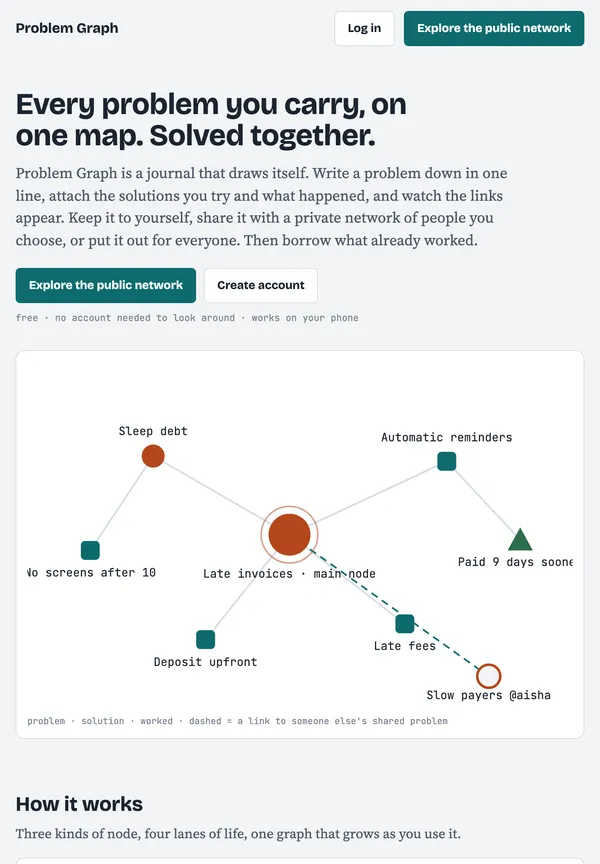
Every problem you carry, on one map. Solved together.
Visit problemgraph.vlvd.net↗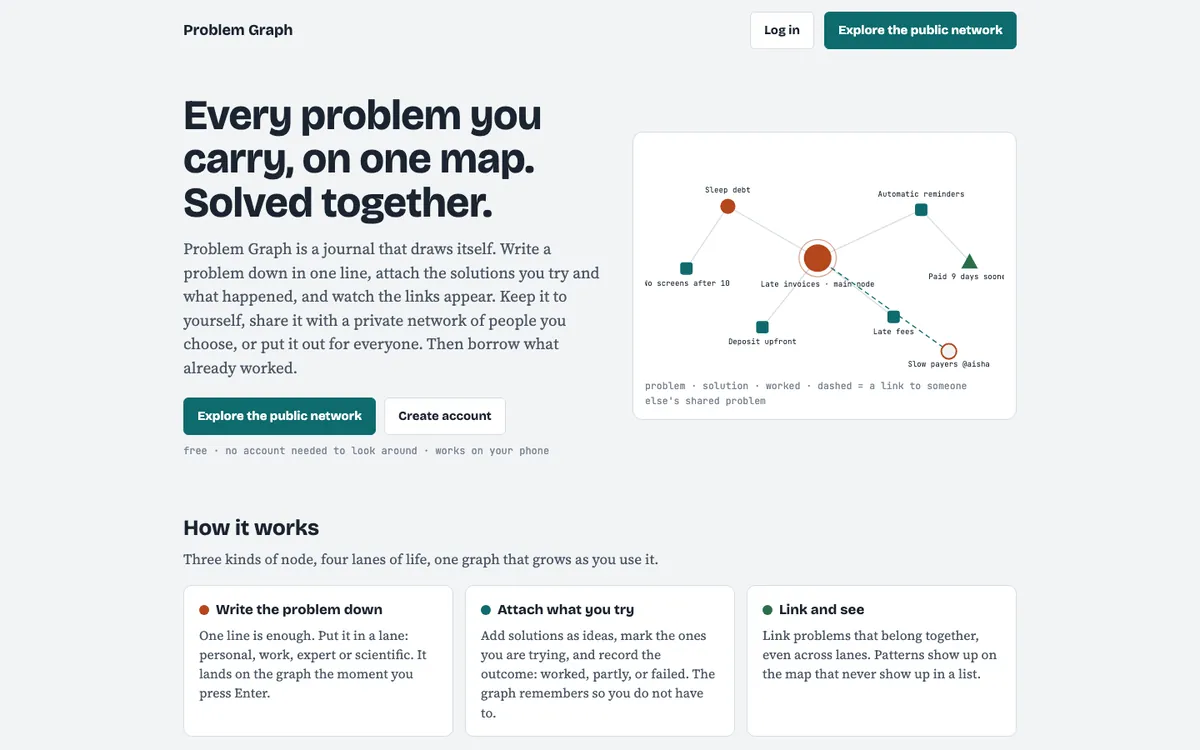
Comments
No comments yet.
Sign in or make an account to comment.