Dunstanburgh Castle: a rebel earl's fortress by the sea
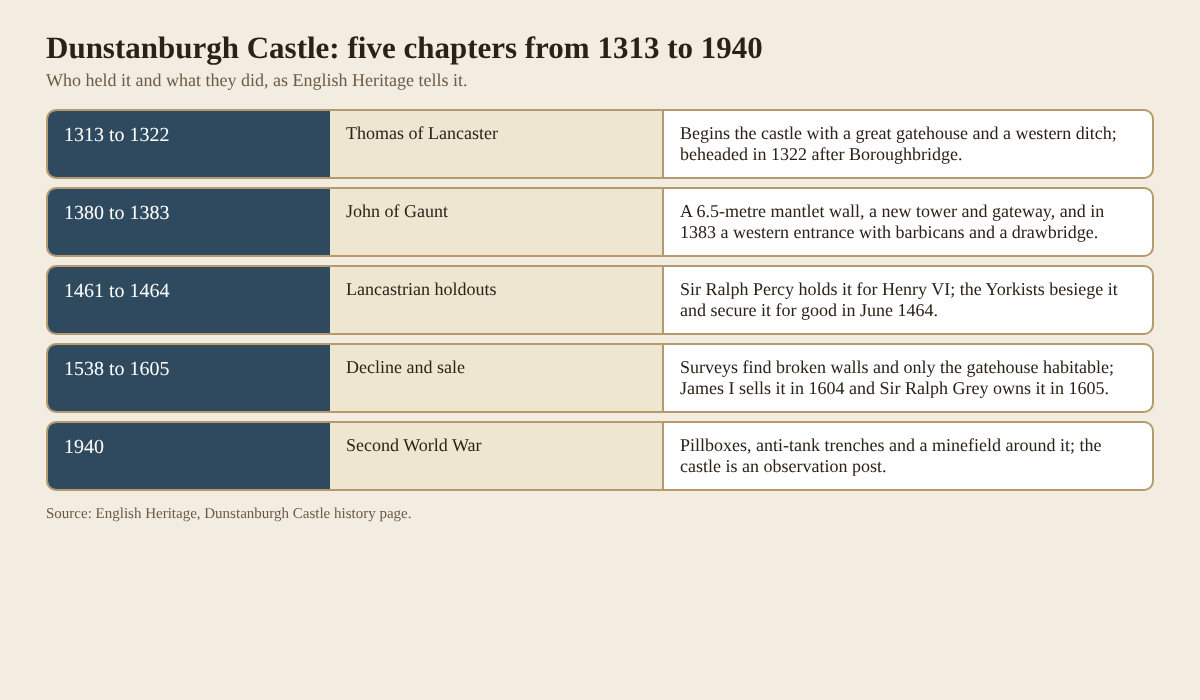
Dunstanburgh Castle on the Northumberland coast was begun in 1313 by Thomas, Earl of Lancaster, who was then the wealthiest nobleman in England. English Heritage says he built it as much to protect himself as to guard the Scottish border, and he was beheaded nine years later for rebelling against Edward II. Its great gatehouse still stands on a headland above the North Sea, and its ruined silhouette drew painters such as JMW Turner.
If you like seeing how one gate is made to carry the whole defence, Two Towers is a free browser game where you pick the two towers that guard a city gate and spend your gold between stages.
Dunstanburgh Castle before 1313: an Iron Age rampart
English Heritage says the name translates as "the fort of the town by the rock", and that such a name could suggest earlier occupation, as at Edinburgh or Scarborough. The ground bears it out. Clearance work in the 1920s and 1930s turned up prehistoric and Roman pottery, Iron Age millstones, a Roman brooch and hearths of the 1st century BC and 2nd century AD. In 2003 English Heritage archaeologists confirmed Iron Age and early Roman use of the headland, and read an earth bank beside the south ditch as the rampart of an Iron Age promontory fort, abandoned centuries before Thomas chose the site. Scarborough has the same pattern of old settlement under a medieval castle, which the Scarborough Castle history follows from 800 BC.
Why Thomas of Lancaster built it
Thomas had inherited one of the largest estates in England from his father Edmund "Crouchback", the king's younger brother, but the barony of Embleton where the castle stands was far from his centre of power in the north Midlands and Yorkshire. War had broken out between England and Scotland, and the border was only 25 miles north. English Heritage says Thomas nevertheless seems to have been less concerned with border security than with his own protection.
The reason was April 1312, when he and other earls led an army against Edward II and his favourite, Piers Gaveston. The earls captured Gaveston at Scarborough and executed him on the road to London, in Warwickshire, on Lancaster's land. Edward had good cause to want revenge, and soon after his formal pardon Thomas began preparing a new castle on his northernmost estate. The one surviving account of the first year's work, from spring 1313, shows a ditch dug on the western side and a great gatehouse begun. No later accounts survive, but the castle was probably operational by March 1319, when Robert of Binchester was appointed its first constable. In August of that year Thomas passed through on his way to the siege of Berwick, almost certainly the only time he saw it.
Boroughbridge and the king's garrison
In 1321 and 1322 Thomas again took up arms against Edward and the Despensers, the king's new favourites. When the campaign began to fail, he and his followers planned to retreat to Dunstanburgh, the safest and most remote of his strongholds. A royalist army cut them off at Boroughbridge in Yorkshire on 16 March 1322 and captured him. After a trial English Heritage calls humiliating, he was beheaded at his own castle at Pontefract. The king took Dunstanburgh into his own hands and put a garrison of 40 foot soldiers and 40 hobelars, or lightly armed cavalry, in it.
Work then finished. English Heritage suggests John de Lilburn, joint constable in 1322 to 1323, completed the tower over Embleton beach and Gull Crag, which still carries his name. By April 1326 the castle was back with Thomas's younger brother Henry. An account of the early 1350s records that it served as a refuge for people and their goods during a Scottish raid, probably the people of Embleton and nearby townships, since the enclosure was large enough to hold them. For the constable's job in such a crisis, see what a castle constable did in a siege.
John of Gaunt's new gate
Edward III's fourth son, John of Gaunt, inherited the castle in 1362 through his marriage to Blanche, Henry's granddaughter. He did little until 1380, when a visit to the Scottish marches, where he was now lieutenant, convinced him the defences were poor. Over three years he reshaped the layout.
First came a wall English Heritage calls a "mantlet", 6.5 metres high and 1.3 metres thick, built by the northern master mason John Lewyn. It made a courtyard on the north side of the great gatehouse for Gaunt's own apartments and cut them off from the rest of the castle. Then came the Peasants' Revolt of June 1381, which Gaunt had narrowly avoided, and his thinking about security hardened. The mason Henry Holme added a tower and gateway to the mantlet to control tightly who could enter the lord's enclosure, and six service buildings inside it. In 1383 a new entrance with barbicans and a drawbridge was cut on the western flank. The carriageway of the great gatehouse was probably blocked, and the old gatehouse was renamed the "donjon", in modern terms the keep. For why a gatehouse was a castle's strongest part, see the castle gatehouse post.
The Wars of the Roses
Under Henry VI the buildings were repaired and furnished, and English Heritage says the king's hall and great chamber were on the top floor of the former great gatehouse. The accounts also show the castle running a wider estate, with mills, a dovecote and a house of pleas in the village.
The fighting came in 1461. Sir Ralph Percy, one of the joint constables and a Lancastrian, held the castle for Henry VI even after the Yorkist victory at Towton in March 1461, submitted briefly, and declared for Lancaster again in 1462, when Margaret of Anjou landed at Bamburgh with a French army. The Earls of Warwick and Worcester besieged Dunstanburgh, with the writer Sir Thomas Malory fighting under their command. Percy gave in on Christmas Eve, but the Yorkists did not secure the castle for good until June 1464. The Warkworth Castle post follows the Percy family's other Northumberland castle.
Decline, corn and the painters
By the late 15th and 16th centuries Dunstanburgh was too big and too costly to keep up, its walls were a handy quarry, and it was too far from the border and the main road to matter. Surveys in 1538 and 1543 found the curtain walls in poor repair, lead missing from some roofs, and only the gatehouse fit to live in. The widow Alice Craster moved in in 1594 and ran a farming estate from it. A year after the crowns of England and Scotland united, James I sold the castle, and in 1605 Sir Ralph Grey of Howick Hall owned it. In 1695 the castle yielded 240 Winchester bushels of corn and several cartloads of hay, harvested inside the walls. Francis Place sketched the ruinous buildings in 1678, and later artists including Turner found the ruins most appealing against a storm at sea.
In 1869 Samuel Eyres of Leeds bought it from the Earl of Tankerville, and in 1929 it passed into the care of the Office of Works on behalf of the National Trust. In 1940, after the fall of Norway, fears of an invasion of north-east England led to pillboxes, gun emplacements, anti-tank trenches and a minefield around the castle, which served as an observation post for a small detachment of the Royal Armoured Corps.
A worked example: plan for the king in Two Towers
Thomas picked a remote fortress he never really used, and it was the road to it that failed him. You can plan a better route in Two Towers, where one tip covers the hardest attacker: "A king leads every fifth stage: Reinforce the gate before it and save gold for Damage."
- Count to five. The king comes on stages 5, 10, 15 and so on. Write the next king stage at the top of your notes.
- Spend early on the gate. On the stage before the king, Reinforce the gate, as the tip says, rather than spending on a hill tower.
- Keep gold back for Damage. The same tip says to save gold for Damage, and the general tip is to spend on Damage between stages.
- Read the warning. The game warns between stages that "The enemy grows stronger", "The enemy grows in number" or "The enemy marches faster". Pick your upgrade to answer the one it names.
- Add the hills last. A tower for each hill costs 150 gold for the first and 300 for the second, so buy them once the king stage is behind you.
Frequently asked questions
Who built Dunstanburgh Castle?
Thomas, Earl of Lancaster, began it in 1313. John of Gaunt reshaped it between 1380 and 1383, adding a new western entrance with barbicans and a drawbridge.
Why did Thomas of Lancaster build a castle so far from his lands?
English Heritage says Dunstanburgh stood on his northernmost estate, and that he seems to have been less concerned with the Scottish border than with his own protection after the execution of Piers Gaveston in 1312.
Was Dunstanburgh Castle besieged?
Yes, in the Wars of the Roses. After Sir Ralph Percy declared again for Lancaster in 1462, the Yorkist Earls of Warwick and Worcester besieged it, and the Yorkists secured it for good in June 1464.
What is Dunstanburgh Castle used for today?
It is a ruin. It passed into the guardianship of the Office of Works in 1929 on behalf of the National Trust, and English Heritage describes its ruined silhouette as having inspired artists such as JMW Turner.
Get started
Dunstanburgh shows how much a castle can ride on one gate. To test your own plan, play Two Towers: pick your two towers, get ready for the fifth stage, and see how far your gate holds.
Defend the castle gate, stage after stage.
Visit twotowers.vlvd.net↗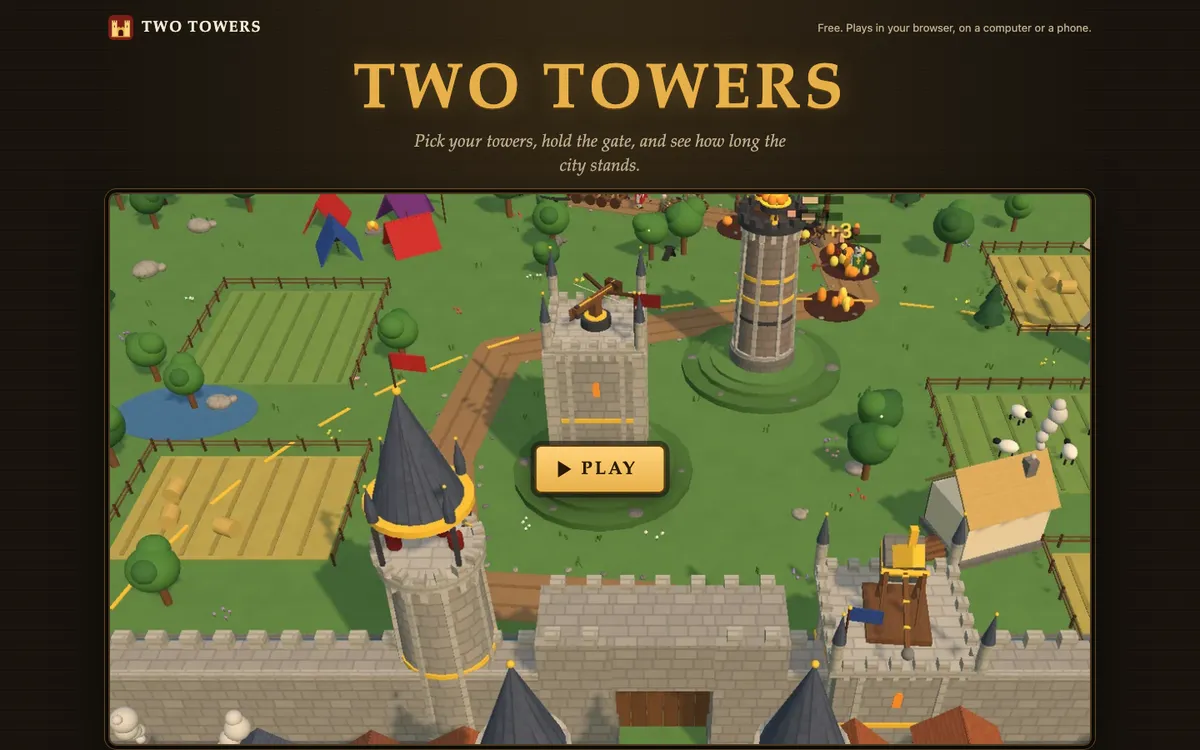
Comments
No comments yet.
Sign in or make an account to comment.