Scarborough Castle history: 3,000 years on one headland
Scarborough Castle history runs through nearly 3,000 years on a single rock above the North Sea. English Heritage says the headland has been "intermittently inhabited and fortified" for that long, and the castle most visitors see was begun by Henry II, who raised its great tower between 1159 and 1169. Roman signallers, a royal builder, a rebel, a Civil War governor and two German warships all left something there.
If a fortress that was held for years by counting supplies appeals to you, Two Towers is a free browser game where you pick the two towers that guard a city gate and spend the gold you win between stages.
Scarborough Castle history before the castle: settlers and a Roman tower
The earliest evidence of anyone on the headland is a scatter of pottery from about 2100 to 1600 BC. Clear settlement comes in the first millennium BC: English Heritage describes two periods of habitation, about 800 BC and about 500 BC, though it is unclear how big either was. In the late 4th century AD the Romans put a fortified tower on the point. Coins, pottery and its likeness to other sites suggest it was one of a set of signal stations along the north-eastern coast, and it was abandoned in the early 5th century. English Heritage says exactly when and why they were built is much debated.
People kept coming back. A chapel was built within the foundations of the Roman signal station and a small cemetery grew beside it, so there was activity on the headland by about the year 1000. The old idea that the name comes from Old Norse has been questioned too: English Heritage says an Anglo-Saxon origin, "the hill with the fort", has been suggested. Its description page notes that grassy mounds near the cliff edge still show a ditch, an enclosure wall and a tower base set one inside another.
Henry II's great tower
The founder of the castle was William le Gros, Count of Aumale, whom King Stephen made Earl of York in 1138. He probably started in the 1130s, and the chronicler William of Newburgh says he enclosed the plateau with a wall and put a tower at the entrance, on the site of the present great tower. A few years later Henry II came to the throne and demanded the return of all royal castles. Scarborough stood on a royal manor, so it passed to the Crown.
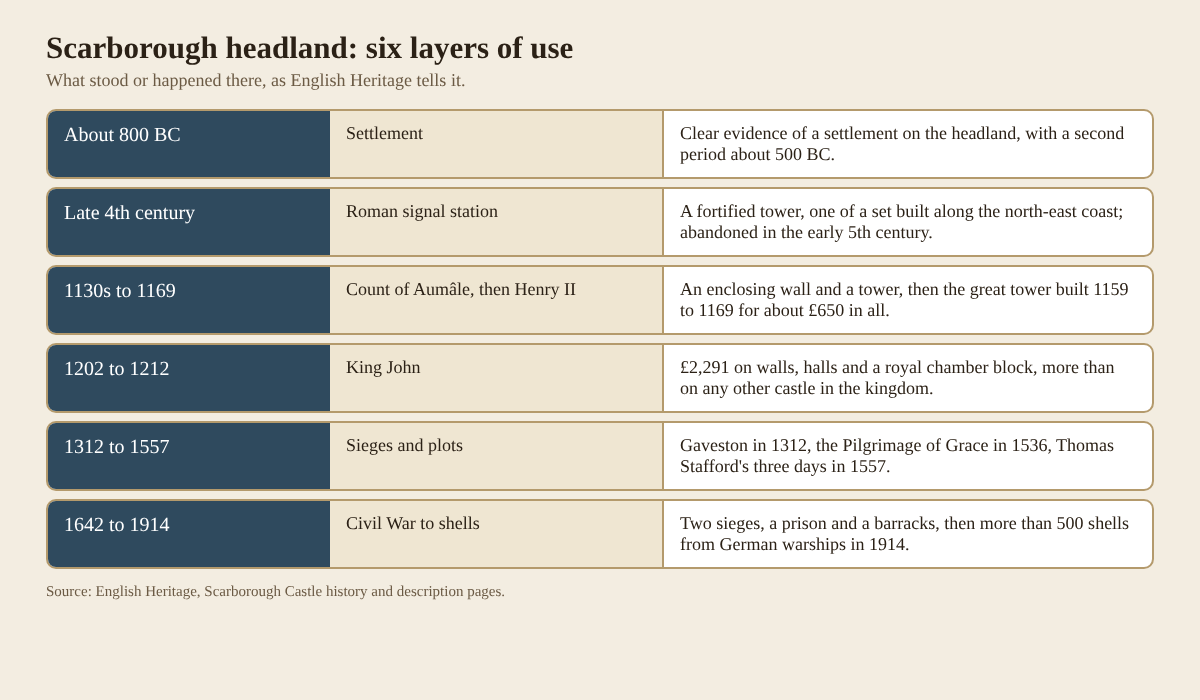
In 1159 Henry began to rebuild the castle and planted a new town beneath its walls. About £650 was spent over the next ten years, an enormous sum by English Heritage's reckoning, and most of it went on the great tower, built 1159 to 1169. English Heritage says it was most probably "architectural confirmation" that the castle had changed hands. The tower stands over 90 feet (27 metres) high with walls 12 feet (3.5 metres) thick, and its internal arrangements suggest it was a grand residence rather than only a strongpoint. What a castle keep was for explains that double role, and the Orford post shows Henry II making the same point elsewhere.
King John's money and the royal fortress
King John visited Scarborough several times and, with Knaresborough, seems to have built it up as a major royal castle to control Yorkshire. English Heritage records that he spent £2,291 there, more than on any other castle in the kingdom. The money came in two phases: an outer wall to the inner bailey in 1202 to 1206, and then the wall carried down to the cliff in 1207 to 1212, along with a hall in the inner bailey, a new royal chamber block and a separate aisled hall in the outer bailey.
The defences it left are easy to read on the ground. Cliffs and sea guard three sides of the headland. On the fourth, facing the town, a massive double ditch is crossed by one great bridge, and the barbican that covers it is first mentioned in 1175. Henry III had the barbican gate tower and bridge built in 1243 to 1245. Inside, a well in the inner bailey, probably of the 12th century, is over 46 metres deep. Henry III also provisioned the castle throughout his reign, and Edward I held court and council at Scarborough in 1275 and kept prisoners from his Scottish wars there.
Sieges and plots, 1312 to 1557
The castle's job was to be somewhere to go when things went wrong. In 1312 Edward II's favourite, Piers Gaveston, took refuge there and it was briefly besieged. Richard III was the last king to stay, in 1484, while he gathered a fleet against the expected invasion of Henry Tudor. When the Pilgrimage of Grace broke out against Henry VIII in October 1536, the constable, Sir Ralph Eure, declared for the king and was besieged. English Heritage says the castle was damaged by gunfire but held. In 1557 Thomas Stafford seized it and held it for three days, hoping to start a revolt against Queen Mary; it was easily recaptured and he and his accomplices were executed.
The Civil War, 1642 to 1648
In September 1642 Sir Hugh Cholmley was commissioned to hold Scarborough for Parliament, but he was soon persuaded to change sides. While he was visiting Charles I in York, 40 seamen under his cousin Captain Browne Bushell surprised the guard and took the castle; Cholmley rushed back and Bushell handed it over. For two years it was a Royalist base whose interception of shipping caused serious coal shortages in London.
In early 1645 Parliamentarian forces closed in. After three weeks Cholmley fell back from the town into the castle, where he resisted for five months in what English Heritage calls one of the bloodiest sieges of the Civil War. The bombardment was so heavy that the great tower's walls sheared and half the building collapsed. Cholmley ran out of gunpowder, then money, and finally food, and surrendered on 25 July 1645. You can follow the collapse in Scarborough Castle great tower: why half fell in 1645, and see how it compares with six other castles in the Civil War sieges post.
It was besieged again on 27 July 1648, when the Parliamentary garrison of 100 men under Colonel Boynton declared for the imprisoned king after Parliament failed to pay them. Boynton surrendered in December. Orders were given to slight the castle, but opposition from the town saved it, which is why the shell still stands. The slighting post covers what that order would have meant.
Prison, barracks and the shelling of 1914
From the 1650s the castle was also a prison; George Fox, founder of the Society of Friends, was held there. After the Jacobite Rebellion of 1745 to 1746 a barracks was built inside the walls of King John's chamber block, and it stayed in use into the mid 19th century. On the morning of 16 December 1914 two German warships fired more than 500 shells on the town and castle. Seventeen civilians were killed and more than 80 seriously wounded, and the barracks block was damaged. The castle passed into state guardianship in 1920, and in 1963 a Royal Observer Corps post was built near the cliff edge, closed and buried by 1968.
A worked example: a gold budget in Two Towers
Cholmley's siege ended when three things ran out in a set order: gunpowder, money and food. You can practise watching your own supplies in Two Towers with a short check you run between stages.
- Pick the pair. On the title screen it says "Choose two towers for the gate". Give the left and right of the gate different jobs, for example Stones on a crowd on one side and Bolts through armor on the other.
- Write down your gold before each stage. The game's general tip is "Spend your gold on Damage between stages, and Reinforce the gate." Decide on paper how much goes to each.
- Look at the gate first. Its sheet says "Repair what the attackers broke, or reinforce it." A gate that is whole can only be reinforced.
- Hold back a hill tower until the pair works. You can buy a tower for each hill, at 150 gold for the first and 300 for the second. Buy one only once the two at the gate are holding.
- After a loss, read what beat you. The game says which attacker the gate fell mostly to. Find its tip, change one number in your budget, and play again.
Frequently asked questions
Who built Scarborough Castle?
William le Gros, Count of Aumale, probably started it in the 1130s. Henry II took it over and built the great tower between 1159 and 1169, and King John spent £2,291 there between 1202 and 1212.
Why is half of the great tower missing?
English Heritage says the bombardment of the 1645 siege was so intense that the walls sheared and half the building collapsed, leaving a shell with no floors, roof or battlements.
Was there a Roman fort at Scarborough?
There was a signal station: a fortified tower built in the late 4th century, probably one of a set along the north-eastern coast, and abandoned in the early 5th century.
Why was Scarborough Castle not slighted after the Civil War?
English Heritage says instructions were given in 1648 that it should be slighted, but opposition from the town preserved it from destruction.
Get started
Scarborough shows how long a well-placed fortress can matter and how a siege can turn on what runs out first. To test your own budget, play Two Towers: pick your two towers, run the check between stages, and see which stage your gate falls at.
Defend the castle gate, stage after stage.
Visit twotowers.vlvd.net↗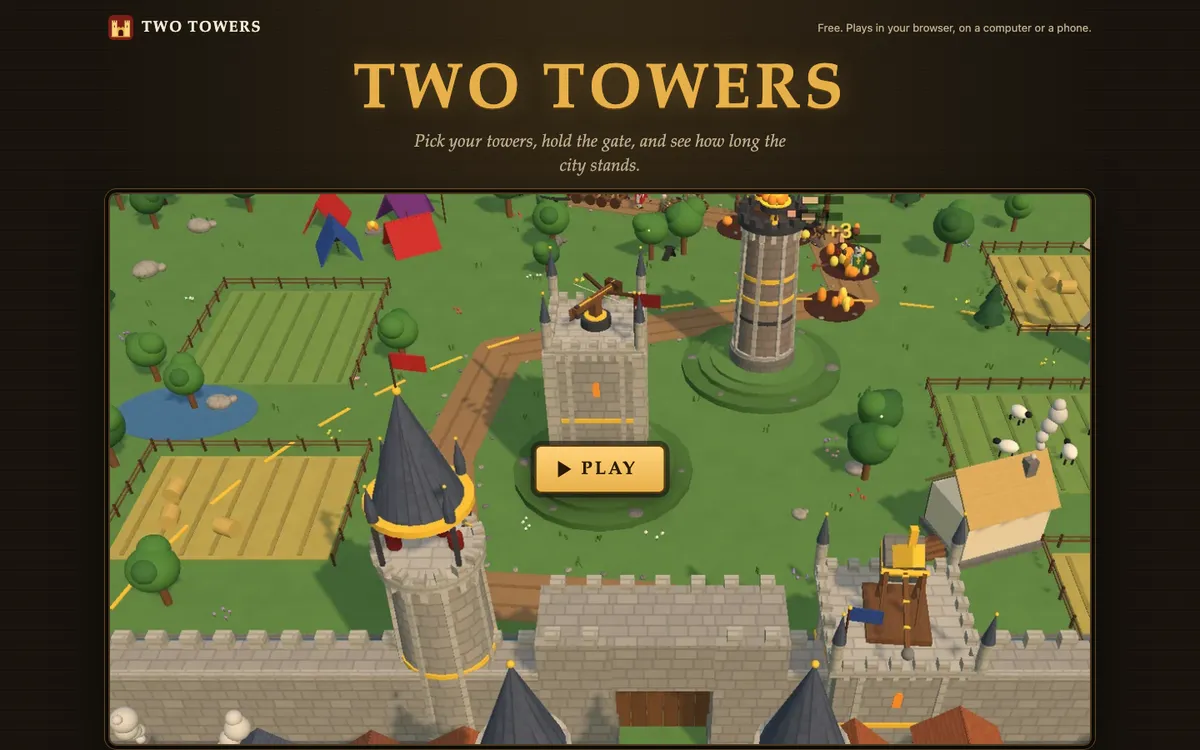
Comments
No comments yet.
Sign in or make an account to comment.