Maxwell's Equations: What They Say and Why They Matter
Maxwell's equations are four short statements about electric and magnetic fields, and together they describe how electricity, magnetism and light fit into one subject. They are named after James Clerk Maxwell, a Scottish physicist who lived from 1831 to 1879. This post sets out what each equation says in plain words, what Maxwell himself contributed, and why people still teach them.
If you want Maxwell in the company of Faraday, Einstein, Bohr and Marie Curie, Learn 100 Influential People has a course on them in short lessons of about 9 minutes, and you sign in with your email to open it.

Maxwell's equations in one minute
HyperPhysics, a physics reference from Georgia State University, calls them "one of the most elegant and concise ways to state the fundamentals of electricity and magnetism." There are four, and each has a name:
- Gauss's law for electricity: the electric flux out of any closed surface is proportional to the charge inside it.
- Gauss's law for magnetism: the net magnetic flux out of any closed surface is zero.
- Faraday's law of induction: a changing magnetic flux through a loop produces a voltage around it.
- Ampere's law: for a static electric field, the magnetic field around a loop is proportional to the current through the loop.
"Flux" means how much of a field passes through a surface. Imagine holding a net in a stream: the flux is how much water goes through it. In textbooks the laws are written with two symbols, divergence and curl. HyperPhysics describes divergence as measuring the density of sources of a field. Curl measures how much a field swirls. You do not need the symbols to follow the ideas.
The four laws, one at a time
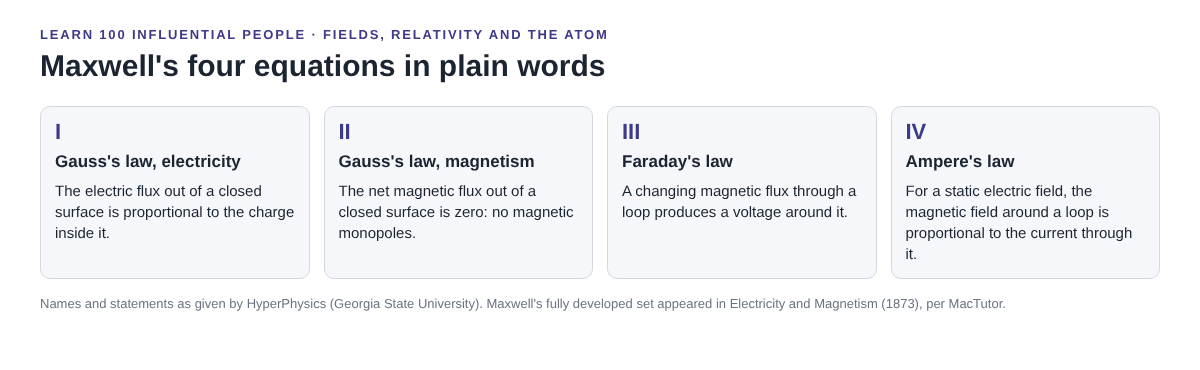
The four laws in plain words, as HyperPhysics states them.
Gauss's law for electricity: charges make electric fields
Draw an imaginary balloon around some charges. Count how many field lines leave through the balloon, and count lines coming in as negative. The total depends only on the net charge inside, which is what the law says.
Put one positive charge in the middle and make the balloon twice as wide. The lines spread thinner, but the same number still pass through. Put in a positive and a negative charge of equal size and the net is zero, because lines that leave the positive charge return to the negative one.
Gauss's law for magnetism: no magnetic monopoles
The magnetic version says the net flux out of any closed surface is zero. HyperPhysics reads this as a statement that there are no magnetic monopoles: a monopole source would give a non-zero result.
In daily life this shows up when you cut a bar magnet in half. You do not get a north pole and a south pole separately. You get two smaller magnets, each with both poles. Every magnetic line that goes out of a surface also comes back in.
Faraday's law: changing magnetic fields make voltage
Michael Faraday worked out that a changing magnetic field can drive a current. Move a magnet through a coil of wire and a voltage appears. Hold the magnet still and nothing happens, because the change is what counts. HyperPhysics notes that this law is the basis for electric generators and also for inductors and transformers.
Maxwell's own link to Faraday is recorded by MacTutor, the history of mathematics site at the University of St Andrews. It says one of Maxwell's most important achievements was "his extension and mathematical formulation of Michael Faraday's theories of electricity and magnetic lines of force." His paper On Faraday's lines of force was read to the Cambridge Philosophical Society in two parts, in 1855 and 1856, and showed that "a few relatively simple mathematical equations could express the behaviour of electric and magnetic fields and their interrelation."
Ampere's law: currents and changing electric fields
HyperPhysics gives the simple form of this law for a static electric field: the line integral of the magnetic field around a closed loop is proportional to the electric current flowing through the loop. This is useful for finding the magnetic field of simple shapes, such as a straight wire.
The full law in Maxwell's set goes further. It also counts a changing electric field as a source of magnetic field, so a changing electric field and a changing magnetic field can each make the other. That is why the fourth equation is the one most tied to Maxwell's name.
What Maxwell found about light
Here is the step that made the equations famous. MacTutor says that around 1862, while working in London, Maxwell calculated that the speed of propagation of an electromagnetic field is approximately that of the speed of light. He proposed that light is therefore an electromagnetic phenomenon, and wrote:
We can scarcely avoid the conclusion that light consists in the transverse undulations of the same medium which is the cause of electric and magnetic phenomena.
Before this, light, electricity and magnetism were separate subjects. After it, they were one.
A short life of Maxwell
MacTutor traces Maxwell's route. He was born on 13 June 1831 in Edinburgh, wrote his first paper at 14, studied at Edinburgh and Cambridge and graduated from Trinity College, Cambridge, in 1854 as Second Wrangler, equal with the Senior Wrangler in the Smith's Prizes. He won the Adams Prize for an essay on Saturn's rings, showing that the rings could be stable only if made of numerous small solid particles. Airy called it "one of the most remarkable applications of mathematics to physics that I have ever seen."
In 1860 he became professor of natural philosophy at King's College, London. MacTutor says the six years there were "the years when he did his most important experimental work." In 1866 he treated gases statistically and, independently of Ludwig Boltzmann, formulated what is now called the Maxwell-Boltzmann kinetic theory of gases.
He left London in 1865 for his estate at Glenlair, and in 1871 he accepted the first Cavendish Professorship of Physics at Cambridge. He designed the Cavendish Laboratory and helped set it up, and it opened on 16 June 1874. The four equations, MacTutor writes, "first appeared in fully developed form in Electricity and Magnetism (1873)", and it calls them one of the great achievements of 19th century mathematics. Maxwell died in Cambridge on 5 November 1879, aged 48.
Why the equations matter
Three reasons they stay on every physics syllabus:
- They unify. Four laws cover electric charge, magnetism, induction and light. HyperPhysics says that from them "one can develop most of the working relationships" in the field.
- They run machines. Generators and transformers rest on Faraday's law, as HyperPhysics notes.
- They sit in a longer story. Maxwell's course in Learn 100 Influential People runs on to Einstein, Bohr and Marie Curie. For two of those, see Einstein vs Bohr and why Marie Curie was important.
One more point from MacTutor: Maxwell's statistical treatment of gases moved physics from heat as something flowing from hot to cold to a question of probabilities among molecules.
A worked example: read one law like a historian
You can learn Maxwell the way a history student learns any source. Take MacTutor's quotation about light and run the four steps from how to analyze a written document in history.
- Identify the source. Maxwell, around 1862, in London, as MacTutor reports it. The quotation reaches us through a biography, not the original paper.
- Read closely. Light consists of transverse undulations of the same medium that causes electric and magnetic effects. Note the hedge: "we can scarcely avoid the conclusion."
- Place it in context. It follows his calculation that the speed of an electromagnetic field is approximately the speed of light.
- Judge it. Compare MacTutor with a physics reference such as HyperPhysics, and note where one gives a detail the other does not.
Frequently asked questions
What are Maxwell's four equations?
They are Gauss's law for electricity, Gauss's law for magnetism, Faraday's law of induction and Ampere's law, in the form Maxwell completed.
Did Maxwell discover all four laws?
No. MacTutor describes his achievement as extending and putting into mathematics Faraday's theories, and it says the four equations appeared in fully developed form in his 1873 book Electricity and Magnetism.
How did Maxwell link light to electromagnetism?
Around 1862 he calculated that an electromagnetic field travels at about the speed of light, and proposed that light is an electromagnetic phenomenon.
Do magnetic monopoles exist?
Gauss's law for magnetism says the net flux through any closed surface is zero, which HyperPhysics reads as a statement that there are no magnetic monopoles.
Get started
To see Maxwell beside the people around him, open Learn 100 Influential People. It has short lessons of about 9 minutes, questions that check you and the sources for every lesson, and you sign in with your email and an emailed sign-in code. The course on fields, relativity and the atom covers Faraday, Maxwell, Einstein, Bohr and Marie Curie.


Comments
No comments yet.
Sign in or make an account to comment.