Fruit and Vegetables Per Day: What the WHO's 400 g Means
The World Health Organization says adults should eat at least 400 g of fruit and vegetables per day, and the UK's NHS turns that into five portions of 80 g, the familiar "5 a day". This post shows what 400 g looks like on a plate, which foods count and which do not, and how to fit it into an ordinary day without a kitchen scale.
If you want to build habits like this one step at a time, How to Find Your Meaning is a free web app of short hands-on lessons on Stoic philosophy, healthy habits and the story of who you are; its course on what you take in opens with a lesson called Food and Drink, which lists its sources.
How much fruit and vegetables per day the WHO recommends
The WHO's fact sheet on a healthy diet gives one plain line: everyone older than 10 should aim for at least 400 grams of fruit and vegetables a day. Children under 10 need less, at least 250 g from ages 2 to 5 and 350 g from 6 to 9.
Two things about that number are worth knowing:
- It is a floor, not a ceiling. The word the WHO uses is "at least".
- Fresh is not the only option. The WHO calls fresh produce a great choice and says frozen and canned are also good, as long as they have no added sugars or excess sodium.
This post explains what the guidance says. It is not advice for your own case. If you have a health condition or a special diet, ask a doctor or a registered dietitian.
What 400 g looks like: five portions on a real plate
The WHO gives the total in grams. The NHS splits it into portions: an adult portion is 80 g, so five of them make 400 g. Its portion size guide gives examples you can picture without weighing anything:
- One medium fruit: an apple, banana, pear or orange
- Two small fruits, such as 2 plums, 2 satsumas or 2 kiwi fruit, or 7 strawberries or 14 cherries
- Three heaped tablespoons of cooked carrots, peas or sweetcorn
- One medium tomato, 7 cherry tomatoes or a 5 cm piece of cucumber
- Two broccoli spears
- About 30 g of dried fruit, roughly one heaped tablespoon of raisins
Here is one ordinary day that reaches five portions.:
- Breakfast: a sliced banana on your oats. One portion.
- Mid morning: an apple. Two portions.
- Lunch: a sandwich with a medium tomato and a 5 cm piece of cucumber on the side. Four portions.
- Dinner: three heaped tablespoons of peas next to whatever else you eat. Five portions, about 400 g.
What counts and what does not: potatoes, juice, beans and frozen food
The NHS page 5 A Day: what counts? answers the common questions:
- Potatoes do not count. Neither do yams, cassava or plantain. They are eaten in place of bread, rice or pasta, so the NHS treats them as starchy foods. They still have a place in your diet.
- Sweet potatoes do count. So do parsnips, swedes and turnips, because they are usually eaten as well as the starchy part of a meal.
- Juice and smoothies count once. Keep them to 150 ml a day in total, one portion however much you drink. Juicing releases the sugars, and the WHO counts the sugars in fruit juice as free sugars.
- Beans and pulses count once. Lentils, chickpeas and beans give you fibre but fewer of some nutrients, so 80 g counts as one portion, no matter how many you eat.
- Frozen, tinned and cooked dishes count. Vegetables in a soup, stew or pasta sauce count too. For tinned produce, pick ones in water or natural juice with no added sugar or salt.
Where fruit and vegetables fit in the wider WHO healthy diet
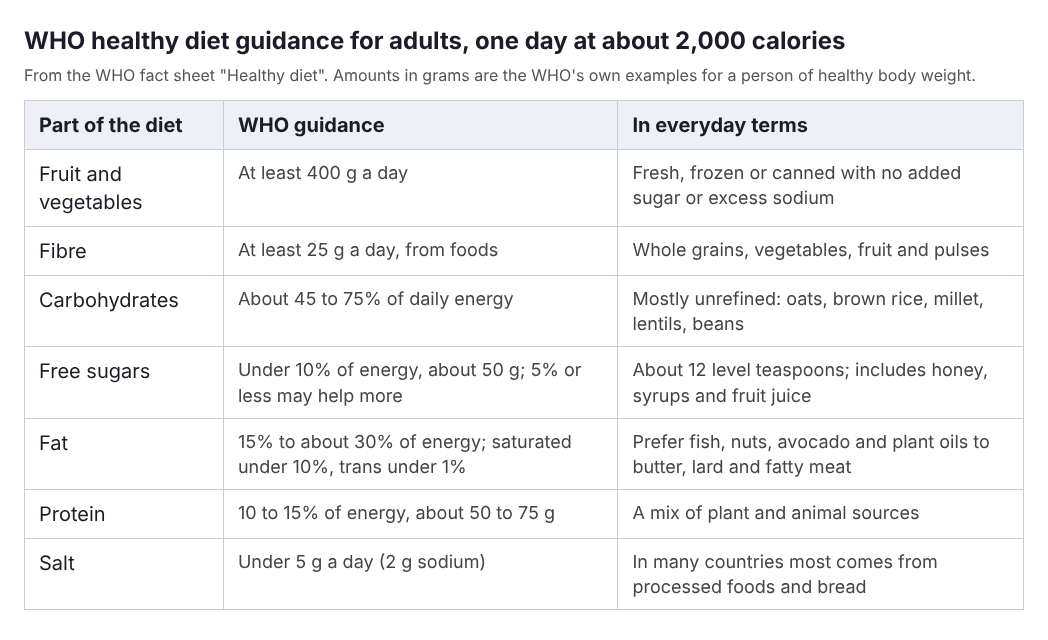
The WHO builds a healthy diet on four principles: adequacy, balance, moderation and diversity. It also says the exact mix will vary with your age, gender, activity, culture and the foods you can get. Its other numbers for adults, with protein and carbohydrates in the table above:
- Free sugars: under 10% of daily energy, which is about 50 g or 12 level teaspoons at 2,000 calories. Going down to 5% or less may bring more benefit. Free sugars are those added by a maker, a cook or you, plus the sugars in honey, syrups and fruit juice.
- Salt: under 5 g a day, which is 2 g of sodium. In many countries most of it comes from processed foods and from foods eaten often in large amounts, such as bread.
- Fat: from 15% to about 30% of energy, with saturated fat under 10% and trans fat under 1%. Industrially produced trans fat should be avoided.
You do not need to track percentages to use this. Putting the produce on the plate first leaves less room for the foods the WHO asks you to keep low.
Simple ways to close the gap
Most of what gets in the way is practical, not a lack of knowledge. Fresh produce goes off, busy days push you to quick food, and breakfast and lunch often have no fruit or vegetables at all, so dinner has to carry the load. Small changes deal with each of these:
- Keep a frozen bag on hand. Frozen peas, spinach or berries last for months and count fully.
- Add one portion to a meal you already eat. Fruit on your breakfast, a tomato with your lunch. Adding is easier than replacing.
- Put fruit where you can see it. A bowl on the counter is a reminder every time you pass it.
- Cook once, eat twice. A big pot of vegetable soup or lentil stew covers several lunches, and the vegetables in it count.
- Count for one week, then stop. A week of tallying shows you where your gaps are. After that, the pattern matters more than the count.
Tie the new step to something you already do, like fruit with your morning coffee. The app's Routines and Habits course, with its lesson How Habits Form, works the same way, and there is more on it in what the research says about 66 days to form a habit.
Eating well as one routine among several
Food sits next to movement and sleep. The WHO also gives adults numbers for activity, set out in how much exercise adults need, according to the WHO, and sleep has its own guidance in how much sleep adults need.
The Stoics had a view on food too, though not a nutrition table. Epictetus, in the Enchiridion, says eating and drinking should be done "incidentally and slightly", with your real attention on your own mind (chapter 41). And at a dinner, he says, "don't talk how persons ought to eat, but eat as you ought" (chapter 46). The Stoics counted moderation among the virtues, next to prudence, justice and courage, as the Stanford entry on Stoicism sets out. Some readers find that framing helpful: what you put on your plate is one of the small things that is up to you. Others prefer to treat food as plain health advice with no philosophy attached. Both are fair ways in.
Here is how a week could look with the daily Stoic practice in How to Find Your Meaning, about ten minutes in three steps:
- Morning: you get a question for the day ahead and one of the four Stoic virtues to practise. On a moderation day you might answer: "Fruit with breakfast and a vegetable with lunch, not only at dinner."
- During the day: a short passage from Epictetus, Marcus Aurelius or Seneca, and one thing to try.
- Evening: Seneca's three questions from Sextius. What bad habit did I cure today? What fault did I resist? In what way am I better? "I ate the apple I packed" is an honest answer.
You can keep notes on each day of the practice, so a week of answers shows you how your eating went without a separate food diary.
Frequently asked questions
Is 5 a day the same as the WHO's 400 g?
Yes, in practice. The NHS counts an adult portion as 80 g, so five portions make the WHO's minimum of 400 g.
Do potatoes count toward fruit and vegetables per day?
No. The NHS leaves out potatoes, yams, cassava and plantain because they are eaten as starchy foods, but sweet potatoes, parsnips, swedes and turnips do count.
Does fruit juice or a smoothie count as a portion?
Once a day at most, and the NHS says to keep juice and smoothies to 150 ml a day in total. The WHO counts the sugars in fruit juice as free sugars, which it asks you to limit.
Are frozen and canned vegetables as good as fresh?
Both count toward your daily total. The WHO calls frozen and canned produce good choices when they have no added sugars or excess sodium.
Get started
Knowing the 400 g figure is the easy part; building the habit is the work. How to Find Your Meaning has 15 courses in three parts, Stoicism first, then Health, then You. The Health part covers daily routines like sleep and movement, and what you take in, from food and drink to what you feed your mind. Each lesson is about nine minutes, with hands-on activities and questions, and lists its sources, the WHO among them. Read more on the about page.
Lessons are free with an account. You sign in with your email and a code sent to it, and you can install the app from the site on your phone or computer.
Start How to Find Your Meaning: free, short hands-on lessons on Stoicism, healthy habits and your own meaning, with a daily Stoic practice to live it.
Find what your life is for.
Visit findyourmeaning.vlvd.net↗
Comments
No comments yet.