Heijunka at home: level out a busy week
Heijunka at home means spreading your recurring chores and errands evenly across the week, so no single day carries the whole load. Instead of a calm Tuesday and a wrecked Sunday, you aim for a similar amount of work each day. This guide shows you how to level out a busy week in three steps, with one made-up household you can copy.
If you want somewhere to keep the problems this exposes and what you tried for each, Problem Graph lets you write a problem in one line, attach the solutions you try, and mark each one as worked, partly or failed.
What heijunka means
The Lean Enterprise Institute defines heijunka as leveling the type and quantity of production over a fixed period of time, and says the Japanese word means, roughly, "levelization". Its own example is a producer who gets 200 orders on Monday, 100 on Tuesday, 50 on Wednesday, 100 on Thursday and 50 on Friday. Instead of building to match each day, the producer keeps a small buffer of finished goods and builds the same quantity every day.
At home, your "orders" are laundry, dinners, dishes, bills, groceries and the school run. They arrive whether you plan for them or not. Leveling means you choose the rhythm instead of letting it choose you. The household below is made up, and the minutes are an illustration, not a benchmark.
Why a busy week gets lumpy
The same Institute's page on muda, mura and muri gives three words that explain why weeks go wrong.
- Mura is unevenness, such as an uneven pace that makes you hurry and then wait. Four loads of laundry on Sunday and none on Wednesday is mura.
- Muri is overburdening: asking more of a person or a day than it can hold. Something slips.
- Muda is activity that uses resources without creating value, like sorting the same pile twice. We cover it in Muda at home: spot the waste in a daily routine.
The Institute says the three are often related, and that unevenness often can be removed through level scheduling. So the lumpy week is the thing to fix first.
Heijunka at home in three steps
Step 1: List every recurring task and its real size Write down every task that comes back each week. Next to each, write the hands-on minutes it really takes, not the minutes you wish it took. Time one or two of them if you are unsure.
- Dinner, 5 nights a week, 40 minutes each: 200
- Dishes, daily, 15 minutes: 105
- Tidy-up, daily, 10 minutes: 70
- School lunches, 5 days, 15 minutes: 75
- Laundry, 4 loads, 20 hands-on minutes each: 80
- Groceries, once: 60
- Bathroom clean: 30
- Floors: 30
- Bills and admin: 30
The total is 680 minutes a week. Write that number down. It is the size of your real load. Step 2: Set a daily target, a simple takt In a factory, takt time is the available production time divided by customer demand. At home a simpler version works: divide your weekly load by the days in the week. 680 minutes over 7 days is about 97 minutes a day. That is your daily target. Now check it against reality. If two adults can each give about 55 minutes a day, you have 110 minutes of capacity a day, and the week fits with a little room. If you only have 60 minutes a day in total, you have a capacity problem, and no schedule fixes that. That is the useful result of this step. It tells you whether you have a scheduling problem or a too-much-work problem. For a too-much-work problem, cut tasks, share them, or lower the standard on some of them. Then recalculate. Step 3: Level the load across days Start with the tasks that happen every day or on fixed days. Dinner, dishes, tidy-up and lunches are the base. Place them first. Then spread the flexible tasks, the ones that can float, so every day lands near your daily target. Three rules help:
- Split big batches. Four loads of laundry on one day becomes one load on each of four days. Each is small enough to fit around other things.
- Pair heavy with light. Put the 60-minute grocery run on a day with few other tasks.
- Keep one light day. A buffer day absorbs whatever overflowed earlier in the week, much like the small buffer of finished goods in the Institute's example.
Use a heijunka box for household tasks
A heijunka box is a grid. The Institute's picture of one shows a schedule by product type on one axis and time on the other. You can build the home version on a wall, a fridge or a sheet of paper. Make the columns the seven days. Make the rows your kinds of task: meals, dishes and tidy-up, laundry, cleaning, errands, admin. Write each task on a sticky note with its minutes and place the notes in the grid. Each day's column should hold roughly the same total. When a day fills up, a new task does not squeeze in. It goes to the next day with room.
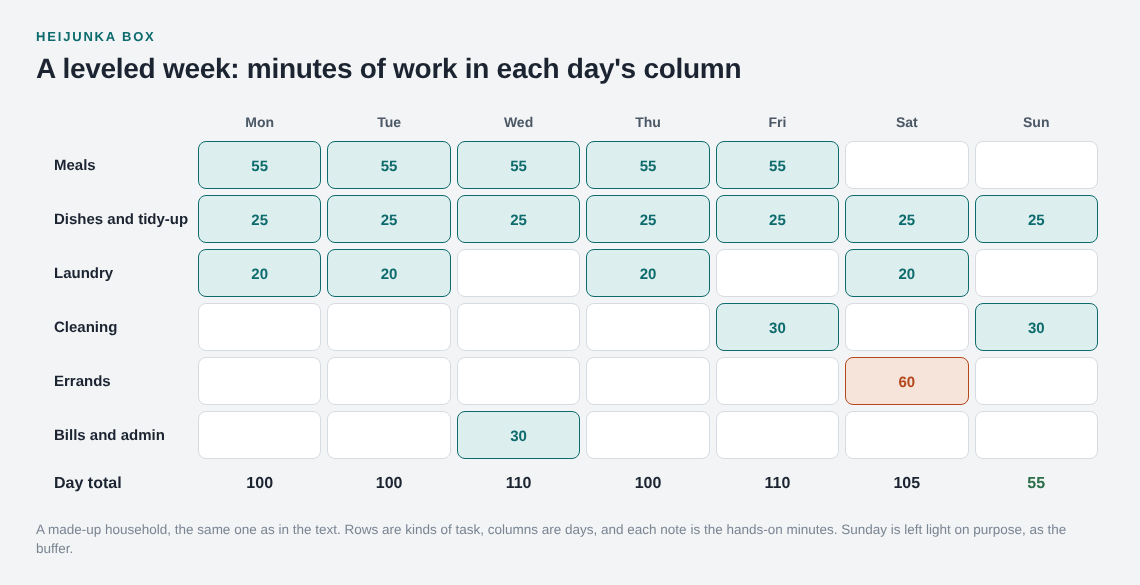
The box also makes overload visible. A column with a tall stack of notes is a lumpy day you can see before you live it.
A worked example: the same 680 minutes, two ways
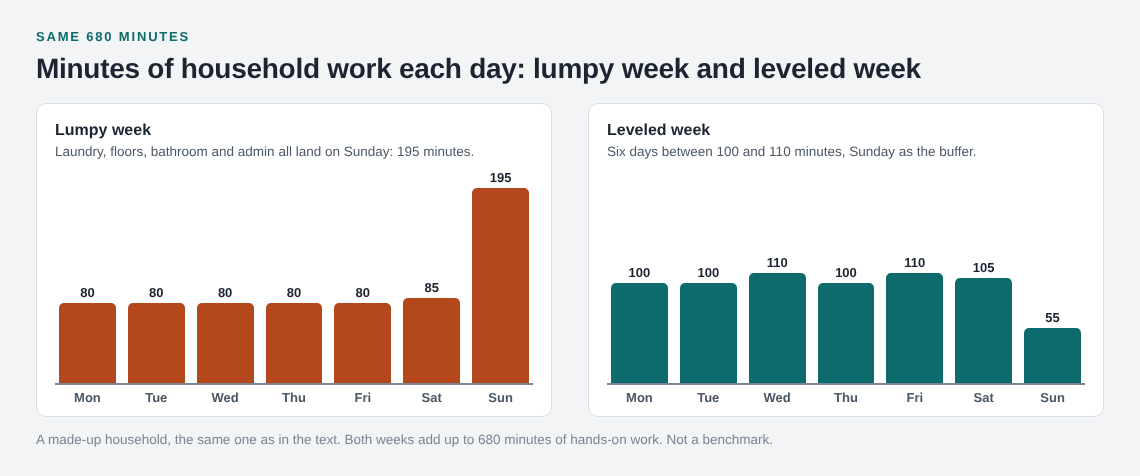
Dinner, dishes, tidy-up and lunches form a base of 80 minutes on each weekday. Dishes and tidy-up alone form a base of 25 minutes on Saturday and Sunday. Here is the leveled week from the grid above.
- Monday: base 80, plus one laundry load 20. Total 100.
- Tuesday: base 80, plus one laundry load 20. Total 100.
- Wednesday: base 80, plus bills and admin 30. Total 110.
- Thursday: base 80, plus one laundry load 20. Total 100.
- Friday: base 80, plus floors 30. Total 110.
- Saturday: base 25, plus groceries 60 and one laundry load 20. Total 105.
- Sunday: base 25, plus the bathroom 30. Total 55.
The days add up to 680 again. Six days sit between 100 and 110 minutes, and Sunday stays light on purpose as the buffer. Compare that with the lumpy version of the same week, where all four laundry loads, the floors, the bathroom and the admin wait for Sunday: 195 minutes, with the other days at 80 to 85.
Common mistakes when leveling your week
- Using wished-for times. If you plan 10 minutes for something that takes 25, the plan fails by Wednesday. Measure first.
- Filling every minute. A week planned to the last minute of your capacity has no room for a sick child or a late meeting. Leave slack.
- Leveling a week that holds too much. If the takt check showed you are over capacity, moving tasks around only hides it. Remove or share work.
- Treating the plan as fixed. Review it after two weeks and move what did not fit. A weekly review is a good place to do it.
- Changing everything at once. Move one or two tasks, then see what happens, as in one change at a time.
Keep the fixes you try on a map
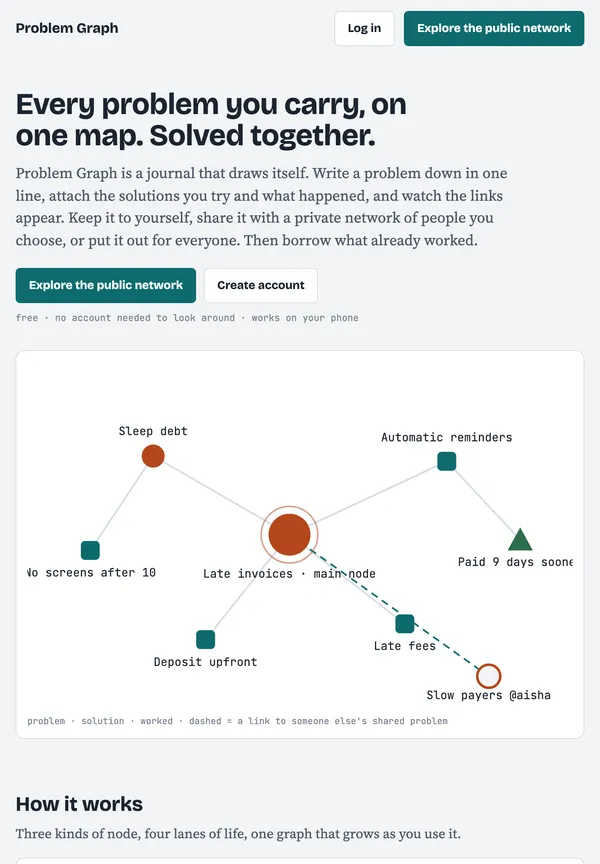
Leveling is a set of experiments. You will try splitting laundry, moving groceries to Saturday, shifting admin to Wednesday. Some will hold and some will not. This is where a record helps. In Problem Graph, you could write one line such as "Sunday is overloaded with chores" and put it in the personal lane. Then attach each solution as you try it: "one laundry load per weekday", "groceries on Saturday morning". Mark each one worked, partly or failed once you know. A failed attempt stays on the map, so you do not repeat it in two months. You can also link related problems, such as "dinner prep runs late" and "no time for admin", and look for patterns across them. If you run a household with others, you can mark one problem as a main node and share it into a private network, such as your family, using an invite code. The main node's solutions and their outcomes go along with it. Members see it and nobody else does. Problem Graph also shows similar problems other people have shared and which of their solutions worked, and you can borrow one with one tap. Sharing is how the feature works, not a promise that matching problems are waiting for you today.
Frequently asked questions
What is heijunka in simple terms?
Heijunka is leveling: spreading work evenly over time so no period is overloaded. At home, it means giving each day a similar amount of chores instead of cramming them into one or two days.
How is heijunka different from a regular chore schedule?
A normal schedule assigns tasks to days. Heijunka starts by measuring the total load and dividing it by your available time, then balances each day to match. That makes overload visible before it happens.
How long should my daily chore target be?
Divide your total weekly task minutes by seven, then compare the result with the time you really have. If the target is higher than your capacity, cut or share tasks before you schedule anything.
Do I need a physical heijunka box?
No. A grid on paper or a fridge works. What matters is that you can see each day's total and move a task when a day is full.
What if my week changes every week?
Level the tasks that repeat, and keep one light day as a buffer for the rest. Adjust the plan after a couple of weeks based on what actually fit.
Get started
Pick one task list and one week. Add up the minutes, divide by seven, and move one lumpy day toward your target. When something works or fails, write it down.
Try Problem Graph: it is free, and you can look around the public network without an account. Write one problem down in a line and attach the first thing you will try. You can open the app straight in your browser, including on your phone.
Every problem you carry, on one map. Solved together.
Visit problemgraph.vlvd.net↗

Comments
No comments yet.
Sign in or make an account to comment.