How Much Water Should You Drink a Day? What the Evidence Says
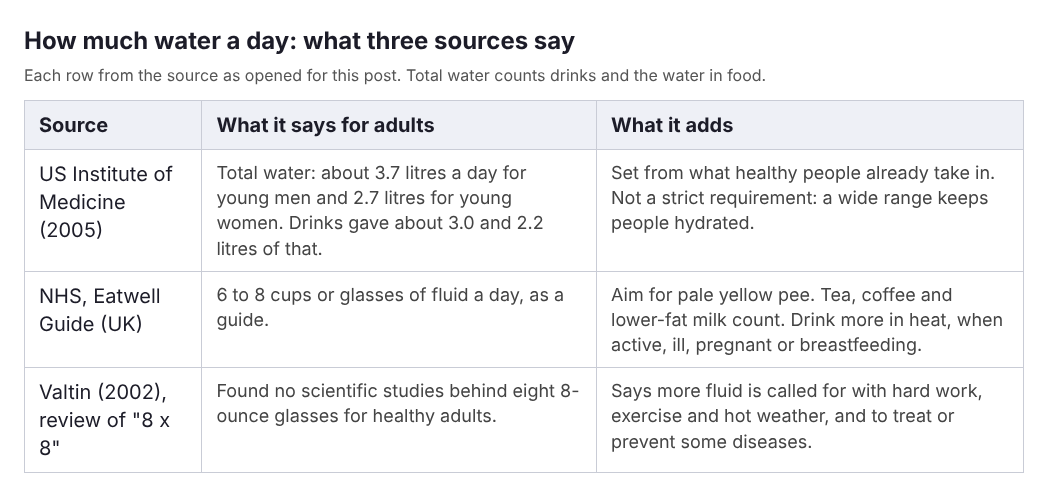
How much water should you drink a day? For most healthy adults there is no single number. The US Institute of Medicine puts typical total water at about 3.7 litres a day for young men and 2.7 litres for young women, and that counts food and every drink, not only plain water. The UK's NHS gives a simpler guide of 6 to 8 cups or glasses of fluid a day. Both say your own need changes with heat, activity and health, and that your body gives you good signals.
How to Find Your Meaning is a free web app of short, hands-on lessons on Stoicism, healthy habits and the story of who you are, and its Health part has a lesson on food and drink that lists its sources, so you can check claims like these yourself.
How much water should you drink a day? The short answer
Here is what the two sources opened for this post say, in plain terms.
- Institute of Medicine (2005): an "Adequate Intake" of total water of 3.7 litres a day for men and 2.7 litres for women aged 19 to 30. Drinks gave about 3.0 and 2.2 litres of that, around 13 and 9 cups.
- NHS Eatwell Guide: 6 to 8 cups or glasses of fluid a day, "just a guide", and enough that your pee is a clear pale yellow.
These numbers are not a test you pass or fail each day. They describe what healthy people take in, and a wide range of intakes keeps people well.
What the Institute of Medicine figure really means
The Institute of Medicine's chapter on water is worth reading for how the number was made. The committee did not find a level below which people get ill. It set the Adequate Intake at the median total water that healthy Americans already took in, from national survey data.
The report then says what that number is not. For a healthy person, taking in less than the Adequate Intake "may not confer additional risk", because normal hydration holds over a wide range of intakes. It should not be read as "a specific requirement". Day to day, thirst and drinks with meals keep the body's water where it should be.
Two more details help. In the survey, drinks gave about 81 percent of total water and food about 19 percent. And people who are physically active or in hot places need more.
Where the 8 glasses of water rule fails
"Drink at least eight 8-ounce glasses of water a day" is the version most people know. In 2002 the physiologist Heinz Valtin set out to find its origin and the evidence for it, in a review in the American Journal of Physiology (abstract on PubMed).
He found no scientific studies in support of it. Surveys of what thousands of healthy adults eat and drink suggested such large amounts are not needed, and he found that caffeinated drinks may count toward the daily total. His conclusion is narrow on purpose: it covers healthy adults in a temperate climate who mostly sit. He also wrote that larger intakes are advisable for treating or preventing some diseases, and for hard work and exercise, especially in hot weather.
So the rule is not harmful advice for most people. It is just not a measured need. The NHS figure of 6 to 8 glasses sits close to it, and the NHS calls it a guide.
Why your number differs from someone else's
A large 2022 study in Science shows how much people vary. Yamada and colleagues measured "water turnover", the water the body uses each day, in 5,604 people aged from 8 days to 96 years in 23 countries, using an isotope tracer (abstract on PubMed).
Turnover was linked to age, body size and composition, physical activity, athletic status, pregnancy, income level, and where people lived: latitude, altitude, air temperature and humidity. The authors give equations to predict it rather than one number for everyone. That fits what the older sources say: one figure cannot cover a builder in summer and an office worker in winter.
When you need more than usual
The NHS lists the times to drink more: pregnancy or breastfeeding, hot weather, long spells of activity, and being ill or recovering. Its dehydration page adds a high temperature, sickness or diarrhoea, too much alcohol, diabetes, and medicines that make you pee more.
If a doctor has told you to limit fluids, or you have a heart or kidney condition, follow their advice over any general guide.
Food, tea and coffee count
You do not need to get all of it from plain water. The NHS says water, lower-fat milk and lower-sugar drinks, including tea and coffee, all count toward your daily fluid. Valtin's review says the same of caffeinated drinks. Food gave about a fifth of total water in the US survey, which is why a diet with plenty of fruit and vegetables helps; our post on fruit and vegetables per day covers the WHO's guide.
Sugary drinks add water too, but the NHS suggests swapping them for lower-sugar ones and keeping fruit juice and smoothies to one small glass a day.
Signs you are drinking enough, or too little
Your body keeps count better than a tally of glasses. The NHS gives these signs.
- Probably enough: your pee is a clear pale yellow most of the day, and you are rarely very thirsty.
- Drink more: thirst, a headache or feeling light-headed, dark yellow and strong-smelling pee, peeing less often than usual, feeling tired, a dry mouth, lips and tongue.
Sleep and movement shape how you feel in the afternoon too, so a tired spell is not always about water. Our posts on how much sleep adults need and on habits cover those.
A worked example: one week to find your own amount
Epictetus taught that people are disturbed not by things but by their judgements about them. A rule you never checked, like "eight glasses or else", is a judgement you borrowed. Here is a week to replace it with your own.
- Day 1, the source. Read the NHS line above. Your aim is pale yellow pee and no strong thirst, not a count.
- Days 1 to 3, notice. Each evening write one line: how thirsty you felt, the colour of your pee by mid-afternoon, and whether it was hot or you exercised.
- Day 4, one small action. Pick one: a glass of water with each meal, or a bottle on your desk on hot days.
- Days 4 to 6, keep it. Same evening line.
- Day 7, review. Did the action change your signals? Was it easy? Keep it, change it or drop it.
The daily Stoic practice in How to Find Your Meaning fits this week. In the morning you get a question and one of the four virtues, so on day 4 the question becomes your one action. During the day you read a short passage from Epictetus, Marcus Aurelius or Seneca and try one thing. In the evening you answer Seneca's questions, taken from Sextius, such as what fault you resisted and in what way you are better. You can keep notes on each day, so the seven lines live in one place. The app does not tell you how much to drink; it gives you a routine for noticing and reviewing.
Frequently asked questions
Is 8 glasses of water a day too much?
For most healthy adults it is close to the NHS guide of 6 to 8 glasses, but Valtin's review found no study showing it is needed. If a doctor has told you to limit fluids, follow their advice instead.
Does coffee count toward how much water you drink?
Yes. The NHS counts tea and coffee as part of your daily fluid, and Valtin's review found caffeinated drinks may be counted toward the total.
What colour should my pee be?
The NHS says aim for a clear pale yellow. Dark yellow, strong-smelling pee is one of its signs of dehydration.
Do I need more water when I exercise?
Yes. The Institute of Medicine says people who are physically active or in hot environments need more total water, and the NHS says drink more if you are active for long periods.
Get started
Checking where a health rule comes from is a habit, and How to Find Your Meaning is built around that kind of habit. Its courses run from Stoicism to routines such as sleep and movement, to what you eat and drink, and then to your own meaning. Read more about the courses, or install the app from the site. Every lesson is free with an account, and you sign in with your email and a code sent to you.
Start How to Find Your Meaning: short hands-on lessons on Stoicism, healthy habits and your own meaning, with a daily Stoic practice to live it.
Find what your life is for.
Visit findyourmeaning.vlvd.net↗
Comments
No comments yet.