Men Are Disturbed Not by Things: Epictetus' Quote Explained
"Men are disturbed, not by things, but by the principles and notions which they form concerning things." That line from the Stoic teacher Epictetus, in Elizabeth Carter's translation of the Enchiridion, says something simple and hard: what upsets you is usually your judgement about an event, not the event alone. A late train is a fact. "My whole day is ruined" is a view you added. Epictetus wants you to notice the gap between the two, because the gap is where you have some choice.
If you want to practise this rather than just read about it, How to Find Your Meaning is a free web app of short lessons whose course on acceptance has one called "Not Things, but Judgements," plus a daily Stoic practice to live what you learn.
What "men are disturbed not by things" actually says
The claim has two parts. First, there is what happens in the world. Second, there is the disturbance you feel, which comes from the opinion you form about what happened: that it is bad, unfair, a disaster, or proof that something is wrong with you.
This does not mean events do not matter. It means your distress is built in two layers. There is what happened, and there is what you told yourself it means. Epictetus thinks the second layer does most of the damage, and it is the one you can work on directly.
Where the quote comes from: Enchiridion 5 and Socrates
The line opens section 5 of the Enchiridion, or "Handbook." You can read the whole of it in Carter's translation at the MIT Internet Classics Archive. Epictetus did not write his teaching down himself. The Stanford Encyclopedia of Philosophy entry on Epictetus explains that the longer Discourses were, by their own preface, written by the historian Arrian of Nicomedia to convey the impact of his teaching.
Section 5 does not stop at the famous line. It gives an example straight away: "Death, for instance, is not terrible, else it would have appeared so to Socrates. But the terror consists in our notion of death that it is terrible." Socrates met his own death calmly, so for Epictetus he shows that the same event can be met with a different view.
Then it turns to blame. "When therefore we are hindered, or disturbed, or grieved, let us never attribute it to others, but to ourselves; that is, to our own principles." It describes three stages. An uninstructed person "will lay the fault of his own bad condition upon others." Someone just starting "will lay the fault on himself." Someone "perfectly instructed will place blame neither on others nor on himself."
That last stage is worth reading slowly. The goal is not to swap anger at others for anger at yourself. It is to stop looking for someone to blame and look at the judgement instead.
Things versus judgements: splitting the event from your view
The practical skill here is separation. You take one upsetting moment and split it into what a camera would record and what you added. The Handbook gives two more examples of the same split.
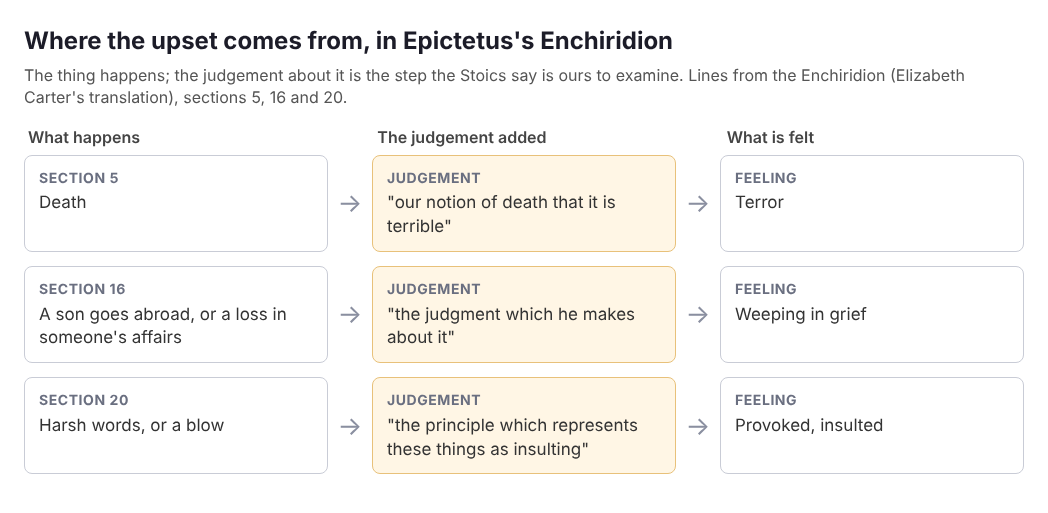
Sections 5, 16 and 20 of the Enchiridion, in Carter's translation.
In section 16, when you see someone weeping over a loss, be ready to say: "It's not the accident that distresses this person, because it doesn't distress another person; it is the judgment which he makes about it." In section 20: "not he who gives ill language or a blow insults, but the principle which represents these things as insulting."
Here is an everyday example. A friend does not reply to your message for two days.
- The thing: You sent a message on Monday. There has been no reply by Wednesday.
- The judgement: "She is annoyed with me. I said something wrong. She does not care."
Only the first part is known. The second part is a story, and it is the story that keeps you checking your phone. Once you see the split, you can ask whether the story is true, whether it is the only possible story, and whether you need one at all.
The dichotomy of control behind the quote
Section 5 makes more sense once you read section 1. In Carter's words, "Things in our control are opinion, pursuit, desire, aversion, and, in a word, whatever are our own actions. Things not in our control are body, property, reputation, command." Opinion, the judgement itself, sits on the first list.
Put the two sections together and the logic is clear. If you place your peace of mind in things that are not in your control, you will be disturbed often, because they change without asking you. If you place it in your judgements, you are working on the one thing you can adjust. Our post on things you can't control goes further into section 1.
In the acceptance course on How to Find Your Meaning, the lesson "What Is Up to Us" comes before "Not Things, but Judgements," and "Accepting What Happens" comes after. That order follows the same logic: first sort what is yours, then look at your views, then practise meeting events as they come.
A daily exercise for catching your judgements
Reading the quote once will not change much. Epictetus treated it as a skill. The Stanford entry describes his method as slowing down "to allow for reflection prior to assent," and quotes him in Discourses 2.18: "Impression, wait for me a little. Let me see what you are, and what you represent." Here is a routine you can try for a week.
- Morning: pick one likely trigger. A meeting, a commute, a hard conversation. Decide in advance that when it happens, you will look for the judgement.
- During the day: wait, then write the split. When you feel the jolt, say "wait for me a little," then write two lines. "What happened:" in plain facts. "What I told myself:" in your own words.
- Then ask one question. "What is a more accurate way to put this?"
- Evening: review. Look back at the day and ask what you handled better than yesterday.
A worked example. Your manager sends "Can we talk tomorrow at 10?"
- What happened: I got a short message asking for a meeting.
- What I told myself: "I am in trouble and might lose my job."
- A more accurate version: "I do not know what the meeting is about. I will find out at 10."
The meeting may still bring bad news. But you have spent the evening on the facts instead of on the worst version of them.
The daily Stoic practice in How to Find Your Meaning follows a similar shape in about ten minutes a day: a question for the day and a virtue to practise in the morning, a short passage from Epictetus, Marcus Aurelius or Seneca during the day, and three evening questions. You can keep notes on each day of the practice, so your "what happened, what I told myself" lines sit in one place and you can spot the judgements that keep coming back.
Where this idea stops helping: grief, injustice and real problems
The quote is useful, and it is also easy to misuse. Here are three places to be careful.
Grief. Losing someone is not a mistake in reasoning. Seneca wrote letters of consolation to grieving people, as our post on Stoicism and grief shows, and people also heal through others, which is one reason humans are social animals matters here.
Injustice. "It is only your judgement that upsets you" should never become a reason to accept unfair treatment, of yourself or of others. Justice is one of the four Stoic virtues. The point is to act from a clear head, not to stop acting.
Real problems. A burst pipe is a burst pipe. Changing your judgement does not fix it. What it can do is stop you adding panic on top, so you call the plumber sooner.
Thinkers disagree about how far Epictetus' idea goes. How to Find Your Meaning has 34 cards that set out where thinkers disagree, and each lesson lists its sources, so you can weigh the arguments yourself. If distress stays with you for weeks, or affects your sleep, work or safety, talk to a doctor or a mental health professional.
Frequently asked questions
Is "men are disturbed not by things" the exact wording?
It is the opening of Enchiridion 5 in English, and translations word it differently. Elizabeth Carter's reads "Men are disturbed, not by things, but by the principles and notions which they form concerning things."
Does Epictetus mean we should feel nothing?
No. He means much of your distress comes from judgements you can examine. His advice in section 20 is "not to be hurried away with the appearance," so you gain time before you react.
What does Epictetus say to do when someone insults you?
Section 20 says the insult lies in "the principle which represents these things as insulting," so when someone provokes you, "it is your own opinion which provokes you." Give yourself time before you answer.
Who wrote down Epictetus's teaching?
Epictetus did not write it himself. By their own preface, the Discourses were written by the historian Arrian of Nicomedia to convey the impact of his teaching, and scholars are confident they represent Epictetus's thought.
Get started
The quote works best as a habit. Start with the acceptance course, then try the daily practice for a week and keep your notes as you go. Lessons are about nine minutes each, and every lesson is free with an account. You sign in with your email and an emailed code. You can read more about the app, or install it from the site on the get the app page.
Start How to Find Your Meaning: short hands-on lessons on Stoicism, healthy habits and your own meaning, with a daily Stoic practice to live it.
Find what your life is for.
Visit findyourmeaning.vlvd.net↗


Comments
No comments yet.