How to get a high score in 2048: where the points come from
If you want to know how to get a high score in 2048, start with what the score actually counts. It is not a clock and it is not a count of moves. It is every merge you make, added up. So a high score comes from two things: lasting longer, and building bigger tiles before the board fills. This guide shows why, with numbers from real test games, and gives you a plan to try in your next game.
Where 2048 points come from
The rule is short. In the original game's code on GitHub, each time two tiles merge, the score goes up by the value of the new tile. Merge two 2s and you get 4 points. Merge two 64s and you get 128 points. Nothing else adds to the score: sliding without a merge pays nothing.
New tiles are 2s most of the time and 4s the rest. In the original code a new tile is a 2 when a random number is under 0.9, so roughly one new tile in ten is a 4. Wikipedia's 2048 article) gives the same 90 and 10 split.
We go through the full rule, with a check on a real board, in how 2048 scoring works. For a high score, you only need the next idea.
Why big tiles pay more than their number
A tile is worth more points than the number printed on it, because every merge that built it was paid on the way up. Count a tile as if it were built from 2s:
- A 4 took one merge: 4 points.
- A 16 took 4 merges into 4s, 2 into 8s and 1 into 16: 48 points.
- A 128 is worth 768 points.
- A 256 is worth 1,792 points.
- A 2048 is worth 20,480 points.
Look at the jump from 128 to 256. Two 128s are worth 1,536 together. Merge them and the new 256 adds 256 more, for 1,792. Every time you merge up, you collect a bonus on top of everything already on the board. That is why a board with one big tile scores far more than a board of many small ones, even when the numbers on the tiles add up to the same total.
One small catch: each new tile that arrives as a 4 skips one merge of two 2s, so it takes 4 points off these totals. You cannot control that. You can control how long you last.
Lasting longer is the whole game
The score only grows while you can still move. Once the board is full and no two equal tiles touch, the game ends and the score stops. So every habit that keeps the board open is a scoring habit.
The best known habit comes from Wikipedia's strategy section: keep your largest tile in one corner, and fill the row next to it with other large tiles. With that row full, you can slide in three directions and the big tile stays put. The same section adds a rule worth keeping: never let a large tile sit between small ones, because the small ones then cannot reach each other to merge.
Our 2048 strategy for beginners walks through the corner plan step by step on a 4 by 4 board.
What seven test games show on a cube
3D 2048 puts the puzzle on a cube like a Rubik's cube: six faces of nine squares, 54 in all. You slide the front face as in 2048, twist a row on the right face or a column on the top face to carry tiles round, and turn the whole cube. The scoring follows the same idea as the original. In the game's script, a slide adds the value of every tile its merges make. A twist adds no points but counts as a move and brings a new tile. A whole-cube turn adds no points and counts no move.
On 9 October 2026 a simple script with fixed rules played seven test games, signed out. These are single games, not averages:
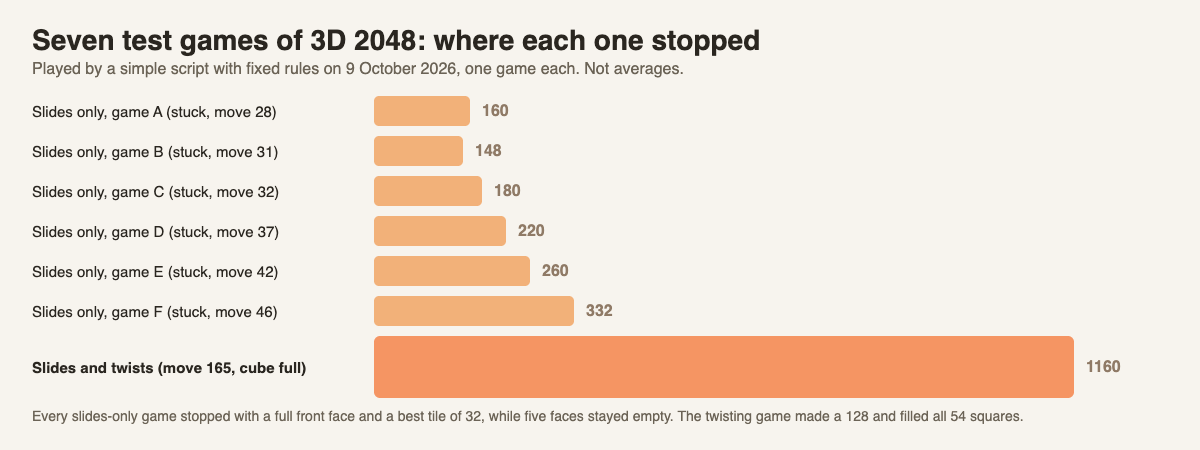
Six slides-only games and one game that also twisted. One game each, played by a script.
All six slides-only games stopped between move 28 and move 46, with scores from 148 to 332 and a best tile of 32. Each one ended the same way: the front face was full and would not slide, while the other five faces sat empty. The game that also twisted whenever the front was stuck reached a 128 at move 118 and kept going until all 54 squares were full at move 165, with a score of 1160.
The lesson is the same one as on a flat board, made louder. The twisting game did not score more because twists pay points. They pay none. It scored more because each twist bought room, and room meant more merges.
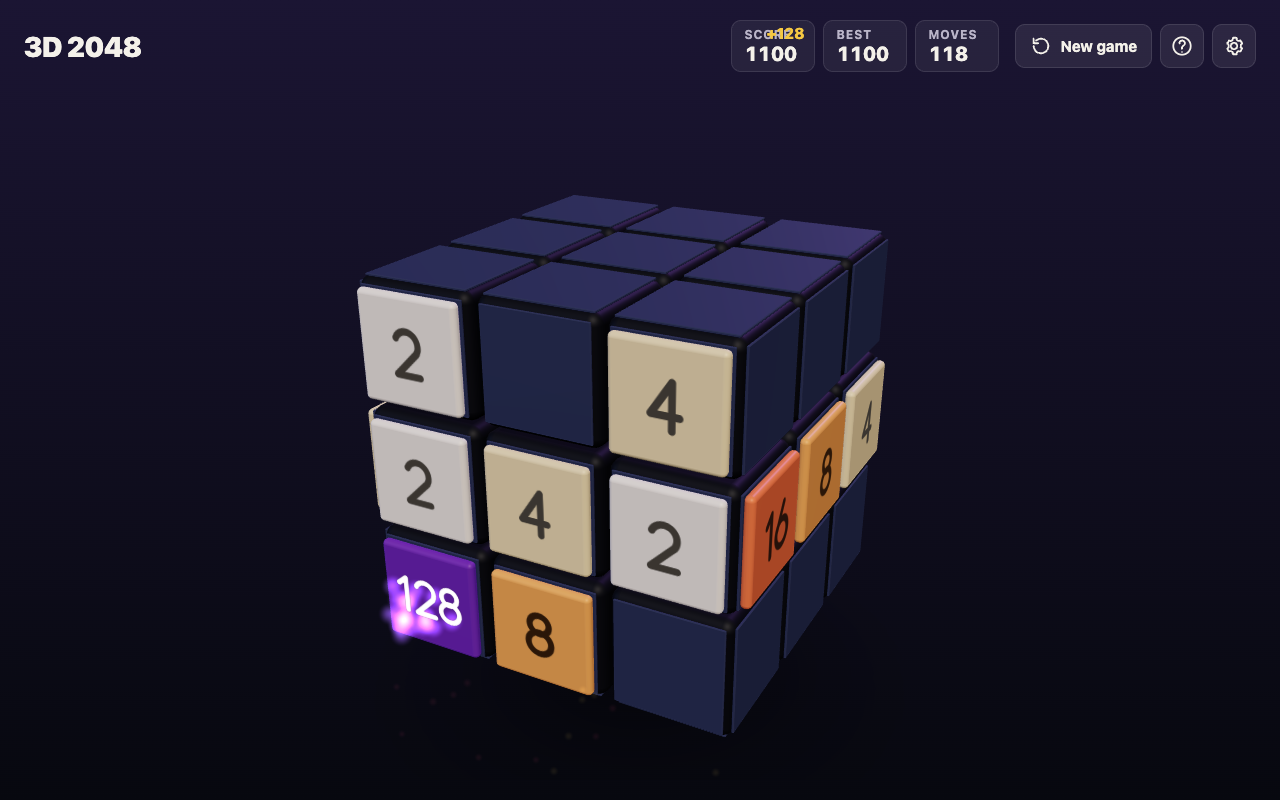
The twisting game at move 118: a 128 in the corner of the front face, with smaller tiles carried onto the right face.
How to get a high score in 2048 on a cube: a worked plan
Here is a plan you can follow in 3D 2048, built only from the rules above. Try it once and compare your Score with the numbers in the chart.
- Pick a corner of the front face. Slide down and left most of the time, so your biggest tile settles in the bottom left. Slide right only when down and left do nothing, and up last.
- Merge up whenever you can. Two equal big tiles side by side are your best move on the board, because merging them pays the bonus described above.
- When the front face is stuck, twist instead of giving up. The game tells you so: "Nothing moves that way. Try another way, or twist a row." Drag a row on the right face sideways, or a column on the top face, to carry tiles off the front.
- Keep one square empty. A twist needs one empty square for its new tile. If the whole cube is full, the game says "The cube is full. Merge two tiles on a face to make room before you twist."
- Look around before you give up. Turning is free: it costs no move and adds no tile. Press Shift and an arrow key, or drag the space around the cube, to check the other faces for equal tiles side by side.
Step 5 is the one the test script never did. When the twisting game filled all 54 squares, other faces still held equal tiles side by side, so the game was not over, but the script stopped there. A person who turns the cube to look would have had more merges to make. Our 3D 2048 tips post follows both test games move by move.
Habits that cost you points
Most low scores come from the board filling early, not from bad luck with 4s. Watch for these:
- Chasing small merges all over the board. Each one pays only a few points and can drag your big tile out of its corner.
- Using the slide you avoid as a habit. Sliding up on a bottom corner plan pulls the big tile away and lets a new 2 drop into the corner.
- Restarting too soon. New game asks first: "This game ends and its score is kept only if it is your best." A stuck front face is often one twist away from more room.
Chance still plays a part, since you never choose where the next tile lands. We set out both sides of that in is 2048 a game of luck or skill.
Frequently asked questions
How is the score counted in 2048?
Each merge adds the value of the new tile to your score, so merging two 8s adds 16. Slides that merge nothing add nothing.
Do twists or turns add points in 3D 2048?
No. In the game's script only slides that merge add points. A twist counts as a move and adds a new tile, and a whole-cube turn costs nothing at all.
Does reaching 2048 end the game?
No. In 3D 2048 the box that appears says "Keep going for 4096, or start again." Playing on is how scores keep growing.
Where is my best score kept?
3D 2048 shows Score, Best and Moves in the top bar, and it saves your game, best score and settings on your own device. There is no sign-in.
Get started
The fastest way to see how a high score is built is to watch your own Score box while you try the plan above. Start in a corner, merge up, twist when the front is stuck, and turn the cube before you call it over.
Play 3D 2048: it is free and plays in your browser on a computer or a phone.
Comments
No comments yet.
Sign in or make an account to comment.