How to Practice Amor Fati: 7 Stoic Exercises for Hard Days
If you want to know how to practice amor fati, start small. Pick one thing that went wrong today, describe it in plain words, and ask what it lets you practise. Amor fati is Latin for "love of fate." In practice it is a daily habit of meeting events as material to work with, not as insults to fight. Below: where the idea comes from, seven short Stoic exercises for a hard day, a worked example, and common mistakes.
How to Find Your Meaning is a free web app of short hands-on lessons on Stoic philosophy, healthy habits and the story of who you are. It has a course on acceptance and a daily Stoic practice with morning, daytime and evening steps, so you can work through these exercises one day at a time instead of only reading about them.
What amor fati means and where the phrase comes from
The phrase is best known from Friedrich Nietzsche. In Ecce Homo he wrote: "My formula for greatness in man is amor fati: the fact that a man wishes nothing to be different, either in front of him or behind him, or for all eternity." He added that the necessary must not only be borne, but loved. In section 276 of The Gay Science (published in English as The Joyful Wisdom) he wished "to perceive the necessary characters in things as the beautiful" and wrote: "Amor fati: let that henceforth be my love!"
The attitude is much older than the phrase. A later source credits Zeno and Chrysippus, the Stoic who built the school's system, with an image for it. A dog is tied to a cart. If it wants to follow, it is pulled and follows. If it does not, it is made to follow anyway. Seneca, in Letter 107, translated lines by Cleanthes that say the same: "the willing soul Fate leads, but the unwilling drags along."
Accepting fate vs. loving it: how far the Stoics went
Tolerance says, "This happened, and I will put up with it." The Stoics asked for more. Epictetus, in chapter 8 of the Enchiridion: "Don't demand that things happen as you wish, but wish that they happen as they do happen, and you will go on well."
You are not just swallowing an event. You are agreeing with it, because it is the only material you have. Marcus Aurelius used the image of a strong fire in Book 4 of the Meditations: it takes whatever is heaped on it, consumes it, "and rises higher by means of this very material." In Book 5 he wrote that "that which is an obstacle on the road helps us on this road," and in Book 7: "Love that only which happens to thee and is spun with the thread of thy destiny."
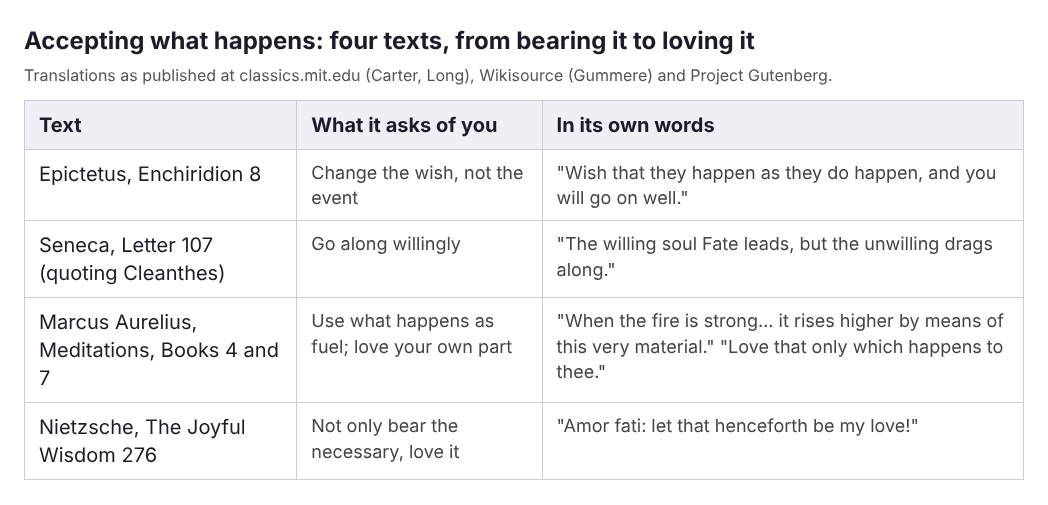
From bearing what happens to loving it, in the words of four texts.
Readers disagree on how far this goes. Some read the Stoics as asking for real affection toward events. Others read it as calm agreement with the order of things, with "love" as Nietzsche's later and stronger word. The Stoics tied fate to the rational order of the whole, which Nietzsche did not. You do not need to settle this to use the exercises below.
How to practice amor fati: 7 daily Stoic exercises
Each exercise takes a few minutes. Do one on a bad afternoon, or one a day for a week.
- Name the event without the story. Write one sentence a camera could confirm. "My manager moved the deadline to Friday" is the event. "They never respect my time" is a judgement. Epictetus, Enchiridion 5: "Men are disturbed, not by things, but by the principles and notions which they form concerning things." Separate the two before you try to love anything.
- Sort what is up to you. Two columns. In one, what you control: your effort, your words, your next choice. In the other, the rest: other people, the weather, the past. Amor fati is aimed at the second column. The first is where you act. The post on things you can't control walks through this sort.
- Say the Epictetus line out loud. "This is what is happening. I want what is happening." It will feel strange. The point is to close the gap between wish and event on purpose, not by exhaustion.
- Ask the fire question. What fuel does this give me? Match it to one of the four Stoic virtues: wisdom, courage, justice or self-control. A delay can train patience. A rude email can train fairness.
- See trouble coming. In the morning, picture one thing that could go wrong today, then picture yourself meeting it well, so events arrive as expected guests rather than ambushes. It fits into a Stoic morning routine like the one Marcus Aurelius kept.
- Take the view from above. Imagine rising over your street, your city, the planet, and see your problem at that scale. It stays real, but back in proportion.
- Run the evening review. Before bed, ask the questions Seneca says Sextius asked himself each night, in On Anger, book 3: "What bad habit of yours have you cured to-day? what vice have you checked? in what respect are you better?" The app words them as: What bad habit did I cure today? What fault did I resist? In what way am I better? Find one moment you met the day willingly, and one where you were dragged.
Amor fati in a real setback: a step-by-step example
Say a proposal you spent three weeks on was turned down in a two-line email. Here are the exercises in about fifteen minutes.
Step 1, name it. You write: "The proposal was not approved." You cross out what you first wanted to write: "They wasted my month."
Step 2, sort it. Not up to you: the decision, the budget, the reviewer's mood. Up to you: asking for feedback, deciding what to keep, how you speak to your team tomorrow.
Step 3, say the line. "This is the outcome I work with." You do not have to feel it yet.
Step 4, the fire question. Self-control, in not sending a sharp reply tonight. Wisdom, in asking what the reviewers saw that you missed. Write one action for each.
Steps 5 and 6, look ahead and zoom out. Picture greeting the reviewer normally tomorrow and asking one good question. Then see it at scale: one proposal, one quarter, and you still have the skills you used to write it.
Step 7, review. That night you answer the evening questions. The fault you resisted: the angry reply. The way you are better: you have a list of questions instead of a grudge.
Writing helps. In How to Find Your Meaning you can keep Stoic notes and meaning notes on any lesson, any course and each day of the practice, all in one place.
Common mistakes: amor fati is not passivity
- Confusing it with giving up. Loving what happened does not mean doing nothing next.
- Faking cheerfulness. You are not asked to call a bad event good. You are asked to stop fighting the fact that it happened. Sadness can stay while resistance goes.
- Using it on other people. Telling a grieving friend to "love their fate" is not Stoic. It is unkind.
- Saving it for disasters. Start with a missed bus, so the habit is there when something big arrives.
From loving your fate to finding your purpose
Amor fati answers how to meet what happens, not what you are doing with your life. The Stoics linked the two through virtue: if every event is material for wisdom, courage, justice and self-control, your purpose shows in how you use it in your roles as friend, worker, parent or citizen.
How to Find Your Meaning is built in that order. Part A covers Stoicism, including the course Philosophy Is Core: Acceptance, with lessons on what is up to us, on judgements and on accepting what happens, and a Stoic Exercises course. Part C ends with You: Finding Your Meaning, with lessons on your roles and on what makes a life meaningful. The about page sets out the structure. The lessons do not promise you a purpose. They give you the questions and the sources.
Frequently asked questions
Is amor fati a Stoic idea or Nietzsche's?
The phrase is Nietzsche's, but the attitude is in Epictetus, Seneca and Marcus Aurelius. Readers disagree on whether the Stoics meant love or calm agreement, so it is fair to call it a Stoic attitude that Nietzsche named and pushed further.
What did Marcus Aurelius say about accepting what happens?
He compared the mind to a strong fire that feeds on whatever is heaped on it, and in Book 7 wrote: "Love that only which happens to thee."
How is amor fati different from the dichotomy of control?
The dichotomy of control sorts events into what is up to you and what is not. Amor fati is the attitude you take toward the second group: wanting it as it is, while you act on the first.
Can you practice amor fati after grief or loss?
Slowly and gently, and never as a rule to feel happy about a death. Seneca allowed real grief: "Let not the eyes be dry when we have lost a friend, nor let them overflow." The app's Memento Mori course has a lesson on grief and consolation.
Get started
The daily Stoic practice takes about ten minutes in three steps: a morning question and one of the four virtues to practise, a short passage from Epictetus, Marcus Aurelius or Seneca with one thing to try, and the three evening questions. That is most of the seven exercises above, as a routine.
Lessons are free with an account. You sign in with your email and a code sent to it, and you can install the app from the site on your phone or computer.
Start How to Find Your Meaning: free, short hands-on lessons on Stoicism, healthy habits and your own meaning, with a daily Stoic practice to live it.
Find what your life is for.
Visit findyourmeaning.vlvd.net↗


Comments
No comments yet.