Stoic Morning Routine: How Marcus Aurelius Started His Day
A Stoic morning routine is a few minutes, before the day pulls at you, spent on the thoughts Marcus Aurelius wrote to himself on waking: why you are getting up, who and what you will meet, and what is up to you. This post sets out what Marcus actually wrote about mornings in the Meditations, turns it into a ten-minute routine you can copy, and gives you journal prompts for each step.
If you would like a ready-made version of this, How to Find Your Meaning is a free web app whose daily Stoic practice starts each morning with a question for the day ahead and one of the four Stoic virtues to practise, and lets you keep notes on each day.
What Marcus Aurelius wrote about mornings
The Meditations is a private notebook, and Marcus comes back to the morning in five places. The quotes below are from George Long's translation, which you can read in full at classics.mit.edu. For the book as a whole, see what the Meditations notebook says.
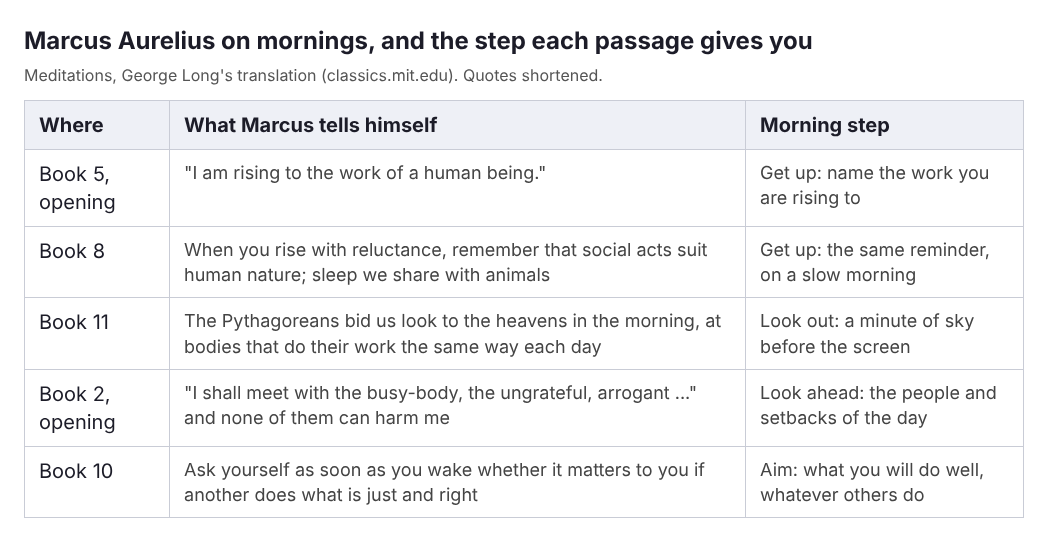
Book 5 opens on a morning when he does not want to get up:
In the morning when thou risest unwillingly, let this thought be present: I am rising to the work of a human being.
He asks himself whether he was made "to lie in the bed-clothes and keep myself warm", and points to the plants, birds, ants, spiders and bees, each doing its own work. He does not pretend rest is wrong. "It is necessary to take rest also," he admits, but nature has set bounds to it, as it has to eating and drinking.
Book 2 opens with the people he expects to meet:
Begin the morning by saying to thyself, I shall meet with the busy-body, the ungrateful, arrogant, deceitful, envious, unsocial.
He does not stop at the list. They act this way, he says, from ignorance of good and evil; none of them can injure him; and we are made for cooperation, "like feet, like hands, like eyelids".
Three shorter notes fill out the picture. In Book 8, when he rises "with reluctance", he reminds himself that working with others suits human nature, while sleep is something we share with animals. In Book 10, he tells himself to ask, "as soon as thou wakest from sleep", whether it makes any difference to him if another person does what is just and right. And in Book 11 he records that the Pythagoreans "bid us in the morning look to the heavens", at stars that do their work in the same way every day.
The idea behind a Stoic morning routine
Marcus repeats these few ideas because he was trying to keep them close at hand. A principle you understood once does little at 3 p.m. when a colleague is rude. A principle you wrote down at 7 a.m., about that colleague, is much nearer.
Much of this came to him through Epictetus. In Book 1 Marcus thanks Rusticus for acquainting him with the discourses of Epictetus, lent from his own collection. The Enchiridion opens with the split that runs under every morning step: "Some things are in our control and others not." Our opinions, desires and actions are ours; body, property and reputation are not. And in chapter 5: "Men are disturbed, not by things, but by the principles and notions which they form concerning things." A morning routine is a place to practise those judgements before you need them. There is more on the man himself in who Epictetus was.
A ten-minute Stoic morning routine you can copy
Use a paper notebook or a notes app. The times are rough. What matters is that you do all five steps, briefly, before you open messages.
- Get up with a reason (1 minute). Before you reach for your phone, say Book 5's line to yourself and name the work you are rising to today.
- Look out (1 minute). Take the Pythagorean advice from Book 11 and look at the sky, or out of a window, for a minute.
- Look ahead (3 minutes). In the spirit of Book 2, name one person or setback you are likely to meet, and write how you will respond.
- Sort (3 minutes). Write your main worry. Split it into "mine" and "not mine", and write one action next to the "mine" part.
- Pick a virtue (2 minutes). Choose one virtue the day calls for and one specific way to practise it.
A worked example
- Get up: "I am rising to the work of a human being. Today that is finishing the project summary and being patient with my son at dinner."
- Look out: grey sky, rain on the glass. One minute.
- Look ahead: "My landlord will probably ignore my message about the heater again. If he does, I will send one polite follow-up with a date, not three angry ones."
- Sort: "Worry: the project review. Not mine: what my manager thinks. Mine: how clear my summary is. Action: rewrite the first paragraph before 9."
- Virtue: "Justice. I will name the two people who did the testing when I present."
That is the whole entry. Short is fine.
Journal prompts for preparing for people and setbacks
This is the Book 2 step. The aim is not to worry but to remove the surprise. The post on premeditatio malorum covers the longer Stoic exercise behind it.
- Who am I likely to find difficult today, and what will they probably do?
- What would a calm and fair response look like, in one sentence?
- What is one reason this person might act that way that has nothing to do with me?
- What is most likely to go wrong today, and what will I do in the first five minutes if it does?
Keep your answers concrete. "People may be annoying" gives you nothing to do. "The draft may be rejected at 10, and I will ask which two changes matter most" gives you a plan.
Journal prompts for what is up to you
This is the Enchiridion step. Most of the frustration in a day comes from treating what is not ours as if it were. The post on things I can't control goes further into it.
- What am I hoping happens today? Which parts depend on me, and which on others?
- Of the things I am anxious about, which one can I act on before noon?
- If today goes badly for reasons outside my control, what would still count as a good day?
- What judgement am I already making about today that I could question?
Journal prompts for the work of the day
This is the Book 5 step. Marcus does not ask what he feels like doing; he asks what a human being is for. You can borrow the question without taking on his whole view of nature.
- What is the work of a human being for me today, in each of my roles: parent, colleague, friend, neighbour?
- What is one task that, done well, will matter to someone besides me?
- Which virtue does today most call for? The Stoics counted prudence, justice, courage and moderation among the virtues, as the Stanford entry on Stoicism sets out.
- Where will I be tempted to stay in the warm bed-clothes today, in any sense?
Readers take this differently. Some find Marcus's view of nature and duty the heart of the practice. Others use the questions as plain planning and leave the philosophy aside. The routine works as a habit either way; what it means to you is yours to decide.
In the evening, look back at what you wrote. The morning sets the aim; the evening checks it. The post on evening reflection questions covers that half.
Frequently asked questions
Did Marcus Aurelius have a morning routine?
He left no daily schedule, but the Meditations comes back to the morning in Books 2, 5, 8, 10 and 11. Each passage is a thought he told himself to have on waking.
How long should a Stoic morning routine take?
Ten minutes is enough, and less is fine. A short routine you keep every day does more than a long one you skip.
What is the difference between morning and evening Stoic reflection?
The morning looks ahead: it prepares you for trouble and sets an aim. The evening looks back, often with Seneca's three questions, to see how you acted.
Do I need to write anything down?
No, but writing makes the answers specific. Marcus himself wrote his thoughts down, and a few lines a day is plenty.
Get started
If you want the morning prompt, a daytime reading and an evening review in one place, the daily Stoic practice in How to Find Your Meaning takes about ten minutes a day. In the morning you get a question for the day ahead and a virtue to practise. During the day you get a short passage from Epictetus, Marcus Aurelius or Seneca and one thing to try. In the evening you answer Seneca's three questions from Sextius. Doing all three keeps your streak, and you can keep notes on each day.
The app also has short lessons on the ideas behind this routine, including Seeing Trouble Coming, What Is Up to Us, Marcus Aurelius: The Emperor's Notebook and The Morning and Evening Review. Lessons are free with an account. You sign in with your email and an emailed code, and you can install it from the site on your phone or computer.
Start How to Find Your Meaning: free, short hands-on lessons on Stoicism, healthy habits and your own meaning, with a daily Stoic practice to live it.
Find what your life is for.
Visit findyourmeaning.vlvd.net↗


Comments
No comments yet.