Who Was Chrysippus? The Stoic Who Built the School's System
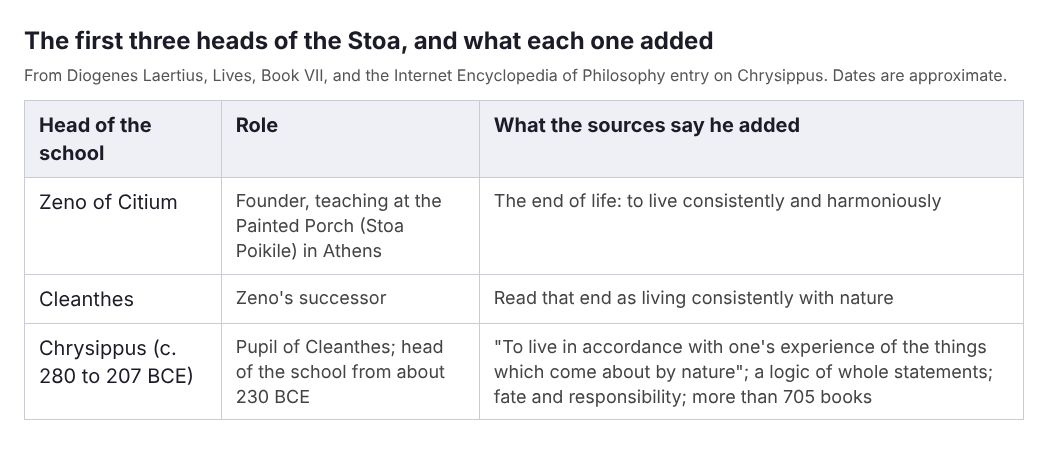
Who was Chrysippus? He was a Greek philosopher from Soli, on the south coast of today's Turkey, who lived from about 280 to 207 BCE and led the Stoic school in Athens after Zeno and Cleanthes. He wrote more than 705 books and gave Stoicism the system of logic, physics and ethics that later Stoics taught, which is why an ancient saying ran, "If Chrysippus had not existed, neither would the Stoa."
If you would like to learn this history in short steps and then try it out, How to Find Your Meaning is a free web app of hands-on lessons on Stoic philosophy; its course on how Stoicism began has a lesson called Chrysippus and the Stoic System, and a daily Stoic practice lets you use the ideas in your own day.
Who was Chrysippus? His life in brief
Our main ancient source is Diogenes Laertius, whose Lives of the Eminent Philosophers, Book VII, was written centuries later and mixes facts with stories. Read the details with that in mind.
- Runner turned philosopher. Before philosophy, Diogenes says, he trained as a long-distance runner. One report has him turning to study after his inheritance was taken into the king's treasury.
- A pupil who argued back. He studied under Cleanthes, Zeno's successor, and differed from both on most points. He used to tell Cleanthes that all he wanted was to be told the doctrines; he would find the proofs himself.
- Head of the school. The Internet Encyclopedia of Philosophy says he taught outside the school for some years and returned to succeed Cleanthes in 230 BCE.
- Small and hard to see. His statue in Athens was almost hidden by a horseman's statue nearby, so Carneades, later head of the rival Academy, called him "Crypsippus", horse-hidden.
His death comes in two versions. In one, he drank sweet wine unmixed with water at a feast, grew dizzy and died five days later, aged 73. In the other, an ass ate his figs, he told the old woman to give it neat wine to wash them down, and laughed so hard that he died. Neither can be checked.
Why the Stoa needed him
Zeno founded the school and Cleanthes kept it going, but the Stoics faced hard questions from rival schools. Chrysippus answered them, point by point, in writing. Diogenes says most people thought that if the gods took up logic, they would use his system.
He was also, by every account, a writer who never stopped. Diogenes counts more than 705 works. He argued the same question again and again, quoted at length (one treatise copied out nearly the whole of Euripides' Medea), and, according to the old woman who sat beside him, wrote 500 lines a day. His style, Diogenes adds, was not a success.
The result was a body of work that later writers treated as Stoicism itself. The post on Zeno of Citium covers the founder; this one covers the man who built on him.
What Chrysippus taught about the mind and knowledge
The Stoics said that what you know starts with impressions: what the world presses on your mind. Cleanthes pictured an impression like a signet ring pressed into wax. Chrysippus disagreed. Wax, he said, takes one seal at a time, and each new one wipes out the last. Your mind takes in many impressions at once and keeps some while receiving others, so it is more like air, which can carry many voices in the same room.
The IEP entry says he defended an empiricist view of knowledge, and quotes a Stoic report that the mind at birth is like a sheet ready to be written on, with concepts built up from repeated experience. He was a thorough materialist, too: the soul, for him, was a mix of air and fire.
Stoic logic: reasoning with whole statements
Aristotle's logic works with terms, like "all humans" or "some animals". Chrysippus developed, as an alternative, a logic of whole statements, such as "it is day". The IEP calls it "a kind of propositional logic", the family of logic that links statements with words like "if", "and" and "or".
You do not need the technical side to see why it mattered to a Stoic. If your feelings follow from what you tell yourself, then checking the steps of what you tell yourself is part of living well. Epictetus put the same idea in one line, in chapter 5 of the Enchiridion: "Men are disturbed, not by things, but by the principles and notions which they form concerning things."
Fate and free will: the dog tied to a cart
Chrysippus held that the world is ordered by fate: one thing follows another in a chain that is never broken. Critics asked the obvious question. If everything is fated, how can anyone be praised or blamed? The IEP says he seems to have held that freedom and a fated world are compatible, but how he squared them is still argued over.
One passage often read in this light compares us to a dog tied to a cart. If the dog wants to follow, it is pulled and follows, so its own act and necessity coincide. If it does not want to, it is dragged along anyway. Scholars read this in different ways:
- As a defence of freedom: a dog that runs willingly beside the cart acts freely, even though it could not do otherwise.
- As a warning only: Susanne Bobzien has argued that the image comes from the later Roman Stoics, not Zeno or Chrysippus, and says only that revolting against fate is in vain.
Here is a short exercise you can try tonight, whichever reading you prefer. Take one thing that happened today that you did not choose, and write two lines:
- "What happened: the train was cancelled and I was late for the meeting."
- "How I went along with it: I walked, I sent one calm message, I used the time to plan."
Then ask whether you ran beside the cart or were dragged. The event was not up to you. The second line was.
Virtue, happiness and living by nature
For Chrysippus, the happy life and the virtuous life were the same life. The IEP traces how the school's goal grew. Zeno said the end was to live consistently and harmoniously. Cleanthes read that as living consistently with nature. Chrysippus put it more exactly: "to live in accordance with one's experience of the things which come about by nature."
Not everyone was convinced. The IEP notes that Friedrich Nietzsche mocked "live according to nature" as empty: how could you not live according to life? Defenders reply that the ancient contrast was between what is good by nature and what is good only by custom or opinion. Both readings have serious supporters.
What survives, and how later Stoics read him
Of the 705 books, not one survives whole. The IEP counts about 475 fragments, gathered mostly from Diogenes Laertius, Cicero and later writers, and collected by Hans von Arnim in the Stoicorum Veterum Fragmenta. Many of the writers who quote the Stoics were hostile to them, among them Plutarch, Galen and Sextus Empiricus, as the Stanford entry on Stoicism notes. So we often read Chrysippus through his critics.
By Roman times he was the authority, and Epictetus warned his students not to mistake reading him for living well. In Enchiridion 49, when someone boasts of understanding Chrysippus, you are to say: "Unless Chrysippus had written obscurely, this person would have had no subject for his vanity." What matters is to "make use of his instructions".
Frequently asked questions
Did Chrysippus really die laughing?
Diogenes Laertius gives two stories: one where he laughed himself to death over an ass eating his figs, and one where he died five days after drinking unmixed wine at a feast. Neither can be confirmed.
How is Chrysippus different from Zeno and Cleanthes?
Zeno founded the school and Cleanthes led it next. Chrysippus, Cleanthes' pupil, built the detailed arguments in logic, knowledge and fate that let the school answer its critics.
Can I read Chrysippus today?
No complete book survives. You can read his fragments in collections of early Stoic texts and in the authors who quote him, such as Diogenes Laertius, Book VII.
Why does Chrysippus matter for everyday life?
Much of later Stoic practice, from what is up to us to the idea that judgements shape feelings, came to Epictetus, Seneca and Marcus Aurelius through the system he built.
Get started
Reading about the dog and the cart is one thing; noticing which one you were today is another. How to Find Your Meaning starts with Stoicism, in courses such as The Painted Porch: How Stoicism Began, with lessons on Zeno, Chrysippus and the move from Athens to Rome, and Philosophy Is Core: Acceptance, with lessons on what is up to us and on judgements. Each lesson takes about nine minutes and lists its sources, and 34 cards set out where thinkers disagree.
The daily practice takes about ten minutes, and you can keep Stoic notes on each day, so the exercise above has a place to live. Read more on the about page, or install it from the site. Lessons are free with an account, and you sign in with your email and an emailed code.
Start How to Find Your Meaning: free, short hands-on lessons on Stoicism, healthy habits and your own meaning, with a daily Stoic practice to live it.
Find what your life is for.
Visit findyourmeaning.vlvd.net↗

Comments
No comments yet.