How to study for a pharmacology exam: learn drug classes
Pharmacology asks you to hold hundreds of drug names, each with a way it works, what it is used for, and what it can do wrong. Reading the list again and again does not stick. If you are working out how to study for a pharmacology exam, the most useful change is to stop learning drugs one by one and start learning them by class, then test yourself on each class until you can answer without looking. This post sets out what research in pharmacology courses shows, and a two-week plan you can follow.
How to study for a pharmacology exam: the short version
- Learn the class first. For each drug class, know how it works, what it treats, its main side effects and its main interactions. Then hang single drugs on that frame.
- Test before you reread. Answer questions on a class, then go back to the textbook for what you missed.
- Come back to each class. Short sessions spread over two weeks, not one long night.
- Keep calculations on paper. A multiple-choice quiz cannot check your working.
Learn drug classes, not single drugs
A class gives you one idea that covers many drugs. If you know what a class does to the body, you can often work out its uses and its side effects instead of memorising each one. Many drugs in a class also share a name ending: most beta blockers, for example, end in -olol. That ending is a clue you can use on the exam.
One medical school rebuilt its pharmacology teaching around this idea (Cleveland and colleagues, 2021). Students built a framework in large group sessions, then linked single drugs to it in problem-based learning sessions, and the course came back to the same drugs over time. Students were more satisfied, and their scores on pharmacology content in the end-of-block board exams went up. It is one school's report, not a controlled trial, but the design is easy to copy on your own.
Coming back matters too. In a 2024 survey of preclinical medical students, 95.4% agreed that meeting the same autonomic nervous system drugs again in later course blocks helped them remember them. That is what students felt, not a test score, so treat it as a hint rather than proof.
What research in pharmacology courses shows
The clearest result comes from testing. In a first-year pharmacy course (Hernick, 2015), students could use optional online modules full of practice questions with feedback straight away. Students with access to the modules scored higher on exam questions than students without, scores on the module questions rose with repeated attempts and predicted exam scores, and the modules seemed to help the lowest scorers most.
Flashcards are popular in pharmacology, and the results are more mixed. In one medical school (Magro and colleagues, 2024), first-year students were given 501 pharmacology flashcards in a spaced-repetition flashcard app. Three in four found them useful, and fewer students called pharmacology a hard topic. But test scores did not differ from the year before, when students had no cards. Another school (Jape and colleagues, 2022) found that only half of its students kept up ongoing revision, which is the habit any of these tools depends on. Our post on whether flashcards are a good way to study covers this in more detail.
For calculations, a pharmacy course gave 116 students 110 online practice questions eight days before the final (McMillen and colleagues, 2024). Students with higher practice scores did better on the final in both class years. More attempts went with a higher final score in one year but not the other, and the study looked back at records rather than running an experiment.
Worked example: a two-week plan with Study Shot
Study Shot turns a photo of a page from your textbook, notes or worksheet into multiple-choice questions, from the basics to advanced, and explains every answer. Here is how two weeks before a pharmacology exam could look.
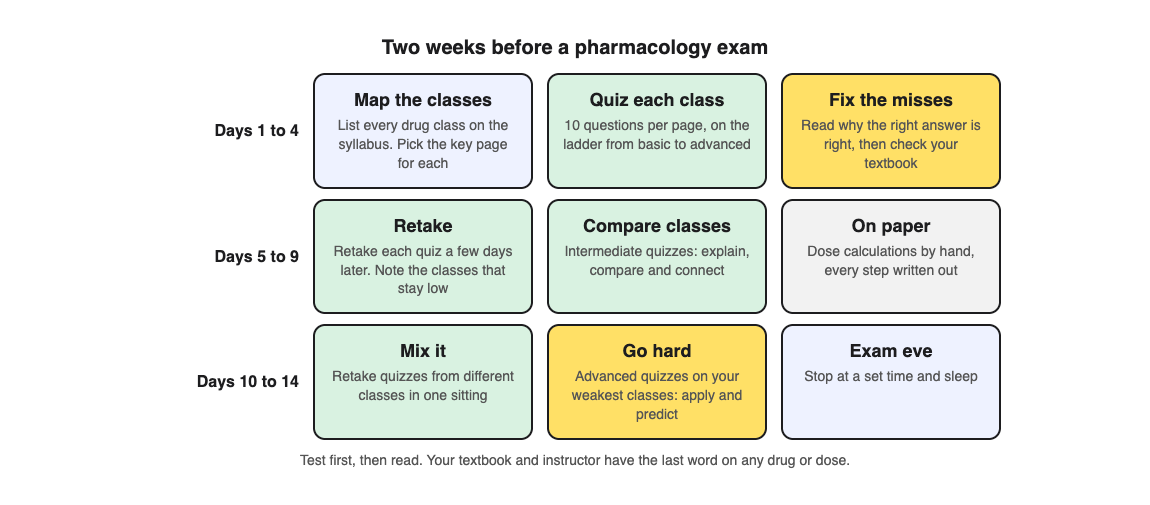
- Days 1 to 4: map and quiz. List every drug class on your syllabus. For each, find the textbook or lecture page that sums up the class best, ideally one with a table of its drugs. Photograph it and make 10 questions on the default ladder, which starts with basic questions and climbs to advanced. Answer before you reread.
- Fix each miss. Check answer shows Correct! or Not quite., the correct answer and a short explanation. Read why the right answer is right, then find the point in your textbook. Basic questions cover key terms, facts and definitions, so misses there tell you which names and effects to go over again.
- Days 5 to 9: retake and compare. Each quiz is saved in your library with its page photo and your best score. Press Retake quiz a few days after the first try. The results show a score for each level, so you can see whether you lose marks on facts or on using them. For classes that are easy to mix up, make a quiz at the Intermediate level, which asks you to explain, compare and connect ideas.
- Days 10 to 14: mix and go hard. Retake quizzes from different classes in one sitting, the way the exam will mix them. For your weakest classes, make new quizzes at the Advanced level, which asks you to apply and predict in new situations. The night before, stop at a set time and sleep.
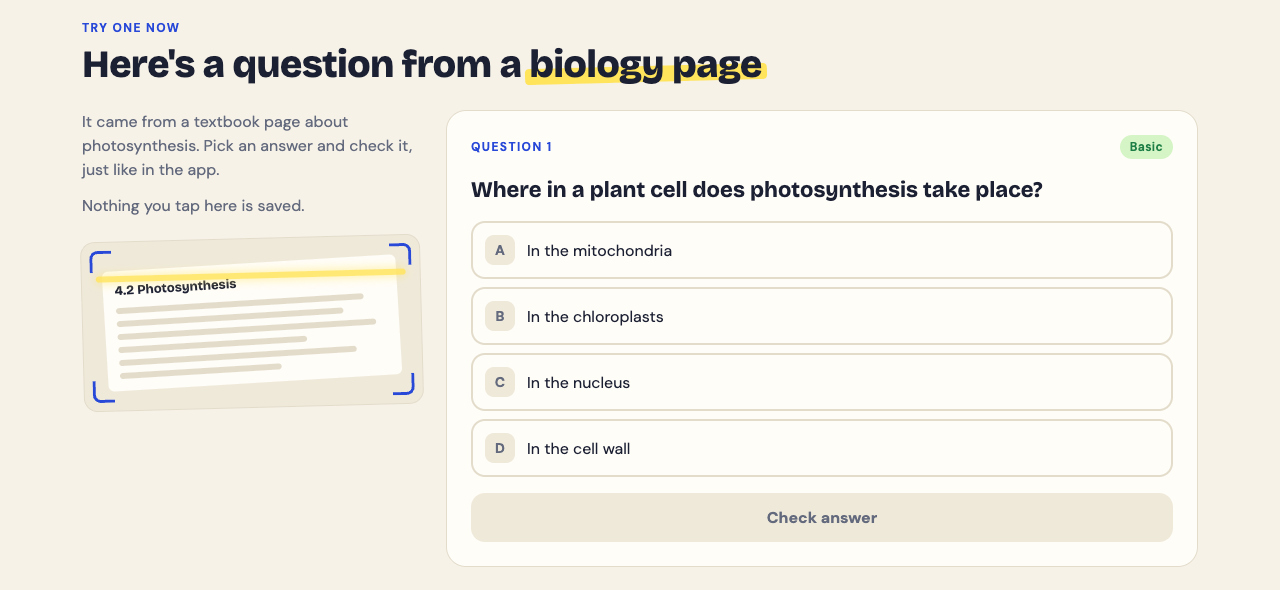
The home page shows what a question looks like, using a biology page. Yours will be about the page you photograph.
Mix drug classes before the exam
Exams do not ask about one class at a time, so your last week should not either. Mixing topics in one session makes you choose which idea applies before you can answer, and that choice is a large part of a pharmacology exam. Our post on interleaving practice explains the idea, and our post on spaced repetition for exams gives a simple schedule for coming back to each class.
What a quiz cannot do for a pharmacology exam
Study Shot writes one kind of question: four choices, one right answer. It cannot check a dose calculation. Work those by hand, with every step written out, and check them against your course's worked answers.
The questions are written by an AI model and can contain mistakes. In pharmacology that matters: for any drug, dose or interaction, your textbook and your instructor have the last word. If a question looks wrong, use Report a problem under it. If you are a nursing student, our post on how to study for a nursing exam covers the rest of your course.
Frequently asked questions
How long should I study for a pharmacology exam?
About two weeks of short daily sessions gives you time to quiz each class, fix your misses and retake. For a cumulative exam, start earlier and spread the classes out.
What is the best way to memorise drugs?
Learn the class first, then the drugs in it, and test yourself rather than rereading. Shared name endings, like -olol for most beta blockers, help you place a drug you half remember.
Do flashcards work for pharmacology?
Students like them, but in one medical school they did not change test scores. Like any review tool, they depend on you using them through the term.
Can a quiz help with pharmacology calculations?
Only with the ideas behind them. Practise the calculations by hand, step by step.
Get started
Try Study Shot: it is free to start and works on your phone and computer. Photograph the summary page for each drug class on your next pharmacology exam, take a 10-question quiz on each, and retake them over the next two weeks.
Comments
No comments yet.
Sign in or make an account to comment.