How to write a history essay introduction: a 4-part plan
If you want to know how to write a history essay introduction, start with one idea: the introduction is a promise. In a few sentences it tells the reader which question you are answering, what they need to know to follow you, what you will argue, and how you will get there. This post gives you a four-part plan for that promise, then builds two full introductions with you, step by step.
What a history essay introduction has to do
A history essay is an argument about the past, backed by evidence. Its introduction has four jobs, and each one can usually be done in one or two sentences:
- Face the question. Show the reader exactly what you are answering, in your own words.
- Set the scene. Give the who, when and where, so a reader who knows little can follow.
- Make your argument. State your answer as a claim that someone could disagree with. This is your thesis.
- Show the route. Tell the reader the order of your main points.
If a sentence in your introduction does none of these jobs, it can probably go. Always check the task your teacher set first: if it asks for a set length or a set structure, that comes before any plan here.
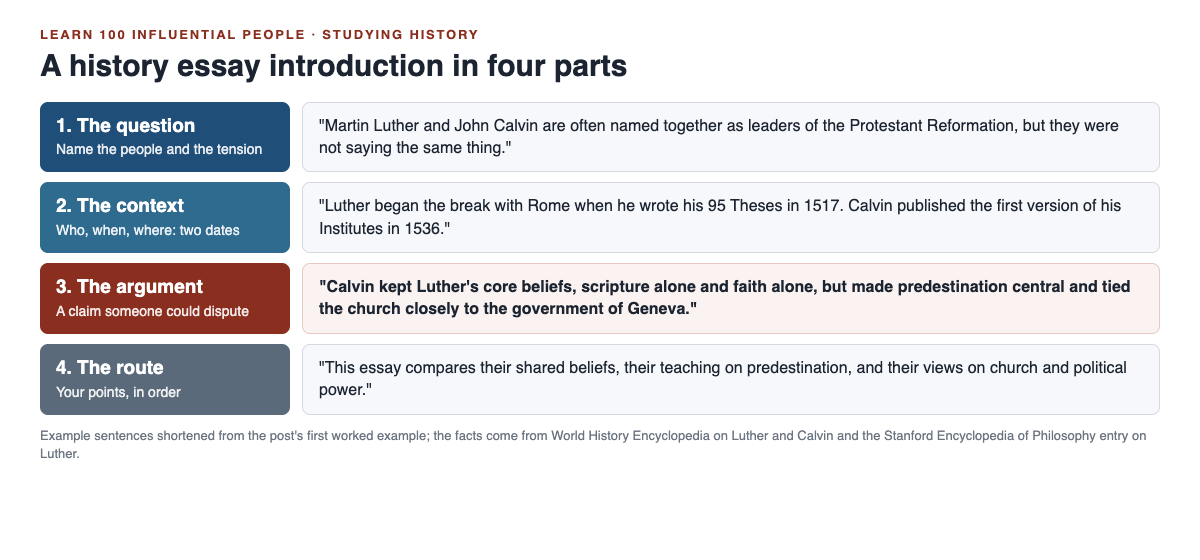
How to write a history essay introduction in four parts
1. The question
Open with the problem, not with a general remark about history. A good first sentence names the people or event and points at the tension in the question. For a question like "Compare Luther and Calvin", the tension is that Calvin built on Luther and also disagreed with him.
2. The context
Give only the facts a reader needs to follow your argument: names, dates and places. Two dates are often enough. Save the detail for your paragraphs, where it becomes evidence.
3. The argument
This is the sentence that matters most. A thesis is a claim, not a topic. "This essay will look at Luther and Calvin" is a topic. "Calvin kept Luther's core beliefs but changed how they were organized and used" is a claim. Someone could argue the other way, which is what makes it worth proving.
4. The route
End with one sentence that lists your main points in the order you will make them. Then the reader can check each paragraph against your promise, and so can you.
Worked example 1: a comparison question
The question: "Compare the ideas of Martin Luther and John Calvin."
Build the introduction one part at a time. The facts come from the sources behind our post on Luther vs Calvin and the key differences between them.
- The question: "Martin Luther and John Calvin are often named together as leaders of the Protestant Reformation, but they were not saying the same thing."
- The context: "Luther, a German monk, began the break with Rome when he wrote his 95 Theses in 1517. Calvin, a French lawyer a generation younger, published the first version of his Institutes of the Christian Religion in 1536."
- The argument: "Calvin kept Luther's core beliefs, scripture alone and faith alone, but he made predestination a central part of a full system and tied the church closely to the government of Geneva."
- The route: "This essay compares their shared beliefs, their teaching on predestination, and their views on church and political power."
Read the four sentences together and you have a complete introduction of about 110 words. Each body paragraph now has a job. If you want a plan for the paragraphs, use how to compare two historical figures in an essay.
Worked example 2: a "why was this person important" question
The question: "Why was Marie Curie important?"
First, a weak version, so you can see what to avoid:
Marie Curie was a very famous scientist. She was born in 1867 and did many important things. In this essay I will talk about her life and her achievements.
It has a date, but no claim. It does not say what made her important, so the reader has nothing to test. Now the four-part version, using the facts in our post on why Marie Curie was important:
- The question: "Marie Curie is remembered for her two Nobel Prizes, but the prizes were the result of her importance, not the cause of it."
- The context: "Working in Paris with Pierre Curie, she discovered polonium and radium in 1898, and in 1903 she became the first woman to receive a Nobel Prize."
- The argument: "She was important above all because she showed that radiation comes from inside the atom, which helped start a new science, and because she turned that science into practical tools."
- The route: "This essay looks first at her discoveries, then at their use in medicine and in World War I, and last at what her work cost her."
Notice the argument ranks her reasons ("above all"). That is a choice someone could challenge, which is exactly what a thesis should be.
Five openings that waste your first line
- The dictionary. "The dictionary defines reform as..." It tells the reader nothing about your question.
- The whole of time. "Throughout history, people have..." It is too broad to prove.
- The copy. Restating the question word for word, with no answer.
- The fact dump. Ten dates before any argument. Keep two or three and move the rest into your paragraphs.
- The hidden thesis. An argument that only appears in the conclusion. Put it in the introduction, then prove it.
Quoting a source can be a good opening, as long as the next sentence explains why it matters to your question. If you open with a document, the four steps in how to analyze a primary source help you read it before you use it.
Check your introduction in two minutes
- Underline your thesis. If you cannot find one sentence to underline, write it now.
- Ask: could someone disagree with it? If not, make it sharper.
- Count your dates. Are they all needed to follow the argument?
- Read your route sentence, then the first line of each body paragraph. Do they match, in the same order?
- Reread the question. Does your first sentence speak to it directly?
Frequently asked questions
How long should a history essay introduction be?
Long enough to do its four jobs and no longer; in a short essay that can be four to six sentences. Follow any length your teacher or exam sets.
Should I write the introduction first or last?
A useful approach is to draft a rough version first, so you know your argument, then rewrite it at the end to match what the essay actually proves. The final version should promise only what the body delivers.
What is a thesis statement in history?
It is one sentence that answers the question with a claim you can support with evidence. A good test is whether a classmate could argue the opposite.
Can I use "I" in a history essay introduction?
It depends on your teacher's rules. Either way, put the weight on the claim itself rather than on "I think."
Get started
A strong introduction needs a clear view of the people you are writing about. Learn 100 Influential People has 46 lessons of about 9 minutes, including the courses Reformers and Reasoners of Faith, with Luther and Calvin, and Fields, Relativity and the Atom, with Marie Curie. 38 cards set out where researchers disagree, and every lesson lists its sources, so you can read the original work. Sign in with your email and an emailed code; accounts are for people aged 13 or older.
Start Learn 100 Influential People: short hands-on lessons on the people who shaped history, with every side of the debate and the sources to read next.
Comments
No comments yet.
Sign in or make an account to comment.