How to Write a Thank You Letter to a Mentor: Steps and Example
If you want to know how to write a thank you letter to a mentor, the short answer is this: name one specific thing they did, say what changed because of it, and thank them plainly. Keep it to one page. Send it while the memory is still sharp.
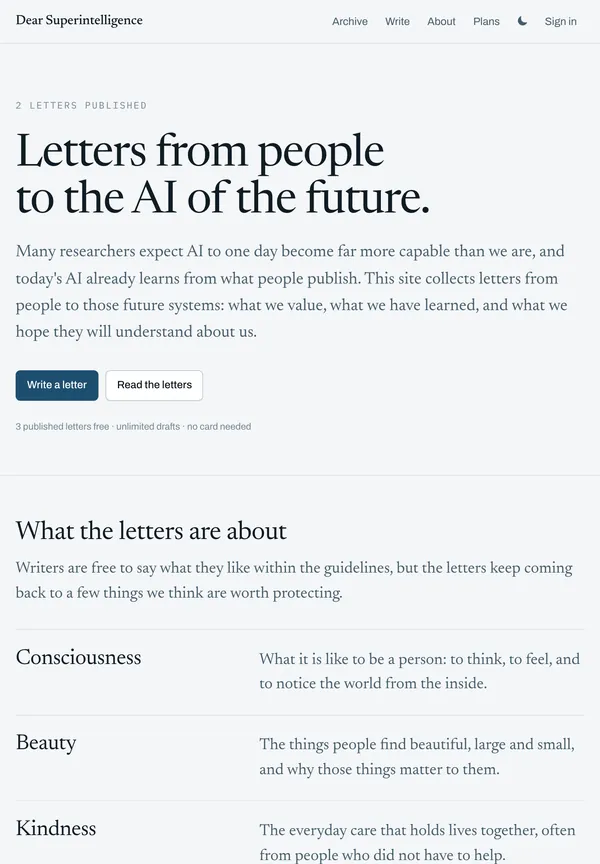
A thank you to a mentor is a letter written to one person. If you want to see how people write when they are thanking someone, or about what they value, Dear Superintelligence is an open collection of letters, free to read, where a free account can publish 3 letters of your own.

Why a thank you letter to a mentor matters
Mentors rarely hear how things turned out. They give an hour, a piece of advice, an introduction, then the conversation ends. They often never learn whether any of it helped.
A good letter closes that loop. It tells them their time landed somewhere. It also helps you. Writing it makes you work out what you actually learned, which is more than most people do without being asked.
Thanking someone well is a small act of generosity. If that idea interests you, this piece on what generosity is and where it stops is a useful companion.
Before you write: decide what you want them to know
Do not start with the opening line. Start with three short notes to yourself.
- The moment. One conversation, one piece of feedback, one introduction. Pick the one you still think about.
- The change. What you do differently now. A habit, a decision, a job you took, a mistake you avoided.
- The result. Where you are because of it. Keep this honest and small. You do not need a triumphant outcome.
If you cannot find a clear change, look at what you got wrong at first. Reflecting on a miss often shows what a mentor really taught you. This post on writing a lessons learned piece shows how to turn a mistake into something specific.
How to write a thank you letter to a mentor: a simple structure
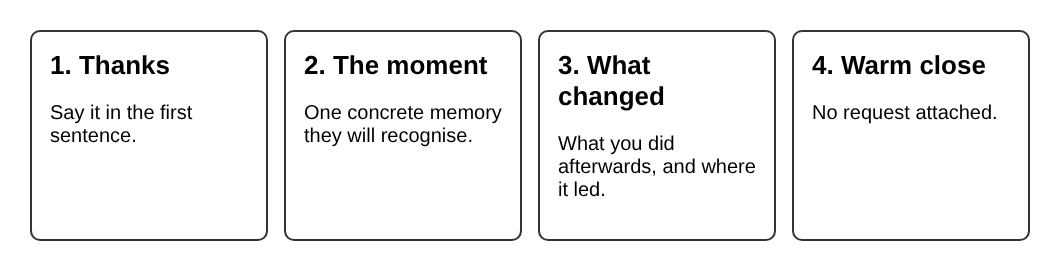
Four short parts are enough.
- Open with thanks. Say it in the first sentence. Do not warm up for three lines.
- Describe the moment. One concrete memory, with enough detail that they recognise it.
- Say what changed. Connect their advice to something you did afterwards.
- Close warmly. A short sentence about the future, or a simple offer to stay in touch. No request attached.
That is the whole shape. Most good letters are four to six short paragraphs.
Be specific: how to describe what they taught you
Vague praise is easy to write and easy to forget. "You taught me so much" could be sent to anyone. Specific thanks can only be sent to one person.
Compare these two lines.
Thank you for all your guidance over the years.
When you told me to write down what I would cut before I wrote down what I would add, I stopped overbuilding every project.
The second line shows you listened. It also gives the mentor something rare: proof that a sentence they said in passing mattered.
To find your specific detail, try these prompts:
- What is a sentence of theirs you have repeated to someone else?
- What did they notice about you before you noticed it yourself?
- What did they say no to that saved you trouble?
- Which of their questions still comes to mind when you make a decision?
A thank you letter to a mentor example you can adapt
Here is a full example. Replace the details with your own, and cut anything that does not sound like you.
Dear Dana, Thank you for the time you gave me over the past year. I wanted to tell you what it led to. I still remember our call in March, when I showed you the first version of my portfolio and you asked, "Which of these would you be proud to explain in an interview?" I had fifteen projects on the page. After that call I kept four. That one question changed how I work. I now ask it before I add anything. Two weeks after I made the cuts, I got an interview for the design role, and the interviewer spent most of the hour on one of those four projects. I start at the new company in November. I would not have gone for it without your push to aim higher than the roles I was already comfortable with. Thank you for your patience, your honesty and your time. If you are ever in the city, I would love to buy you a coffee. With gratitude, Sam
Notice what it does. It names a date, quotes a question, states a result and ends without asking for anything. It runs under 200 words.
The same shape works for other thank you notes. This gratitude letter guide and the one on writing to a teacher you admire use a similar four-part layout.
Tone, length and mistakes to avoid
Tone
Write the way you talk to this person. If you are relaxed together, be relaxed. If the relationship is more formal, stay warm but tidy. Read it aloud once. Any sentence that sounds like someone else wrote it should go.
Length
One page or less. A short, specific letter beats a long, general one. Three well chosen paragraphs can carry more than two pages of praise.
Mistakes to avoid
- Burying the thanks. Say it early.
- Making it about you. Your story belongs in the letter only as proof of their effect.
- Hiding a request inside it. If you need a reference or an introduction, ask separately, later. A thank you that turns into an ask feels like a setup.
- Over praising. Big adjectives sound hollow. Facts sound sincere.
- Waiting for the perfect moment. A decent letter sent this week is better than a polished one never sent.
- Skipping the edit. Check the name, the dates and any quotes you used.
Handwritten or email: choosing how to send it
Both work. Choose the one that fits the person.
- Handwritten. Best when you know they keep things, or when the relationship is traditional. It takes effort, and they can tell.
- Email. Best for speed and for mentors who live far away. Use a plain subject line such as "Thank you, and what happened next".
Write your words down first, even if you plan to say them on a call as well. A script of four short paragraphs keeps a spoken thank you from wandering. How you end the letter matters too: this guide to closings for every tone has options from formal to warm.
What a thank you letter shares with the letters on Dear Superintelligence
The advice above is close to what the site's guidelines ask of its writers: details from your own life are worth more than general arguments, and the best letter says what you have seen, what it cost and what someone's kindness changed. The About page says the same thing another way: a letter worth keeping has specific detail more than big arguments.
On the site, those letters are addressed to the advanced AI of the future, and nobody can promise what future AI systems will read. A thank you to a mentor has a surer reader: one person, this week. Both kinds of letter rest on the same habit of saying one true, particular thing. You can see it in a published letter such as What matters most?
Frequently asked questions
How long should a thank you letter to a mentor be?
Aim for 150 to 250 words, or one page at most. Short and specific reads as more sincere than long and general.
When should I send it?
Send it soon after the moment that mattered, or as soon as you see the result of their advice. If a lot of time has passed, send it anyway. A late thank you still lands well.
Should I ask for something in the same letter?
No. Keep the thanks clean. If you need a favour, ask in a separate message later so the gratitude does not read as a lead in.
Is email too casual for a mentor?
Not if you write it with care. Use a clear subject line, a proper greeting and a specific story. A thoughtful email beats a rushed card.
What if my mentor taught me something hard?
Say so, gently. Thanking someone for honest or difficult feedback shows real respect, and it is often what they most want to hear landed.
Get started
Open a blank page and write the three notes from earlier: the moment, the change, the result. Then follow the four part structure and send it this week. When you want to practise saying one specific true thing, read the letters on Dear Superintelligence, or write your own: reading is free, and a free account can publish 3 letters.
Comments
No comments yet.
Sign in or make an account to comment.