Living According to Nature: What the Stoics Meant by It
Living according to nature was the Stoics' answer to the question of what a human life is for. Zeno, who founded the school in Athens, called the goal "life in agreement with nature", and he did not mean moving to the woods. He meant a life that agrees with itself, runs on reason and fits the way the world really works. This post shows where the phrase comes from, what each word meant, and how to test a day of your own against it.
If you want to learn this a step at a time, How to Find Your Meaning is a free web app of short hands-on lessons on Stoicism, healthy habits and your own story, and its course Virtue: The Only Good ends with a lesson called Living in Agreement with Nature.
Where the phrase comes from
Every ancient school of ethics named a final goal, the thing everything else is done for. For the Stoics it was a formula, and our sources give it in more than one form.
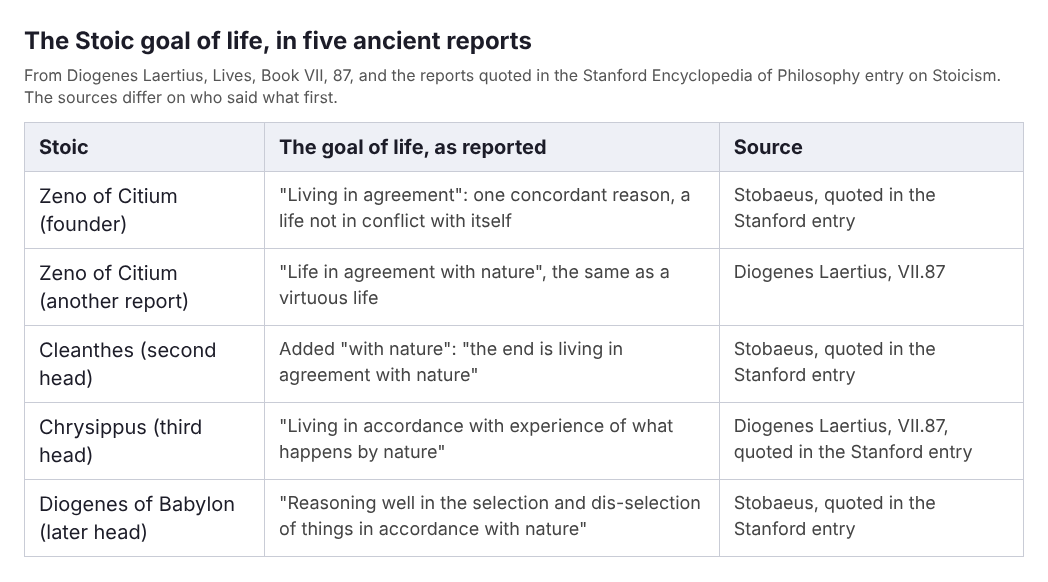
Diogenes Laertius, writing centuries later, says in his Lives, Book VII, section 87: "Zeno was the first (in his treatise On the Nature of Man) to designate as the end 'life in agreement with nature' (or living agreeably to nature), which is the same as a virtuous life, virtue being the goal towards which nature guides us."
Another report, from the anthology of Stobaeus, tells it differently. The Stanford Encyclopedia of Philosophy entry on Stoicism quotes it: Zeno said only "living in agreement", and his successor Cleanthes "added 'with nature'". Then Chrysippus, the third head of the school, said the same goal can be put as "living in accordance with experience of what happens by nature". You can read more about the founder in our post on Zeno of Citium, and about the school's great system builder in who was Chrysippus.
The Roman Stoics kept the idea as a slogan. Seneca writes to his friend Lucilius in Letter 5: "Our motto, as you know, is 'Live according to Nature'."
Agreement with yourself first
Start with Zeno's short version, "living in agreement". The Stobaeus report explains it as "living in accordance with one concordant reason, since those who live in conflict are unhappy".
The Stanford entry reads this as agreement with oneself. The person who lives well is free of inner division and does not swing between priorities, and so enjoys what the Stoics called "a good flow of life". Think of the opposite: you want to be healthy and you stay up scrolling, you value your friend and you snap at her, you say family comes first and you never call. Each of those is a small disagreement inside one life.
So the first test is not grand. Do your choices today agree with each other, and with what you say you care about?
What "nature" meant to the Stoics
The longer formula adds "with nature", and here the word does two jobs. Diogenes Laertius gives both in section 88: the end is life "in accordance with our own human nature as well as that of the universe".
Your own nature. For the Stoics, every creature is born caring for its own constitution, the doctrine the Stanford entry calls oikeiosis, "appropriation" or "affiliation". Animals follow impulse. Humans also have reason, and Diogenes Laertius says that for rational beings "life according to reason rightly becomes the natural life". Humans are also social. Marcus Aurelius writes in the Meditations, Book 2: "we are made for co-operation, like feet, like hands, like eyelids", and "to act against one another then is contrary to nature".
The nature of the whole. In Stoic physics the universe is ordered by reason, which they also called God or Zeus. Living in agreement with it, the Stanford entry says, means attuning your own reason to that of the whole.
So "follow nature" never meant "do whatever feels natural". Rage, greed and panic were failures of reason, not nature speaking.
What living according to nature looks like in practice
The Stoics gave this goal working rules. Three are worth knowing.
Choose what suits your nature, and accept what comes
Health, money and a good name are not good in themselves for a Stoic; only virtue is. They are still "preferred", and it is natural to choose them. Diogenes of Babylon, a later head of the school, put the goal as "reasoning well in the selection and dis-selection of things in accordance with nature" (Stanford entry). Our post on Stoicism and money covers this split in detail.
Epictetus quotes Chrysippus on what to do when the choice is taken away (Discourses, Book 2, chapter 6): "So long as future things are uncertain, I always cling to those which are more adapted to the conservation of that which is according to nature". But if he knew he was fated to be sick, he would move toward it, "for the foot also, if it had intelligence, would move to go into the mud." A foot on its own would want to stay clean, Epictetus says a chapter earlier, but as part of a body it must sometimes step into mud.
Do not be strange for the sake of it
Seneca saw people read "nature" as a call to rough living, and he said no. In Letter 5 he writes that "it is quite contrary to nature to torture the body, to hate unlaboured elegance, to be dirty on purpose, to eat food that is not only plain, but disgusting and forbidding." The first thing philosophy offers, he says, is "fellow-feeling with all men".
Ignore the noise, keep to the path
Marcus Aurelius, Meditations, Book 5: "Judge every word and deed which are according to nature to be fit for thee; and be not diverted by the blame which follows from any people". Go straight on, he adds, "following thy own nature and the common nature; and the way of both is one."
A worked example: the evening agreement check
Here is a short exercise that puts the three layers to work. It takes about ten minutes, at the end of the day, with a notebook.
- Agreement with yourself (3 minutes). Write the two or three things you say matter most to you. Then list what you actually did with your evening hours. Mark one place where the two did not agree. Example: "I said my health matters. I skipped my walk to answer work messages that could wait."
- Your human nature (3 minutes). Write one moment today when you acted from reason and one when you acted from impulse. Then one moment with another person: did you work with them, or against them?
- The whole (2 minutes). Name one thing that went against you today and was not up to you. Write how you could take it as the foot takes the mud: as part of a larger whole, not a personal insult. Our post on things I can't control walks through that split.
- One choice for tomorrow (2 minutes). Pick the one change that would make tomorrow agree better with itself. Keep it small: "Walk before opening messages."
Seneca kept a nightly review of his own, set out in our post on evening reflection questions. The daily Stoic practice in How to Find Your Meaning ends the same way: three short steps a day, about ten minutes in all, with a morning question and one of the four virtues, a passage and one thing to try during the day, and Seneca's three evening questions at night.
Where readers disagree
The idea is old and still argued over, and it helps to know the main points.
- Which wording came first. Diogenes Laertius credits "life in agreement with nature" to Zeno; the Stobaeus report credits the words "with nature" to Cleanthes. The sources do not settle it.
- How preferred things fit. If only virtue is good, why does choosing health or money well matter at all? The Stanford entry says whether the Stoic account escapes this problem "remains the subject of ongoing scholarly debate".
- The cosmic part. For the old Stoics, agreeing with nature meant agreeing with a rational, divine order. Some readers take that as the heart of the idea; others keep only the human part, a life of reason that agrees with itself and works with others. Each reader has to decide what the phrase still means without the old physics.
Frequently asked questions
What does living according to nature mean in Stoicism?
It means a life that agrees with itself, runs on reason and fits how the world really works. Diogenes Laertius says Zeno held it was "the same as a virtuous life".
Who first said "live according to nature"?
Diogenes Laertius credits Zeno of Citium, in his treatise On the Nature of Man. Another ancient report says Zeno said "living in agreement" and his successor Cleanthes added "with nature".
Does following nature mean living simply or outdoors?
No. Seneca warns in Letter 5 that torturing the body or being dirty on purpose is "quite contrary to nature". For the Stoics, human nature meant reason and a social life.
Is living according to nature the same as accepting everything?
No. You still choose what suits your nature, like health over illness, and act well toward others. Acceptance is for what is already decided and not up to you.
Get started
How to Find Your Meaning has 15 courses and 46 lessons of about 9 minutes, in three parts: Stoicism, then health, then you. Its Stoicism part covers the founders, the four virtues, good, bad and indifferent, and living in agreement with nature, and every lesson lists its sources. Lessons are free with an account, and you sign in with your email and an emailed code. Read what the app covers.
Start How to Find Your Meaning: short hands-on lessons on Stoicism, healthy habits and your own meaning, with a daily Stoic practice to live it.
Find what your life is for.
Visit findyourmeaning.vlvd.net↗


Comments
No comments yet.