Loneliness and Meaning: What the Research Says
Loneliness and meaning often show up together. People who feel lonely tend to say their lives feel less meaningful, and a sense of meaning often comes from being part of something bigger than yourself. The research is real but limited, and it shows links more than causes, so this post sets out what two studies found, what they cannot show, and what the Stoics said about belonging.
If you want to look at your own connections alongside this, How to Find Your Meaning is a free web app of short hands-on lessons on Stoicism, healthy habits and your own story, with a daily Stoic practice, and you sign in with your email and an emailed code.
What loneliness is, and how it differs from being alone
Loneliness is the felt gap between the connection you have and the connection you want. You can be lonely in a crowd and content on your own. Researchers separate that felt gap, which they call perceived or subjective isolation, from objective isolation, which means having few contacts or living alone.
That distinction matters for what follows. A 2015 review we look at below found that both kinds were linked to health outcomes, and the second study asks about feelings. A post cannot tell you which kind you have. Only you can say whether the gap is about numbers of people, quality of closeness, or something else.
What the research says about loneliness and meaning
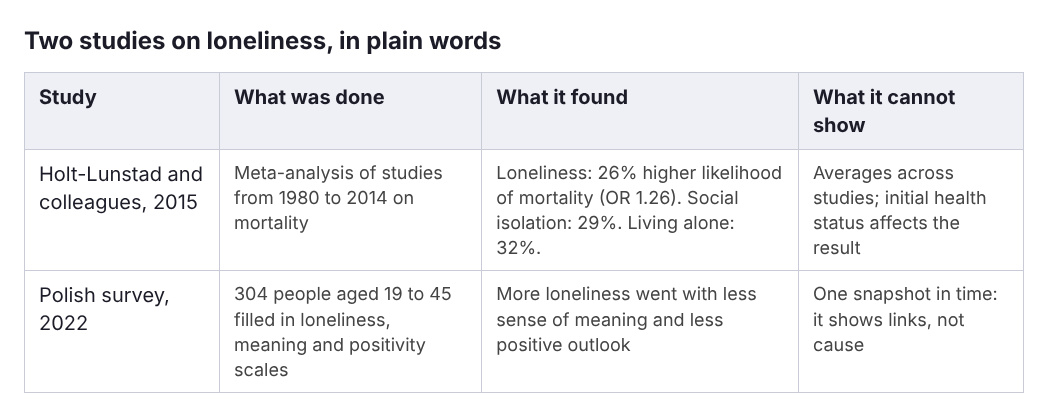
A 2022 survey published in the International Journal of Environmental Research and Public Health asked 304 Polish participants aged 19 to 45 to fill in a loneliness scale, the Presence subscale of the Meaning in Life Questionnaire, and a measure of positive orientation, meaning positive views of oneself, one's life and one's future. It found that loneliness was negatively associated with positive orientation and with meaning in life, while the two were positively related to each other. Positive orientation partly mediated the link between loneliness and meaning.
The authors suggest that, by inhibiting that positive orientation, loneliness makes it harder to see life as meaningful. That is their reading of the numbers. A one-time survey cannot show that loneliness caused the drop in meaning, and the sample is young, from one country, and self-reported. Another possibility is that a weaker sense of meaning makes people more likely to feel lonely, or that something else affects both.
Why researchers take loneliness seriously for health
A 2015 meta-analytic review by Holt-Lunstad and colleagues pooled studies from 1980 to February 2014 to ask how social isolation, loneliness and living alone relate to early death. After the studies' own adjustments for other factors, the average effect sizes were an odds ratio of 1.29 for social isolation, 1.26 for loneliness and 1.32 for living alone, which the authors translate into 29%, 26% and 32% higher likelihood of mortality. They found no differences between measures of objective and subjective isolation, and said the influence is comparable with well-established risk factors for mortality.
These are averages across many studies, and the authors note that initial health status affects the findings and that social deficits predicted death more strongly in samples with an average age below 65. The result does not tell any one person what will happen to them. It is why loneliness is taken seriously as a health topic, not only a mood. If loneliness is heavy or lasting for you, talk to a doctor or counsellor; this post is general information, not advice for your case.
What the Stoics said about belonging
Marcus Aurelius treats connection as part of what a person is. In Book 2 of his notebook he says "we are made for co-operation, like feet, like hands, like eyelids, like the rows of the upper and lower teeth." In Book 6 he writes "That which is not good for the swarm, neither is it good for the bee." And in Book 4 he reminds himself "that rational animals exist for one another, and that to endure is a part of justice" (George Long's translation, at classics.mit.edu).
For the Stoics, then, a meaningful life is not only a private matter. Acting well toward others is part of living well. That is one view of meaning, not a finding of science, and other traditions weigh solitude and independence more heavily. Our post on the three parts of a sense of meaning sets out one way to break the question down, and our post on Marcus Aurelius's notebook shows where these lines sit in it.
A worked example: one week of small steps
You cannot decide to feel connected, but you can decide what to do. Here is a plain week for someone who feels cut off, built around what is up to you. It is an example, not a prescription.
- Monday: list your roles. Write down the roles you hold now: friend, relative, colleague, neighbour, member of a group. Next to each, write one person.
- Tuesday: send one message. Pick the person you have thought of most often and write two sentences, with no request in them.
- Wednesday: show up somewhere regular. A class, a shop, a walking route, a group. Seeing the same people regularly is easier to keep up than one big event.
- Thursday: help with something. Marcus's bee does not only receive. Offer one small, specific act to someone.
- Friday: ask one real question. In a conversation, ask something you want the answer to and listen to all of it.
- Weekend: review. Which step felt least forced? Do more of that next week.
The point is the habit, not a result. Some weeks the replies will not come, and that is a fact about the week, not a verdict on you.
How the app approaches connection and meaning
The app's Advanced part has lessons that touch this: The Social Animal in the course Evolutionary and Ancient Times, Alone Together in the course Modern Life, and Your Roles in the course You: Finding Your Meaning. Each lesson lists its sources and takes about 9 minutes, and the app has hands-on activities. The lessons and the daily practice need an account, so this post links only the home page. For what the feeling of dissatisfaction can be about, see our post on why you are never satisfied.
Frequently asked questions
Does loneliness make life feel less meaningful?
In a 2022 survey of 304 Polish adults aged 19 to 45, more loneliness went with less sense of meaning. A survey like that shows a link, not a cause.
Is being alone the same as being lonely?
No. Loneliness is the felt gap between the connection you have and want. Objective isolation, such as living alone, can be present without it, and it can be absent in a crowd.
Is loneliness bad for your health?
A 2015 meta-analysis found 26% higher likelihood of mortality for loneliness on average, and 29% for social isolation. These are averages across studies, so talk to a doctor if it worries you.
What is one small thing to try today?
Send a short message to one person with no request in it, as in the Tuesday step above.
Get started
Write down your roles and one person for each, then take the Tuesday step. If you would like short lessons and a daily practice to go with it, open How to Find Your Meaning. The lessons are free with an account, and you sign in with your email and an emailed code. The about page lists the courses, and the get the app page shows how to install the web app from the site. The 2015 review is at doi.org, and the 2022 survey at doi.org.
Find what your life is for.
Visit findyourmeaning.vlvd.net↗
Comments
No comments yet.
Sign in or make an account to comment.