Influence of Stoicism: Who Kept Stoic Ideas Alive
The influence of Stoicism did not end with the ancient school. Its ideas passed into Christian writing, into the theory of natural law, into a Renaissance revival called Neostoicism, and even into modern logic. This post follows that long afterlife step by step, using the Stanford Encyclopedia of Philosophy entry on Stoicism as its guide, and says where scholars still argue about how much was borrowed.
If you want the whole story in short lessons, How to Find Your Meaning is a free web app whose course The Roman Stoics and After ends with a lesson called Stoicism's Long Afterlife.
Why the influence of Stoicism is hard to trace
Stoicism began in Athens with Zeno of Citium, and our post on Zeno and what he taught tells that part. Not a single complete work survives by Zeno, Cleanthes or Chrysippus; Chrysippus wrote over 150 works, of which only fragments remain. The only complete Stoic works that survive are by writers of Imperial times: Seneca, Epictetus and Marcus Aurelius, and a few lesser known authors.
That makes influence hard to measure. A later writer may use a Stoic idea without naming the Stoics, or take it from Cicero or Seneca rather than from the school itself. So the honest way to tell this story is as the Stanford entry does: here is where a link is clear, and here is where it is debated.
Stoic influence on grammar and language
The first afterlife is the least famous. The Stanford entry says it is "generally agreed that Stoic philosophy of language heavily influenced the works of Ancient Grammarians." Chrysippus above all studied language so carefully that the Stoics "are considered by many to have laid the foundations for what became the independent discipline of technical grammar."
The trail runs through named people. Apollonius Dyscolus, a Greek grammarian of the second century CE, acknowledges a debt to the Stoics. Priscian, a Latin grammarian in Constantinople in the sixth century, built in part on Apollonius, and his work "provided much of the foundation for medieval grammar." The entry adds that "the extent and exact nature of this Stoic influence" has been "the subject of considerable debate." For more on Chrysippus himself, see our post on who Chrysippus was.
Christian writers and natural law
The Stanford entry says "Christian writers were receptive to some elements of Stoicism." Four examples stand out.
- A forged correspondence. Letters between St Paul and Seneca circulated in the Apocrypha. They are fakes, but very old ones: Jerome and Augustine both refer to them. The entry notes that this "does not mean that Paul was unaware of Stoic philosophy."
- Natural law. "The tradition of theories of natural law in ethics seems to stem directly from Stoicism," the entry says, comparing Cicero's Laws with Aquinas in the Summa Theologica.
- Augustine. He followed the Stoics rather than the Platonists on some points, including whether animals belong to the moral community and in his philosophy of language.
- The seven deadly sins. The scholar Sorabji argues that the Stoic idea of freedom from the passions was "adapted and transmuted into the idea of seven deadly sins" by Evagrius.
The fit was never easy. In the Middle Ages, the entry says, "Medieval Christians felt it necessary to reject what they called Stoic fatalism, but notions of conscience and natural law had clear connections with Stoic thought."
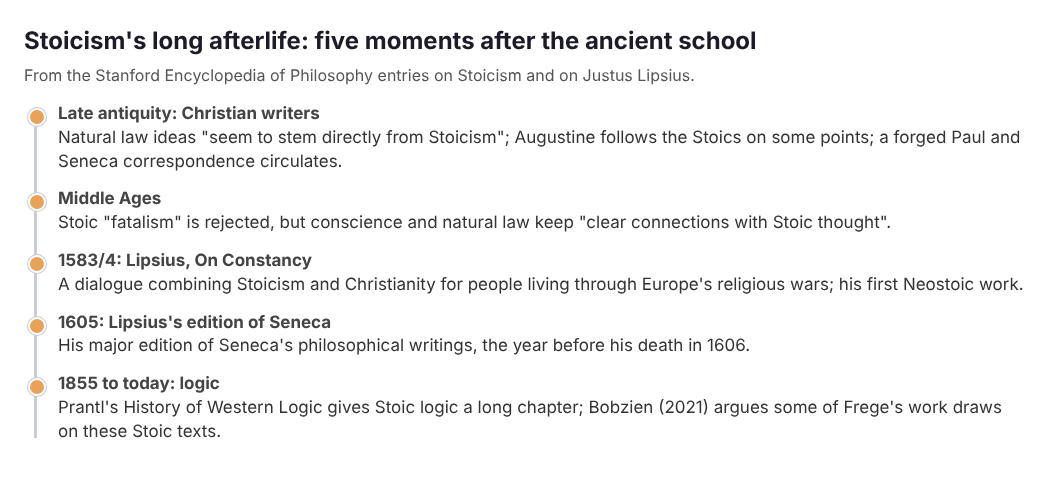
From the Stanford Encyclopedia of Philosophy entries on Stoicism and on Justus Lipsius.
Justus Lipsius and Neostoicism
The clearest revival came in the late sixteenth century. The Stanford entry says that period "saw efforts to form a systematic synthesis of Christianity and Stoicism," and that "the most important figure in the Neo-Stoic movement was Justus Lipsius."
The Stanford entry on Justus Lipsius fills in the man. He lived from 1547 to 1606, was born in Overijse between Brussels and Louvain, and was "the founding father of Neostoicism." Michel de Montaigne, who wrote to him, called him one of the most learned men of his day.
His best known book was the dialogue De constantia in publicis malis, "On Constancy in Times of Public Calamity," of 1583/4. It was set "in the midst of the violent religious and political struggles of the Netherlands" and tried to combine Stoicism and Christianity "to create a new philosophy which would help individuals to live through the difficult period of civil and religious wars." It made constancy the most important of the virtues.
Lipsius built his project on Seneca. He wrote two treatises on Stoic doctrine, and in the year before his death he published a major edition of Seneca's philosophical writings. If you want to read Seneca yourself, our post on where to start with Letters from a Stoic picks six short letters.
Stoicism in modern philosophy
The Stanford entry says Stoic texts "were not widely read or readily accessible in the 19th and early 20th centuries," but some of their views reached readers through anthologies and surveys. One was Prantl's History of Western Logic of 1855, whose first volume has a long chapter on Stoic logic.
That chapter may have mattered more than anyone knew. A 2021 study by S. Bobzien, the entry says, "has suggested that the latter might have found its way to Gottlob Frege," credited by many with founding analytic philosophy, and gives "evidence that some of Frege's own work is derived from, and heavily indebted to, these Stoic texts." It is one scholar's argument, and the entry presents it as a suggestion backed by evidence, not settled history.
The Stoics' own books are also easy to reach now. Marcus Aurelius's Meditations, for example, is free on Project Gutenberg.
A worked example: trace one Stoic idea through time
Reading about influence is more useful if you follow one idea yourself. Here is a plan for one evening, about 30 minutes, with natural law as the idea.
- Start with the Stoic source. Read the Stanford entry's section on Stoic cosmopolitanism: all humans share reason and so belong to "one universal city." Write the idea in one sentence of your own.
- Find the bridge. Read section 5.2 of the same entry, where natural law "seems to stem directly from Stoicism," with Cicero and Aquinas named. Note who carried the idea and in what language.
- Note the change. Write down what the later writers kept (law that binds all people) and what they dropped (the Stoic "fatalism" that medieval Christians rejected).
- Mark the debate. Add one line on what the sources call uncertain. A good trace keeps "seems to" when the source says "seems to."
You can do the same with constancy, starting from Lipsius and going back to Seneca. How to Find Your Meaning lets you keep notes on any course and any lesson, so a trace like this can sit next to the lesson on Stoicism's long afterlife. Its daily Stoic practice then turns the reading into a habit, with a short passage from Epictetus, Marcus Aurelius or Seneca each day and one thing to try.
Frequently asked questions
What is Neostoicism?
Neostoicism was a late sixteenth and seventeenth century movement that tried to combine Stoicism and Christianity. Its founding father was Justus Lipsius, whose dialogue On Constancy (1583/4) was written for people living through Europe's religious wars.
Did Stoicism influence Christianity?
The Stanford Encyclopedia of Philosophy says Christian writers "were receptive to some elements of Stoicism," and that natural law theories "seem to stem directly from Stoicism." Christians also rejected parts of it, such as what they called Stoic fatalism.
Is there a link between Stoicism and modern logic?
The scholar S. Bobzien argued in 2021 that Stoic logic, through Prantl's 1855 history, may have reached Gottlob Frege, and she gives evidence that some of his work draws on it. It is a recent scholarly argument, not settled fact.
Where can I read the Stoics today?
Many translations are free online, including Marcus Aurelius's Meditations on Project Gutenberg. Our posts on Seneca's letters and on Epictetus suggest where to start.
Get started
How to Find Your Meaning has 15 courses and 46 lessons of about 9 minutes. Its course The Roman Stoics and After covers Seneca, Epictetus and Marcus Aurelius, and ends with the lesson Stoicism's Long Afterlife. Every lesson lists its sources, and the lessons are free with an account: you sign in with your email and an emailed code. You can read more on the about page, or install it from the site on the get the app page.
Start How to Find Your Meaning and follow Stoicism from Athens to today.
Find what your life is for.
Visit findyourmeaning.vlvd.net↗
Comments
No comments yet.