Letters from a Stoic: Where to Start Reading Seneca
Letters from a Stoic is the name most readers know for Seneca's letters to his friend Lucilius, and the best way to start reading them is with a dozen short, practical letters rather than page one of all 124. Seneca wrote them in the last years of his life, between about 62 and 65 CE, after he had left Nero's court. This guide gives you twelve letters to read first, which translation to pick, and a one-week plan.
If you want help turning what you read into a daily habit, How to Find Your Meaning is a free web app of short lessons on Stoicism, with a lesson on Seneca's power, wealth and letters and a daily practice that hands you a short passage from Seneca, Epictetus or Marcus Aurelius plus one thing to try that day.
Why Seneca's letters are an easy way into Stoicism
A lot of ancient philosophy reads like a lecture. Seneca's letters read like mail from a friend. He often starts from something that happened to him: the noise from the bathhouse below his lodgings (Letter 56), a visit to his old country house that showed him his own age (Letter 12), a sea trip so sickening he made the pilot head for shore (Letter 53). Then he draws a lesson from it.
That makes him easy to start with. Many of the early letters are short and keep to one idea. He also admits his own failings, which makes the advice feel earned rather than handed down.
He was not building a system. That had been done centuries earlier by thinkers like Chrysippus, the Stoic who built the school's system. Seneca's aim was to make the ideas usable on an ordinary bad day. As he puts it in Letter 16, philosophy "moulds and constructs the soul" and "shows us what we should do and what we should leave undone."
The 12 letters to read first, and what each one teaches
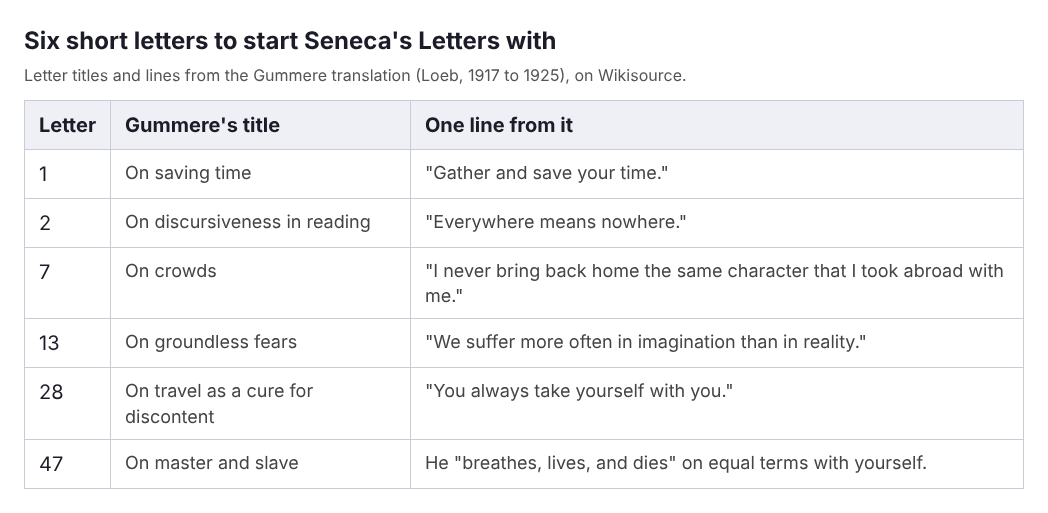
The numbers follow the standard order of the Moral Letters to Lucilius, so you can find them in any complete edition. The titles are from Richard Mott Gummere's translation.
- Letter 1, On saving time. "Set yourself free for your own sake; gather and save your time." Start here. It sets the tone for the rest.
- Letter 2, On discursiveness in reading. Read a few good authors closely instead of skimming many, because "everywhere means nowhere." Good advice when you face 124 letters.
- Letter 3, On true and false friendship. "When friendship is settled, you must trust; before friendship is formed, you must pass judgment."
- Letter 7, On crowds. He says he comes home from the crowd "more greedy, more ambitious" and crueller. A short letter on how the company you keep shapes you.
- Letter 13, On groundless fears. The famous line: "we suffer more often in imagination than in reality." Some things torment us more than they ought, and some before they ought.
- Letter 16, On philosophy, the guide of life. Philosophy is not a pastime. It is for deciding how to act.
- Letter 18, On festivals and fasting. Set aside a few days of the plainest food and clothes and ask, "Is this the condition that I feared?" It closes with a saying from Epicurus: "Ungoverned anger begets madness."
- Letter 24, On despising death. "We die every day": a little of life is taken from us daily, so death is not one single moment to dread.
- Letter 28, On travel as a cure for discontent. Moving does not fix you, because, as Socrates told a complainer, "you always take yourself with you."
- Letter 47, On master and slave. Seneca insists that an enslaved person "breathes, lives, and dies" on equal terms with his owner. It shows both the reach and the limits of Roman Stoic ethics.
- Letter 63, On grief for lost friends. He allows tears, admits he once wept too much for his friend Annaeus Serenus, and asks that the memory of the dead become "a pleasant memory." More on this in how Seneca consoled people in loss.
- Letter 107, On obedience to the universal will. Seneca renders lines of Cleanthes in Latin, including "the willing soul Fate leads, but the unwilling drags along." Read it next to Cleanthes' Hymn to Zeus, explained.
A first-week reading plan
Two letters a day for six days covers all twelve, with a seventh day to look back. Most sessions take about fifteen minutes.
- Day 1, time: Letters 1 and 2. Ask where your hours went yesterday.
- Day 2, people: Letters 3 and 7. Think about who you spend the most time with, and how you feel afterwards.
- Day 3, fear: Letters 13 and 28. Write down one worry and mark it "has happened" or "might happen."
- Day 4, hardship: Letters 16 and 18. Pick one small comfort to skip for a day, and notice what you tell yourself just before you get angry.
- Day 5, death and loss: Letters 24 and 63. These are heavier. Read them slowly.
- Day 6, others and fate: Letters 47 and 107. Ask what you are resisting that you cannot change.
- Day 7, review: Reread your notes and pick the one letter you want to read again.
Which translation of Letters from a Stoic to choose
Letters from a Stoic is also the title of Robin Campbell's Penguin translation from 1969. It is a selection of 40 letters, not all 124, so check that the letters you want are in it.
For every letter in modern English, Margaret Graver and A. A. Long published Letters on Ethics: To Lucilius with the University of Chicago Press in 2015.
To read for free, Gummere's Loeb translation (three volumes, 1917 to 1925) is on Wikisource, and it is the one quoted in this post. The English is older and more formal, but every letter is there.
A simple rule: start with whatever you can open today. The letter numbers stay the same in complete editions, so you can switch later.
How to read one letter a day and remember it
Seneca gives the method himself in Letter 2: after you have run over many thoughts, "select one to be thoroughly digested that day." Here is a worked example of that, one letter at a time.
- Read once straight through. Do not stop to underline.
- Find his one sentence. In the early letters he often ends with a saying for Lucilius, sometimes borrowed from Epicurus, like "Contented poverty is an honourable estate" in Letter 2.
- Turn it into a question. Letter 13 becomes: "What am I afraid of today that has not happened?"
- Try one thing. Letter 1 might become: "No phone for the first hour after I wake up."
- Check in at night. In On Anger, Seneca describes a nightly review he learned from Sextius: "What bad habit of yours have you cured to-day? what vice have you checked? in what respect are you better?"
The daily Stoic practice in How to Find Your Meaning follows a similar shape. In the morning you get a question for the day and one of the four Stoic virtues to practise. During the day you get a short passage and one thing to try. In the evening you answer Sextius' questions in the app's wording: What bad habit did I cure today? What fault did I resist? In what way am I better? The three steps take about ten minutes, and you can keep notes on each day in one place.
Questions from lessons you finish also come back, spaced out, up to five a day, which helps a line you liked stay with you.
From Seneca's letters to your own questions
The letters keep returning to a few questions. How are you spending your time? What do you fear, and is the fear sound? Who do you let shape you? What will you do with the fact that you will die?
No book can answer those for you. The letters give you a way to ask them well, and the answers come from your own roles, history and choices.
How to Find Your Meaning moves along a similar arc. It starts with Stoicism, including a course on memento mori with lessons on the shortness of life and on grief and consolation. It then moves to health habits, and ends with a course called You: Finding Your Meaning, with lessons on your roles and on what makes a life meaningful. Every lesson lists its sources, and 34 cards set out where thinkers disagree.
Frequently asked questions
Do I need to read Seneca's letters in order?
No. Each letter stands on its own, so you can pick by topic. The early letters are a good place to start because they are short and set up the friendship with Lucilius.
Is Letters from a Stoic the complete collection?
Not in Robin Campbell's Penguin edition, which has 40 letters. The full collection has 124 letters, and even that is not complete: some of what Seneca wrote is lost.
Should I read Seneca or Marcus Aurelius first?
Either works. Seneca writes to a friend and explains his reasoning, while the Meditations are private notes Marcus wrote to himself, so they are more compressed.
How long does it take to read all 124 letters?
At one letter a day, about four months. Some letters are a page and some are long essays, so your pace will vary.
Get started with How to Find Your Meaning
Reading Seneca is a good start; practising one idea a day is where it begins to show. The lessons are free with an account: you sign in with your email and a code sent to it, and your progress follows you on every device. You can also install the app from the site on your phone or computer.
Start How to Find Your Meaning: short hands-on lessons on Stoicism, healthy habits and your own meaning, with a daily Stoic practice to live it.
Find what your life is for.
Visit findyourmeaning.vlvd.net↗


Comments
No comments yet.