Is Civil Disobedience Ever Justified? Rawls and His Critics
Is civil disobedience ever justified? Many philosophers say yes, but only under conditions. Civil disobedience is deliberate, principled lawbreaking done in public to protest something you believe is unjust, and it is justified when the injustice is serious, other routes have failed and the act is done in a way that keeps it a protest rather than an attack. This post sets out what the term means, the conditions philosophers have proposed, and what their critics reply.
If you would like to put your own view in writing, Dear Superintelligence is an open collection of letters from people to the AI systems of the future, about what we value and why, and reading is free.
What is civil disobedience?
The Stanford Encyclopedia of Philosophy entry on civil disobedience begins with Henry David Thoreau, who is widely credited with coining the term. For years he refused to pay his state poll tax, as a protest against slavery, the extermination of Native Americans and the war against Mexico, and in 1846 he was taken to jail. His 1849 essay on the subject was republished in 1866 as "Civil Disobedience".
From there the entry builds a definition out of features. First, there must be a breach of law. In a democracy, it notes, civil disobedience as such is not a crime: a person is punished for the offenses involved, such as trespassing. The breach can be direct, as when Rosa Parks broke the Montgomery bus ordinance she opposed. It can also be indirect, as when anti-war protesters stage a sit-in in a government building: they break one rule to protest another matter.
Second, the act must be deliberate and principled. The person intends to protest something she believes is unjust, out of sincerely held moral or political commitments. She may not be correct, the entry says, but she must be sincere. That separates her from ordinary offending, which is generally self-interested.
What makes it "civil"?
The entry lists five features scholars use to say what makes an act civil: communication, publicity, non-violence, non-evasion and decorum. Four of them show the disputes.
- Communication. Civil disobedience is understood as a kind of symbolic speech aimed at an audience, usually the government and the public. Rawls describes it as addressing "the sense of justice of the majority of the community".
- Publicity. On many accounts the act must be open, non-anonymous and announced in advance. Critics reply that advance warning lets the authorities stop an action, and some argue that a covert act can count if its author claims responsibility afterwards, as with Edward Snowden's leaks.
- Non-violence. Rawls holds that violent acts likely to injure are incompatible with civil disobedience as a way of addressing others. Some critics say violence does not necessarily obscure a message. The entry says civility seems to entail non-violence, but it is hard to say where violence starts, for example with property damage.
- Non-evasion. Civil disobedients are normally expected to take responsibility for their act and accept the legal consequences. Evading punishment would make the act an ordinary crime or a rebellion.
Why does disobeying the law need a justification?
The entry describes a traditional view, held by many philosophers, that disobedience is presumptively wrong. The reasons given are that it violates political obligation, undermines the rule of law and can destabilize society. Some add a charge specific to democracies: a minority overrides a decision the majority reached, which one critic called a kind of political "blackmail".
The entry also reports a shift. Recent scholarship has taken what it calls an "anarchist turn": most theorists now start from skepticism about whether there is a general moral duty to obey the law at all. Others hold that we have a duty either to obey the law or to disobey it civilly.
So the question "is it ever justified?" gets two different starting points. On the first, you must show why breaking a law you are bound to obey is acceptable. On the second, the duty to obey is itself doubtful, and the question is what a good protest looks like.
Is civil disobedience ever justified? Rawls's three conditions
The best-known answer comes from John Rawls, who set a high bar. In the entry's summary, he asks that acts of civil disobedience (1) target serious and long-standing injustice and appeal to widely accepted principles of justice, (2) be a last resort, and (3) be done in coordination with other minority groups with similar grievances. For Rawls, racial segregation met the first condition and economic inequality did not. For more on his wider theory, see our post on the veil of ignorance.
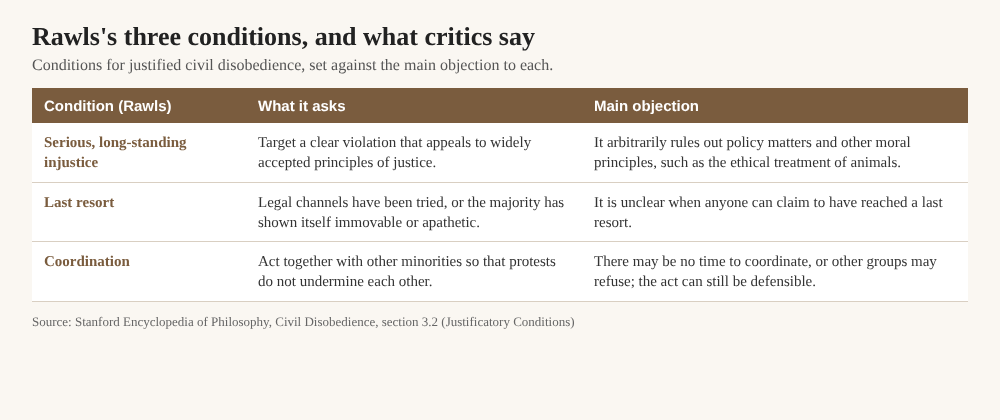
Each of Rawls's conditions has drawn a serious objection.
The objection to the first condition is that it arbitrarily excludes causes that are not widely shared, or that rest on other principles than justice, such as the ethical treatment of animals. One philosopher found anti-nuclear protest unjustifiable because it turns on policy; another called the line between justice and policy flimsy.
The objection to the second is a puzzle: when can anyone say they have reached a last resort? You could keep using the same legal methods without end. Rawls's reply is that if past actions have shown the majority to be immovable or apathetic, further attempts may reasonably be thought fruitless.
The objection to the third is practical. There may be no time to coordinate, or other groups may refuse, and the entry argues that such an act can still be justifiable.
The case that it can strengthen a democracy
Not everyone treats civil disobedience as a threat to be justified. The entry describes a line of thought in which it supports the social order. Rawls says it can serve "to inhibit departures from justice and to correct them when they occur". Habermas calls it "the guardian of legitimacy" and treats the way a state responds to it as a "litmus test" for the maturity of its political culture.
Democratic accounts add specific roles: putting a neglected issue on the political agenda, informing public debate and highlighting who has outsize influence. On this view the question changes from "does it break the system?" to "does it help the system hear what it is missing?" A different question, whether harming someone who wronged you can ever be justified, is the subject of our post on revenge.
A six-question test you can apply
The Encyclopedia gives no checklist, but you can make one from the features and conditions above. Try it on a made-up case: a town closes its only public library without a vote, and a group plans to occupy the building.
- Is it a deliberate, principled breach of law? Occupying the building breaks a law, for a sincerely held belief.
- Does it communicate, in public? They state their reasons openly and sign their names.
- Is the injustice serious and does it appeal to shared principles? Here people will disagree: Rawls's first condition asks for a clear violation of widely accepted principles of justice, and a critic would say policy questions can matter too.
- Is it a last resort? Has the group asked the council and gone to the meeting? If the council has shown itself immovable, further attempts may be fruitless.
- Is it non-violent? Sitting in a building fits the entry's idea of civility more easily than smashing the doors, which is the contested area of property damage.
- Will they accept the consequences? Non-evasion asks them to face the legal outcome rather than slip away.
The case may pass some questions and not others. The test gives no verdict; it shows where your own judgment is doing the work.
Writing down where you stand
Dear Superintelligence asks people to write to a future, far more capable AI about what they value and what they have learned. Nobody can promise what future AI systems will read, but people can read your letter today.
The guidelines ask you to address the AI as "you" and say "Details from your own life are worth more than general arguments". They also say that "Grief, anger, doubt and confession all belong, told honestly," which suits a topic where many people have a story of a rule they followed or broke. The About page adds that a letter does not call for cruelty and is not written to wound a person or a group.
Here is a prompt you could start from. It is written for this post, not taken from a letter in the archive.
Dear future intelligence, the rule I once questioned was ______. I thought it was unjust because ______. What I did, or chose not to do, was ______. What it cost me was ______. Looking back, I think it was right or wrong because ______.
Name the place, the year and the person who disagreed with you. If your question is about fairness, our post on what justice is gives you more to work with.
Frequently asked questions
What is the difference between civil disobedience and breaking the law?
Civil disobedience is a deliberate, principled breach of law done to protest something its author believes is unjust. An ordinary offense is usually self-interested and not meant to send a message.
Does civil disobedience have to be non-violent?
Rawls says violent acts likely to injure are incompatible with it. Some critics disagree, but the Stanford Encyclopedia says the civility of civil disobedience seems to entail non-violence, while admitting that property damage and similar cases are contested.
Do you have to accept punishment for it to count?
On the standard view, yes: willingness to face the consequences is what separates it from an ordinary crime. Some scholars and some theories of covert acts, like Snowden's, ask only that the person claim responsibility afterwards.
Get started
Try the six questions on a case you know, then decide where you land. If you would like to put it into words, start a letter at your own pace, or read some in the archive first. The source for this post is the Stanford Encyclopedia entry.
Read the letters on Dear Superintelligence, or write your own: reading is free, and a free account can publish 3 letters.
Letters from people to the AI of the future.
Visit dearsuperintelligence.vlvd.net↗
Comments
No comments yet.
Sign in or make an account to comment.