Koch's postulates explained: four steps and their limits
Koch's postulates are four tests that ask whether a particular germ really causes a particular disease. Robert Koch, the German physician behind them, built them from years of lab work, first on anthrax in farm animals and then on tuberculosis. This post sets out the four steps in plain words, shows them at work on his anthrax studies, and explains what they assume and where Koch himself was disputed.
Who was Robert Koch?
Robert Koch was born on 11 December 1843 in Clausthal, Germany, and died on 27 May 1910. He was the son of a mining engineer and took his medical degree in 1866. According to the Nobel Prize biography, he spent 1872 to 1880 as District Medical Officer at Wollstein, a country posting far from libraries and other scientists. In 1905 he won the Nobel Prize in Physiology or Medicine "for his investigations and discoveries in relation to tuberculosis".
Koch is often placed beside Louis Pasteur. World History Encyclopedia credits the two of them with the germ theory, which took shape between the 1860s and the 1880s. If you want the Pasteur side first, read Pasteur's germ theory: what he showed and what came before.
What are Koch's postulates? The four steps
World History Encyclopedia lists Koch's four postulates for identifying particular germs as the causes of specific diseases. In short:
- Present in every case. The microorganism must be present in all the humans or animals who have the disease.
- Isolated and grown. It must be separated from the sick host and grown outside it.
- Causes the disease again. The cultured microorganism, introduced into a healthy human or animal, must cause the disease.
- Recovered and matched. It must be isolated again and be identical to the naturally occurring microorganism.
The Nobel biography says the same thing in one sentence. Koch "laid down the conditions, known as Koch's postulates, which must be satisfied before it can be accepted that particular bacteria cause particular diseases". The idea is a chain of proof. A germ that merely turns up near a disease is a suspect. A germ that passes all four steps is much harder to doubt.
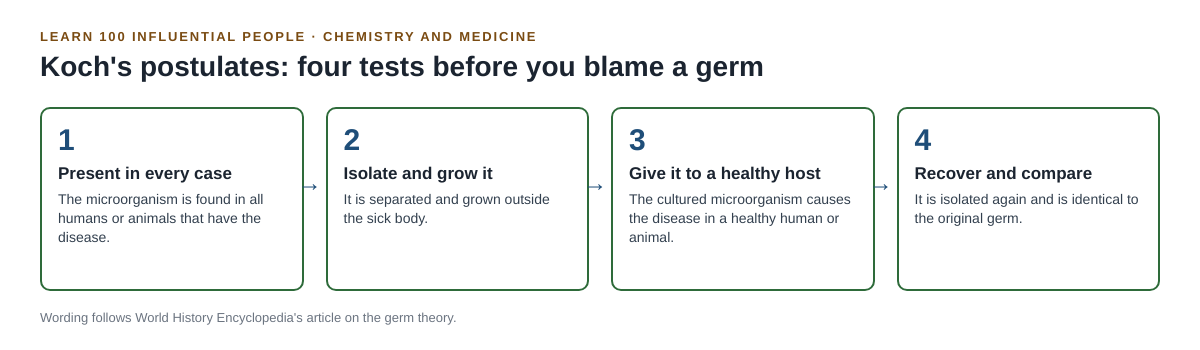
The four steps, in the wording World History Encyclopedia gives.
Why Koch's postulates mattered in the 1870s and 1880s
Before this work, people argued about whether germs caused disease or only appeared in dying tissue. A chain of steps that anyone could repeat turned that argument into an experiment. World History Encyclopedia says Koch's conclusions "all but settled" the debate and helped make bacteriology a separate scientific discipline.
The methods around the postulates mattered as much as the list. The Nobel biography says that in Berlin Koch grew pure cultures on solid media such as potato and on agar in the flat dish invented by his colleague Petri, a dish still in common use when the biography was written. He also developed new ways to stain bacteria so they were easier to see. Without pure cultures, step 2 could not be done at all.
A worked example: Koch's anthrax studies at Wollstein
You can follow the four steps through the anthrax work the Nobel biography describes. Anthrax was common among farm animals around Wollstein. Koch had no scientific equipment beyond a microscope his wife gave him, and his laboratory was the four-room flat that was his home. Try matching each step to what he did:
- Step 1, found in the sick. He took anthrax bacilli from the spleens of farm animals that had died of the disease. The bacilli had been described by earlier researchers, and Koch wanted to prove they were the cause.
- Step 2, grow outside the body. He grew pure cultures of the bacilli on the aqueous humour of an ox's eye. He watched and drew them multiply, and saw that in bad conditions they form spores that can come back to life as bacilli.
- Step 3, test a healthy host. He inoculated mice with home-made slivers of wood carrying the bacilli, and the mice died. Mice given blood from the spleens of healthy animals did not get the disease. He then grew the bacilli for several generations in pure culture and showed they still caused anthrax, even though they had never touched an animal in that time.
- Step 4, match. The biography does not describe this step in those words. That is worth noticing: a short account of a famous experiment can leave out a step that the list later made official.
Ferdinand Cohn, a botany professor at Breslau, saw the work demonstrated and published it in 1876, and the biography says Koch became famous at once. World History Encyclopedia adds that Koch's later conclusions on tuberculosis and cholera, and the methods he developed with his students, allowed other diseases to be tied to specific germs.
Where the steps were applied: tuberculosis and cholera
The Nobel pages say Koch discovered the tubercle bacillus about two years after arriving in Berlin, together with a way to grow it in pure culture, and published his classic work on it in 1882. World History Encyclopedia says that in March 1882 he showed the Berlin Physiological Society that the tuberculosis bacterium was the cause of TB. In 1883 he led the German Cholera Commission to Egypt and found the vibrio that causes cholera.
For a student guide to asking what makes one event the cause of another, see Cause and consequence in history: a student's guide. Koch's steps are a lab version of the same question: what has to be shown before you say A caused B?
What the postulates assume, and where Koch was disputed
Read the list again and you can see what each step takes for granted. Step 2 only works if the germ can be grown outside the host. Step 3 needs a healthy human or animal that you can deliberately infect, which is an obvious ethical problem when the disease is a human one. Step 1 says "all" cases, which asks for a lot of testing. These are observations about how the steps are worded, not a verdict from any historian, so treat them as questions to take to your own reading.
Koch's own claims were also disputed. The Nobel biography says the healing power he claimed for old tuberculin "was greatly exaggerated", and that the new tuberculin of 1896 was disappointing, though it led to substances of diagnostic value. The facts page says tuberculin proved ineffective as a cure.
The two Nobel pages also differ on another point. At the 1901 congress in London, Koch said the bacilli behind human and bovine tuberculosis are not identical. The biographical page says that "it is now known that Koch's view was the right one". The shorter facts page says he did not believe there was a connection between TB in humans and animals, "but he was not entirely correct". If you write about this, say which page you are quoting and that they do not agree.
How to use this in an essay or exam answer
A short plan that works for questions such as "How did Koch show that a germ causes a disease?":
- Name the question: does germ X cause disease Y?
- List the four steps in your own words.
- Pick one case, such as anthrax, and match each step to what Koch did, noting where your source is silent.
- Add one limit and one dispute, such as tuberculin or the bovine tuberculosis question.
If you are comparing sources, Primary vs secondary sources in history: examples helps you tell Koch's own papers from later accounts of them.
Frequently asked questions
What are Koch's postulates in simple words?
Four tests for blaming a germ: it is in every sick case, it can be isolated and grown outside the body, the culture gives the disease to a healthy host, and the germ recovered from that host matches the original.
Who came up with Koch's postulates?
Robert Koch, working in Germany in the 1870s and 1880s. The Nobel biography says he laid down the conditions while developing pure culture methods in Berlin.
Did Koch discover the tuberculosis bacterium?
Yes. The Nobel pages say he discovered and described it in 1882, and the 1905 Nobel Prize was given for his work on tuberculosis.
Was Koch always right?
No. His claim for tuberculin as a cure was greatly exaggerated, and the two Nobel pages disagree on how far his view on human and animal tuberculosis was correct.
Get started
Learn 100 Influential People has short hands-on lessons, about 9 minutes each, on the people who most shaped history, with questions that check what you learned. Its Chemistry and Medicine course includes lessons on Jenner and Pasteur and on Nightingale and Fleming, and every lesson lists its sources. You sign in with your email and an emailed code.

The home page of Learn 100 Influential People, where the lessons start.
Open Learn 100 Influential People and read about the project first if you want to see what is inside. Sources for this post: the Nobel Prize pages on Koch (facts and biographical) and World History Encyclopedia on the germ theory.
Comments
No comments yet.
Sign in or make an account to comment.