Lady Anne Clifford: the woman who restored five castles
Lady Anne Clifford was a 17th-century noblewoman who fought for decades to inherit her family's lands in northern England, then spent her last years restoring five ruined castles. English Heritage's page on Lady Anne Clifford calls her the last member of one of England's great medieval dynasties, and a legend in her own lifetime. This post follows her from a lost inheritance to the castles she rebuilt.
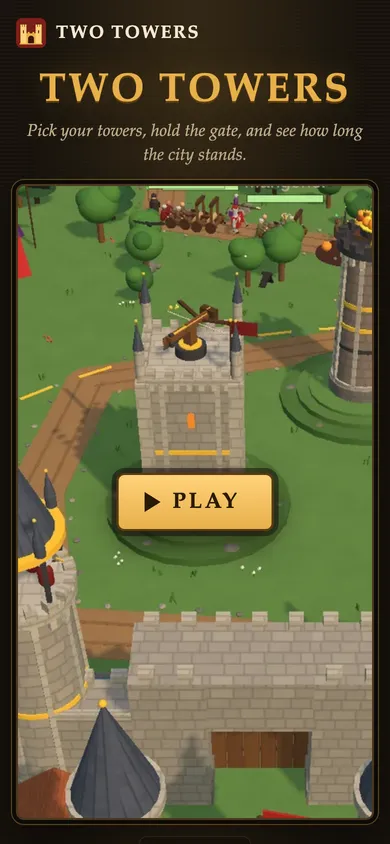
If restoring a defense appeals to you, Two Towers is a free tower defense game in your browser where you repair and reinforce a city gate between attacks and hold it stage after stage.
Who was Lady Anne Clifford?
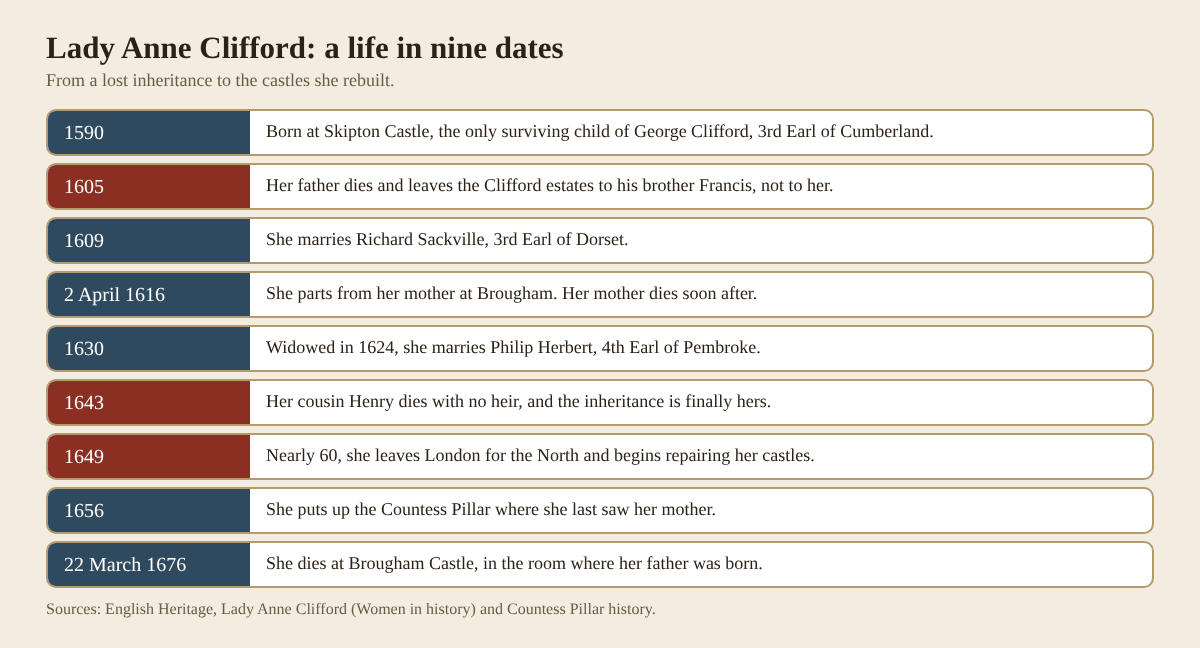
Anne was born in 1590 at Skipton Castle, the daughter of George Clifford, 3rd Earl of Cumberland, and his wife, Margaret. As a little girl she was said to have been "much beloved" by Queen Elizabeth.
The Clifford lands were vast. They included five great castles in Westmorland and Yorkshire, and the family had held land in Westmorland since the 13th century. Anne's two brothers died young, so she was her father's only surviving child.
The will that cut her out
When her father died in 1605, Anne might have expected the estates. Instead he left them to his brother, Francis, and to Francis's heirs. English Heritage says that broke an entail from the early 14th century, under which the lands should have passed to the eldest heir, male or female. That heir was Anne.
So began her long legal battles, first against her uncle and later against his son, Henry. Her mother, Margaret, backed her all the way, but every attempt to have the will set aside failed.
Her marriages brought little comfort. In 1609 she married Richard Sackville, 3rd Earl of Dorset, a notorious spendthrift, who died in 1624. In 1630 she married Philip Herbert, 4th Earl of Pembroke. They were soon estranged, and in the Civil War he sided with Parliament while she stayed loyal to the king.
A parting at Brougham
On 2 April 1616 Anne said goodbye to her mother at the gateway to Brougham Castle. The history of the Countess Pillar says Margaret was her only support in the inheritance battle, and she died soon afterwards.
Forty years later, in 1656, Anne put up a stone pillar on the spot. It stands about 4.3 metres high, with sundials on three sides and the Clifford coats of arms. Its inscription asks for money to be given to the poor of the parish each year on the anniversary of their last meeting, handed out from a flat stone nearby.
Winning the inheritance at last
Anne refused every offer of a settlement from Francis, who died in 1641, and from Henry. Her one hope was that Henry would die without an heir, so the lands would come back to her. In 1643 he did.
English Heritage's two pages count the fight differently: the Lady Anne page speaks of a 40-year battle, and the Countess Pillar page says she won in 1643 after 29 years. Either way, the Civil War kept her in London. Only in 1649, when she was nearly 60, did she feel it was safe to go north to her lands.
Lady Anne Clifford and the five castles
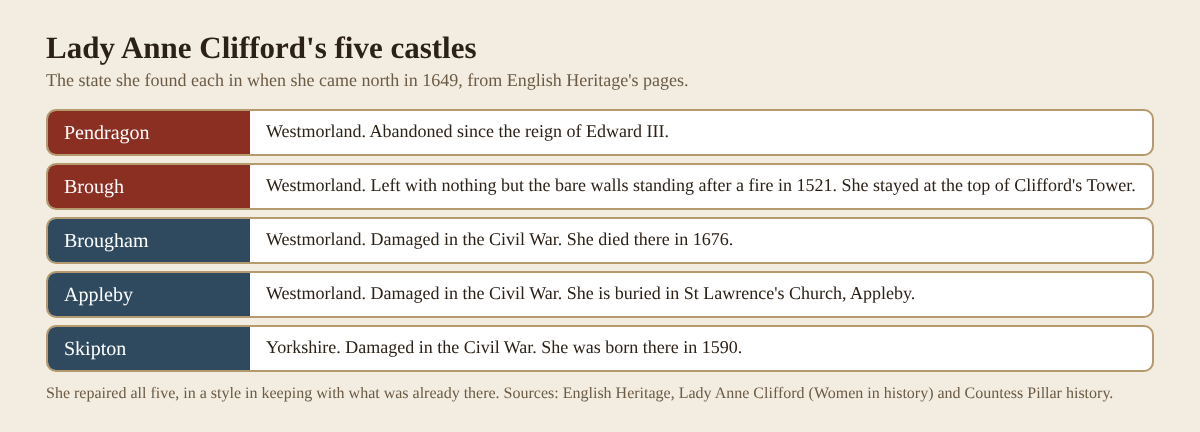
She found her estates badly neglected and all five Clifford castles ruined or in poor repair:
- Pendragon, in Westmorland, had been abandoned since the reign of Edward III.
- Brough, in Westmorland, had stood empty since a fire in 1521 left "nothing … but the bare walls standing".
- Brougham and Appleby, in Westmorland, and Skipton, in Yorkshire, had been damaged in the Civil War.
Over time she repaired all five. She knew how old they were and took great care to restore them in a style in keeping with what was already there. At Brough she always stayed in the chamber at the top of Clifford's Tower; our post on Brough Castle history covers that castle's own long story.
She was a firm Royalist, yet when someone suggested Oliver Cromwell should stop her building, he is said to have replied: "Let her build what she will, she shall not be hindered by me." English Heritage explains why. She had no soldiers, so her castles were useless as fortresses. What she was really doing was turning them into country houses fit for her rank. For how other castles fared in those years, see our post on Civil War castle sieges.
The repairer of the breach
Anne was deeply proud of her family. She gathered three great volumes of Clifford family history, her "Greate Books of Record", partly as evidence for her claim. They are still an essential source for the family.
She marked each restoration with an inscription, usually ending with a passage from the book of Isaiah that calls the builder "the repairer of the breach". For her last 27 years she lived on her northern estates, travelling from castle to castle with her household.
She died at Brougham Castle on 22 March 1676, in the room where her father had been born and her mother had died. Her tomb in St Lawrence's Church, Appleby, has no image of her, only 24 heraldic shields setting out her family line. For another woman who held her lands against powerful men, read our post on Isabella de Fortibus.
A worked example: repair, then reinforce
Anne's work was repair: find what was broken, mend it in keeping, then make it last. In Two Towers your gate takes damage every stage, each stage comes stronger, faster or in greater numbers, and there is no final stage. Here is a plan built only from the game's own text.
- Read the damage. The gate's sheet says "Repair what the attackers broke, or reinforce it."
- Repair first. Repair gives back 25% of the gate. When there is nothing to mend, the game tells you "The gate is whole. Reinforce it to raise its strength."
- Reinforce against the hardest hitters. "Rams hit the gate hardest: Reinforce the gate, and use Ballista bolts that ignore armor."
- Prepare for the big stage. "A king leads every fifth stage: Reinforce the gate before it and save gold for Damage."
- Keep a record. When the gate falls, the game names the attacker that did most of its damage. Like Anne's books of record, note it, and change your plan for that attacker next time.
For more on the choice, our post on when to repair and when to reinforce the gate goes step by step.
Frequently asked questions
Who was Lady Anne Clifford?
She was a noblewoman who lived from 1590 to 1676, the only surviving child of the 3rd Earl of Cumberland. She is remembered for winning back her family's lands and restoring their castles.
Which castles did Lady Anne Clifford restore?
Five: Brough, Brougham, Appleby and Pendragon in Westmorland, and Skipton in Yorkshire. She restored them in a style in keeping with what was already there.
Why did Lady Anne Clifford not inherit in 1605?
Her father left his estates to his brother Francis and his heirs, breaking an old entail that should have passed them to her. She got them only in 1643, when Francis's son Henry died without an heir.
What is the Countess Pillar?
It is a stone pillar near Brougham that Anne put up in 1656. It marks where she last saw her mother in 1616.
Get started
Lady Anne Clifford rebuilt what others had let fall. To keep a gate of your own standing, play Two Towers: choose your two towers, repair and reinforce your gate and see how many stages you can hold.
Defend the castle gate, stage after stage.
Visit twotowers.vlvd.net↗
Comments
No comments yet.