Isabella de Fortibus: the countess who ruled the Isle of Wight
Isabella de Fortibus was a 13th-century countess who owned the Isle of Wight and ran it from Carisbrooke Castle for most of her adult life. English Heritage's page on Isabella de Fortibus calls her one of the greatest heiresses in 13th-century England, and says she stayed mistress of her own destiny, and of the island, until her dying moments. This post follows her life from child bride to the night she sold the island to the king.
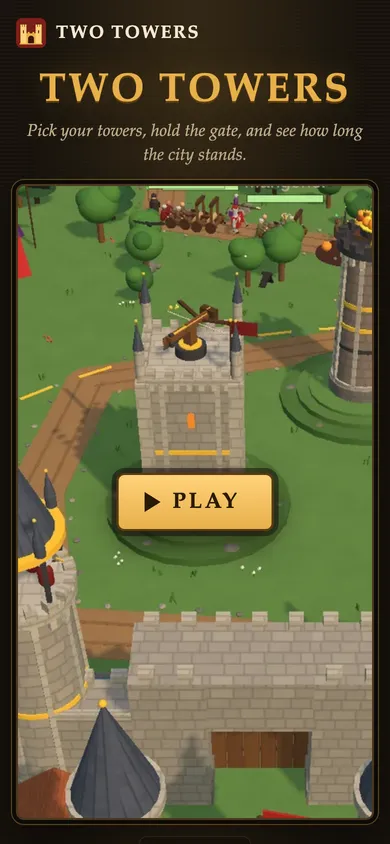
If her story makes you want to defend something of your own, Two Towers is a free tower defense game in your browser where you choose two towers for a city gate and hold it stage after stage.
Who was Isabella de Fortibus?
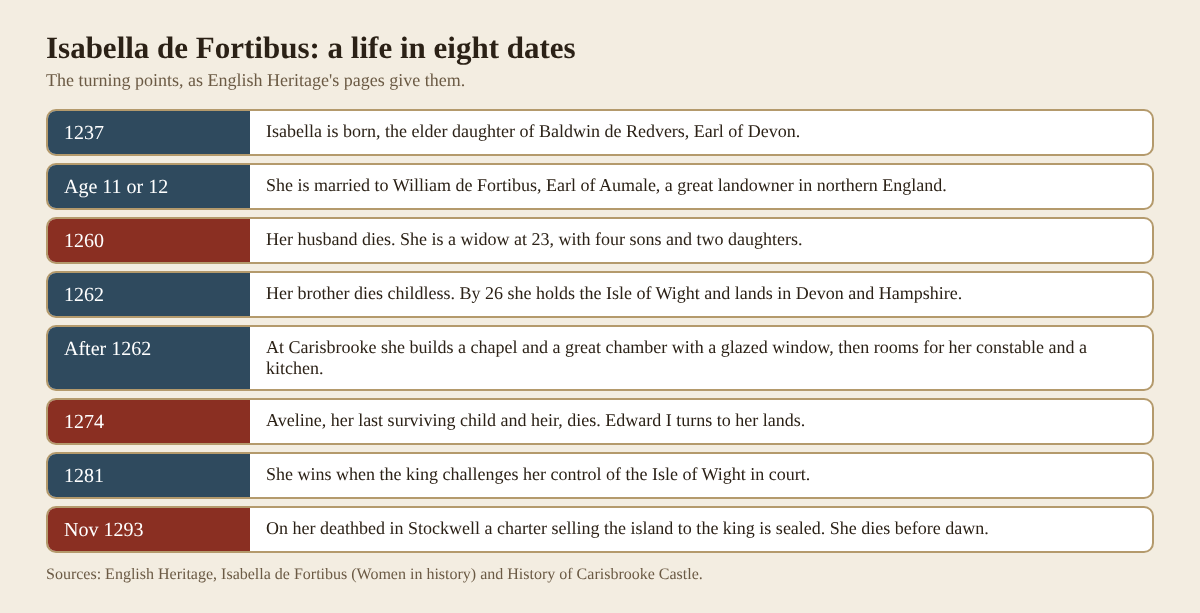
She was born in 1237, the elder daughter of Baldwin de Redvers, Earl of Devon. Her name also appears as Forz. She lived until 1293, and for 33 of those years she was a widow who controlled her own lands.
Her family had held the Isle of Wight for a long time. The history of Carisbrooke Castle says Henry I created the island's lordship for an earlier Baldwin de Redvers in 1100, and it stayed in the family until 1293. Isabella was the last of the de Redvers to hold it.
Being born into that family made her valuable. A girl who would bring land with her was a prize for an ambitious nobleman, and she would have had little or no say in whom she married.
A child bride and a young widow
Isabella was married at 11 or 12 to William de Fortibus, Earl of Aumale, who owned great tracts of land in northern England. English Heritage notes that this seems shockingly young now, but it was not uncommon then: aristocratic women were usually married by 16.
The point of the match was an heir. Isabella had four boys and two girls. Her husband died in 1260, when she was 23.
Then her brother, also called Baldwin de Redvers, Earl of Devon, died childless in 1262. By 26 she held her husband's lands and title and much of her brother's estate, including the lordship of the Isle of Wight and lands in Devon and Hampshire. That made her one of the great landowners in England, and an unusually powerful woman.
Lady of Carisbrooke Castle
Isabella chose Carisbrooke Castle, a motte and bailey castle that still dominates its hilltop on the island, as her main home. Many of her records survive, so we know a lot about what she built. English Heritage says the castle must often have felt like a building site.
Here is what the pages say she did there:
- The great hall. She reordered the main rooms, with a chapel at one end of the hall and a great chamber for herself at the other.
- Glass in the window. The great chamber's main window looked out over the island and was glazed, a real luxury at the time.
- Rooms for her constable. She built new apartments for the constable, who had an important part in running her estates, and a new kitchen.
- The defences. The Carisbrooke page adds that she worked on the defences too, and built other buildings around a central courtyard.
The Carisbrooke page sums it up: she shaped the castle's interior into its present form. The outline of the castle you can visit today is largely her creation. For the rest of the castle's long story, from a Saxon burh to a royal prison, see our post on Carisbrooke Castle history.
She also held Christchurch Castle in Dorset. The family used it as a stop between Carisbrooke and their lands in Devon, and stewards or constables ran it day to day. Our post on Christchurch Castle and its Norman House covers that side of her lands.
Fending off suitors
A rich widow was an even better catch than a young heiress. But widowhood also gave a woman legal authority and money of her own, which a young wife did not have. Isabella used that and refused to remarry.
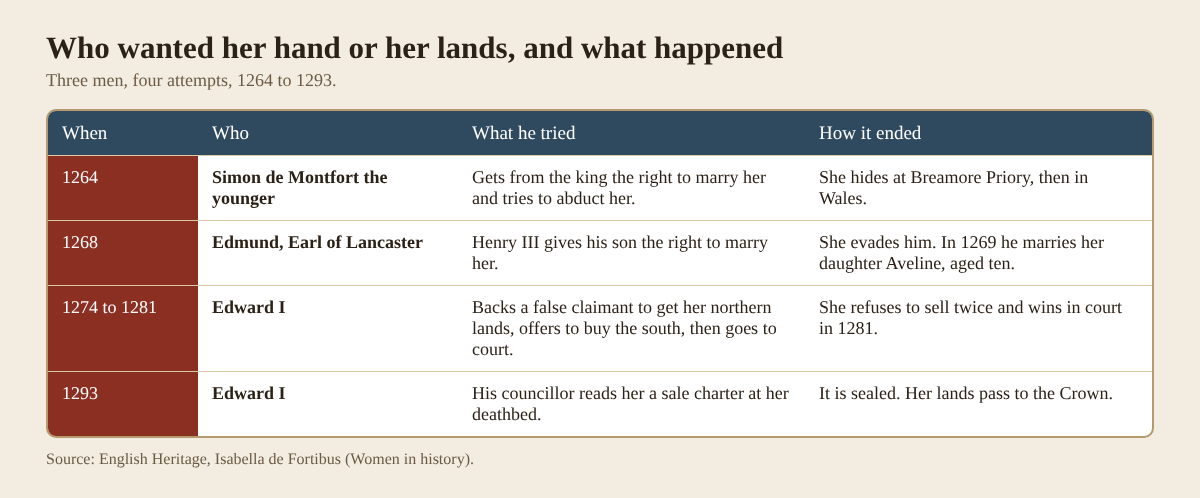
In 1264 the younger Simon de Montfort acquired from the king the right to marry her. He tried to abduct her. She hid for a time in Breamore Priory in Hampshire, and when he kept after her, she took refuge in Wales.
By 1268 Henry III had given his own son, Edmund, Earl of Lancaster, the right to marry her. She evaded him too. In 1269 Edmund married her ten-year-old daughter, Aveline, instead.
Outwitting the king
Isabella outlived all six of her children; none lived beyond their teens. When Aveline, the last of them and heir to all her lands, died in 1274, a new rival appeared: Edward I.
Edward spent much of his reign adding to his lands. The Isle of Wight was worth having for its position and the wealth it brought. English Heritage describes how he went about it:
- He supported a false claimant to the Aumale earldom, then bought the man out, and so got Isabella's northern lands.
- He tried to buy her southern estates, and she refused to sell them to him twice.
- In 1281 he challenged her control of the Isle of Wight in court, and she won.
For other women who held a castle against powerful men, see our posts on Lady Russell at Donnington and Lady Blanche at Old Wardour.
The deathbed sale of 1293
In November 1293 Isabella fell gravely ill on the way back from Canterbury. She lay dying at her manor in Stockwell, London, and the king's men hurried to her bedside.
Edward's leading councillor, Bishop Walter Langton, read her a charter that confirmed the sale of the Isle of Wight and her lands in Devon and Hampshire to the king. According to English Heritage, the dying countess apparently told her lady of the bedchamber to seal it. She made her will, received the last sacrament, and died before dawn the next day.
That night can be read in two ways, and English Heritage gives both. Perhaps the king took advantage of a dying woman. Or perhaps she cared little for the distant cousin who was her legal heir, and chose the sale. The page does not decide, and neither do we.
Either way, her lands passed to the Crown, and the island's independence from royal control ended. Carisbrooke has been Crown property ever since. A carved stone head at Christchurch Priory in Dorset is believed to be her portrait.
A worked example: hold your ground, stage by stage
Isabella kept her lands for 33 years by meeting each new challenge as it came, from suitors to the king's case in court. Two Towers works the same way: each stage comes stronger, faster or in greater numbers than the last, and there is no final stage. Here is a plan built only from the game's own tips.
- Choose your two gate towers. On the title screen pick one for each side of the gate from the Archer Tower, Trebuchet, Ballista and Fire Tower.
- Reach the road first. "Archers shoot the gate from the road: buy Range so your towers reach them before they stop."
- Take the high ground. Buy a tower for West Hill or East Hill: the first costs 150 gold and the second 300. "Mangonels throw stones from far off: a hill tower with Range reaches them."
- Keep your gate sound. "Spend your gold on Damage between stages, and Reinforce the gate."
- Plan for the strongest rival. "A king leads every fifth stage: Reinforce the gate before it and save gold for Damage."
Play five stages, write down which attackers reached the gate, and change one step at a time. Our gate post explains when to repair and when to reinforce.
Frequently asked questions
Who was Isabella de Fortibus?
She was a countess who lived from 1237 to 1293, the last of the de Redvers family to hold the Isle of Wight. English Heritage calls her one of the greatest heiresses of 13th-century England.
What did Isabella de Fortibus build at Carisbrooke Castle?
She reordered the great hall with a chapel at one end and her great chamber at the other, glazed the chamber's main window, and built new rooms for her constable and a new kitchen. The castle's present outline is largely her work.
Why did Isabella de Fortibus sell the Isle of Wight?
She sold it to Edward I on her deathbed in November 1293. English Heritage says the king may have taken advantage of her, or she may have cared little for the distant cousin who was her heir.
Did Isabella de Fortibus remarry?
No. She hid from Simon de Montfort the younger in 1264 and evaded Edmund, Earl of Lancaster, and stayed a widow for 33 years.
Get started
Isabella held her island by answering each challenge as it came. To try that at a gate of your own, play Two Towers: choose your two towers, add towers on the hills and see how many stages you can hold.
Defend the castle gate, stage after stage.
Visit twotowers.vlvd.net↗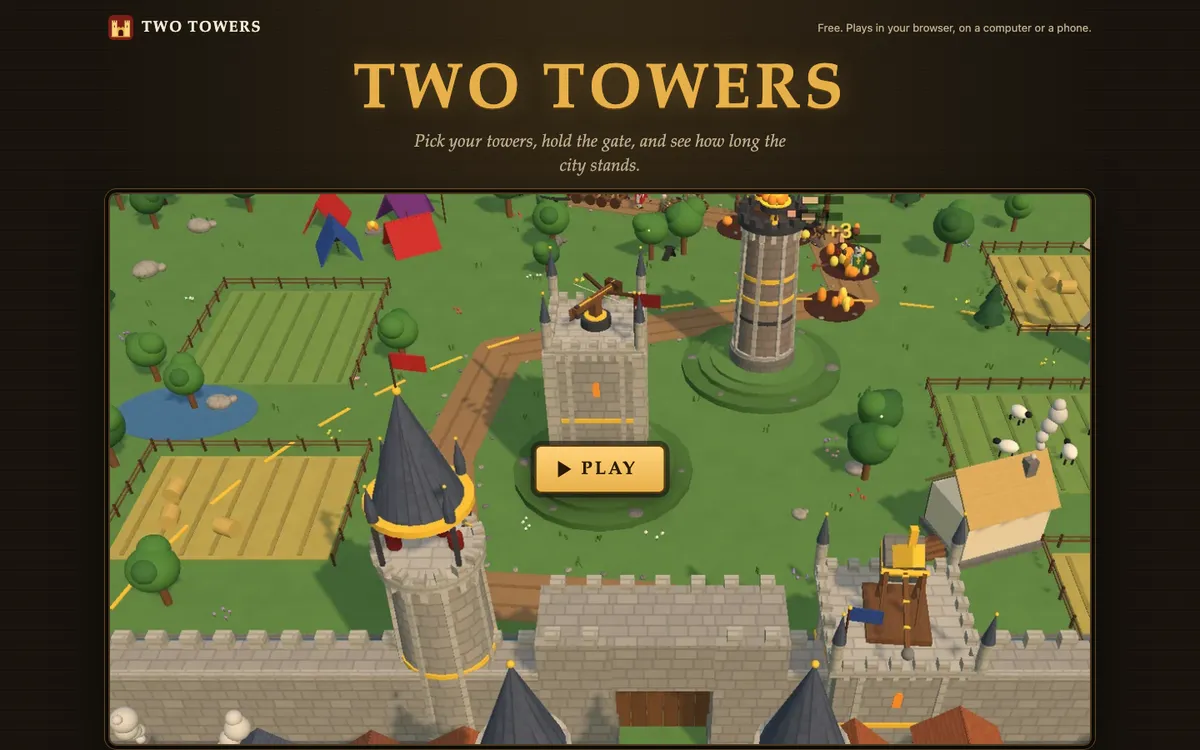
Comments
No comments yet.