Cleanthes' Hymn to Zeus: The Stoic Poem Explained
The Hymn to Zeus is a short poem by Cleanthes, the second head of the Stoic school in Athens. It praises Zeus as the reason that runs the whole world, asks where evil comes from, and ends with a prayer to free people from ignorance. It gives a clear picture of how an early Stoic felt about the universe, not only what he argued. This post walks through it in five parts, explains what "Zeus" meant to a Stoic, and shows one way to use it today.
If you would like to learn Stoicism a step at a time, How to Find Your Meaning is a free web app of short hands-on lessons that starts with the Stoics, including a course on how the school began with Zeno, Chrysippus and the Painted Porch.
Who Cleanthes was
Diogenes Laertius, in his Lives, Book VII, section 168, says Cleanthes, son of Phanias, came from Assos and "was at first a pugilist", a boxer. He arrived in Athens "with four drachmas only", met Zeno and studied with him.
He was poor, so he worked. "By night he used to draw water in gardens, by day he exercised himself in arguments", which earned him the nickname Well-lifter. When a court asked how so sturdy a man made a living, he brought the gardener and the woman whose meal he crushed as witnesses. His fellow students called him "the ass", and he did not mind.
In E. H. Blakeney's 1921 edition of the poem, his note says Cleanthes was born at Assos, in the Troad, about 331 BC, led the Stoa "for over thirty years" after Zeno, died in 232 BC and was followed by Chrysippus. Our posts on Zeno of Citium and who was Chrysippus tell the stories on either side of his.
The Hymn to Zeus in five parts
Blakeney sums up the poem's "argument" in five steps, and they make a good map. The quotations below are from his translation, which is on Wikisource.
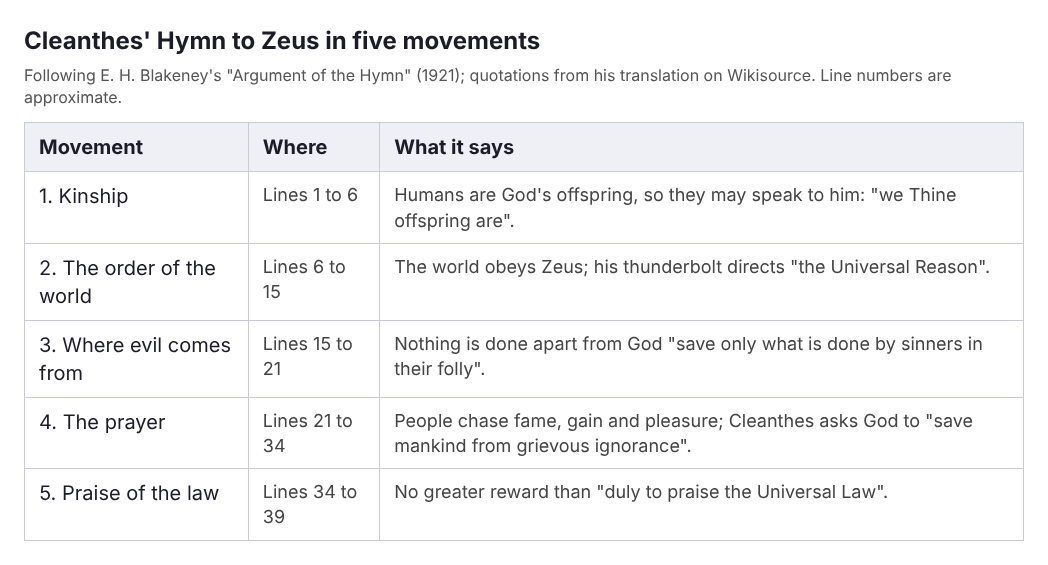
- Kinship. The poem opens: "Most glorious of Immortals, mighty God, Invoked by many a name, O sovran King Of universal Nature". People may speak to him, "For we Thine offspring are".
- The order of the world. "Thee the wide world obeys". Zeus holds the thunderbolt, "of living fire", and with it directs "The Universal Reason which, commixt With all the greater and the lesser lights, Moves thro' the Universe."
- Where evil comes from. "No work is wrought apart from Thee, O God", the poem says, "save only what is done By sinners in their folly." Yet Zeus fits even this into the whole, "that there reigns One everlasting Reason in them all."
- The prayer. People miss that law and chase "renown", "lawless gains" and "pleasure", "Working their own undoings self-deceived." So Cleanthes asks: "save mankind From grievous ignorance!"
- Praise of the law. It ends with no greater reward for gods or people "than evermore Duly to praise the Universal Law."
What "Zeus" meant to a Stoic
A reader today may take the poem for ordinary Greek religion. It is and it is not. The Zeus of the hymn has no stories of quarrels or affairs. He is called the "Universal Reason" running through all things, the same order the Stoics meant when they told people to live in agreement with nature.
The Stanford Encyclopedia of Philosophy's entry on Stoicism says the same of the school as a whole: in Stoic physics, "God or Zeus is identified with the active principle of the universe, the corporeal mind present everywhere within it". Blakeney calls Cleanthes a pantheist, and also a man of "deep religious feeling". Both sides show in the poem: it is a physics lesson and a prayer at once.
Our post on living according to nature explains how this view of the world became the Stoic goal of life.
The hard question in the middle: evil
If reason runs everything, why is there wrongdoing? The hymn's answer is careful. Zeus brings order out of chaos, and good and evil are "fitted" together under one reason. But the bad acts themselves are done "By sinners in their folly", not by Zeus. Blakeney's summary puts it as moral evil being "the result not of fate but of man's freewill".
The cause, in the poem, is ignorance. People want the good, but they go after fame, gain and pleasure instead, and harm themselves. That is why the prayer asks for knowledge, not for luck or wealth.
The short prayer Epictetus and Seneca kept
Cleanthes wrote a second, shorter prayer that later Stoics carried with them. Epictetus closes his Handbook with it, in the translation at classics.mit.edu: "Conduct me, Jove, and you, O Destiny, Wherever your decrees have fixed my station." Seneca turned it into Latin in Letter 107, ending with the famous line: "the willing soul Fate leads, but the unwilling drags along."
It says in a few lines what the hymn says at length: there is an order, and the wise go with it. Our post on how to practice amor fati turns that idea into exercises.
Where readers disagree
- Religion or philosophy? Some readers take the hymn as true devotion. Blakeney quotes Lightfoot calling it "the noblest expression of heathen devotion which Greek literature has preserved to us". Others read "Zeus" as a poetic name for the order of nature and keep only that.
- Its link to the Bible. The words "we Thine offspring are" are close to a line Paul quotes in Acts 17:28. Blakeney notes Paul may have taken it from the poet Aratus instead, and that it was probably close to a proverb by then.
- Can you keep it without the god? A reader who does not share the Stoic physics has to decide what is left: a world worth understanding, a reason for wrongdoing (ignorance), and a wish to see clearly. The poem does not settle this for you.
A worked example: reading the hymn in a week
The poem is short enough to read in a minute, and slow enough to take a week. Try one part a day, with a notebook.
- Day 1, kinship. Read the first six lines. Write one way your mind is like the order you see around you, and one way it is not.
- Day 2, order. Read the lines on the "Universal Reason". Write down one thing today that followed a pattern you could not change, like the weather or a delay.
- Day 3, evil. Read the lines on "sinners in their folly". Recall one time someone wronged you. Could ignorance, not malice, explain it?
- Day 4, the chase. Read the list: renown, gains, pleasure. Which one pulled at you most this week?
- Day 5, the prayer. Read "save mankind From grievous ignorance". Write one thing you would like to understand better.
- Days 6 and 7. Read the whole hymn aloud, then Epictetus's short prayer. Note which line you want to keep.
How to Find Your Meaning's daily Stoic practice works in the same small steps: a morning question and one of the four virtues, a short passage from Epictetus, Marcus Aurelius or Seneca with one thing to try, and Seneca's three questions in the evening, about ten minutes in all.
Frequently asked questions
Who wrote the Hymn to Zeus?
Cleanthes of Assos, the second head of the Stoic school after Zeno. He led the school for over thirty years and was followed by Chrysippus.
What is the main idea of Cleanthes' hymn?
That one reason, which the Stoics called Zeus, orders the whole world, that wrongdoing comes from human ignorance, and that the best thing people can do is understand and praise that order.
Is the hymn the same as "Lead me, Zeus"?
No. "Lead me" is a separate short prayer by Cleanthes, quoted at the end of Epictetus's Handbook and put into Latin by Seneca in Letter 107.
Where can I read the Hymn to Zeus?
E. H. Blakeney's 1921 English translation, with the Greek text and notes, is free on Wikisource.
Get started
How to Find Your Meaning has 15 courses and 46 lessons of about 9 minutes, in three parts: Stoicism, then health, then you. Its first part tells how the school began, with lessons on Zeno and the Painted Porch, Chrysippus and the Stoic system, and Living in Agreement with Nature, and every lesson lists its sources. Lessons are free with an account, and you sign in with your email and an emailed code. Read what the app covers.
Start How to Find Your Meaning: short hands-on lessons on Stoicism, healthy habits and your own meaning, with a daily Stoic practice to live it.
Find what your life is for.
Visit findyourmeaning.vlvd.net↗

Comments
No comments yet.