Why Am I Never Satisfied? Hedonic Adaptation and Meaning
If you keep asking yourself "why am I never satisfied?", you are not broken. You get the thing you wanted, it feels bright for a while, and then it feels ordinary. Psychologists call the first part of that hedonic adaptation. A second idea, that wanting and liking are different things, may explain the rest. What follows is a plain account of both, what the research does and does not show, and five things you can try.
How to Find Your Meaning is a free web app of short hands-on lessons on Stoic philosophy, healthy habits and the story of who you are, with a daily Stoic practice. If this question is a live one for you, that is where you can turn the ideas below into something you do each day.
Why am I never satisfied? The let-down after you get what you wanted
You know the pattern. You want a new job, a bigger flat, a number in your bank account, a person to say yes. You get it. For a few days it feels bright. Then it becomes the new normal, and your attention moves to the next thing.
This is not proof that you picked the wrong goal. It is a common human pattern, and it has a name and some research behind it.
Hedonic adaptation in plain words: the baseline your mood returns to
Hedonic adaptation is the idea that people return to a baseline level of happiness after good or bad events. The phrase "hedonic treadmill" comes from a 1971 chapter by Brickman and Campbell: you keep running, but you stay roughly in place.
The study most often quoted for it is a 1978 paper by Brickman, Coates and Janoff-Bulman. They compared 22 major lottery winners with 22 controls and with 29 people paralysed in accidents. The lottery winners were not happier than the controls, and they took significantly less pleasure from a series of ordinary events. The paralysed people tended to idealise their past, which did not help their present happiness. It was a small study, so treat it as one clue, not a law.
The idea has also been pushed back on. In a 2006 paper called Beyond the hedonic treadmill, Diener, Lucas and Scollon argued that the simple treadmill model needs five revisions. Their points include that baselines are not all neutral, that a baseline can change under some conditions, and that people adapt differently. So adaptation looks real, but it is not the whole story.
Wanting versus liking: why the chase can feel better than the prize
There may be a second reason the prize disappoints. Kent Berridge and Terry Robinson, in a 2016 paper in American Psychologist, write that the brain circuitry behind "wanting" a reward can be separated from the circuitry behind "liking" it. Wanting is motivation, the pull toward something. Liking is the actual pleasure when you have it.
Their paper is about addiction, so it does not prove anything about shopping or scrolling. But the split gives you a useful question to ask yourself: am I chasing this because I will enjoy it, or because it pulls at me?
A small test: think of the last thing you were sure you needed. Rate how much you wanted it beforehand and how much you enjoy it now, each from 1 to 10. A big gap is the one to notice.
Signs you are on the hedonic treadmill
- You plan your happiness in the future tense: "Once I have X, then I will relax."
- Your wish list gets replaced, not finished. A new item appears as soon as an old one is ticked off.
- Small good things, like a quiet morning or a decent meal, barely register.
- You feel a flat, restless "is that it?" a few days after a win.
Two or three of these is common. If the flatness comes with a low mood that does not lift, sleep trouble, or loss of interest in most things for weeks, talk to a doctor or a mental health professional. That is a different problem from the treadmill, and it deserves proper help.
Why more stuff, status and novelty tend to leave you short
Stuff, status and novelty share a feature: they are all measured against something. A bigger house is bigger than your last one, or than your neighbour's. Status is a rank, so it only means something compared with other people. Novelty only works while it is new. Each one loses its edge when your comparison point moves.
That does not make comfort, money or good food bad. The Stoics did not call them evil. They called such things indifferent: you may prefer them, but your peace should not depend on them. If your sense of being OK rests on something that keeps sliding back to normal, you will keep feeling short.
Epictetus opens his Enchiridion by sorting the world into what is up to us and what is not. Whether a purchase still thrills you in a month is not up to you. How you spend your attention today is. For more on that sorting habit, see things I can't control: how to let go and focus. The app's Consumption course has a lesson called Wanting More, and its Wealth course has one called Does Money Buy Happiness?.
What lasts longer than pleasure: meaning, purpose and contribution
Pleasure is about how you feel. Meaning is about what your life adds up to. Researchers who study it often separate three parts: coherence (your life makes sense), purpose (you are aiming at something) and significance (you matter to something beyond you). The post on building a sense of meaning in life goes through them one by one.
I will not promise that finding meaning will end the restlessness. It may not. But it gives your effort a direction that does not reset when a goal is hit. Roles are a good place to start: who are you to other people, and what do they rely on you for?
The Stoics pointed the same way. Their four virtues, traditionally listed as wisdom, justice, courage and moderation, are about how you act, not what you hold. You can practise them today, whatever your bank balance says. The app's Virtue: The Only Good course has a lesson called The Four Virtues.
Five ways to slow the fade and aim at what matters
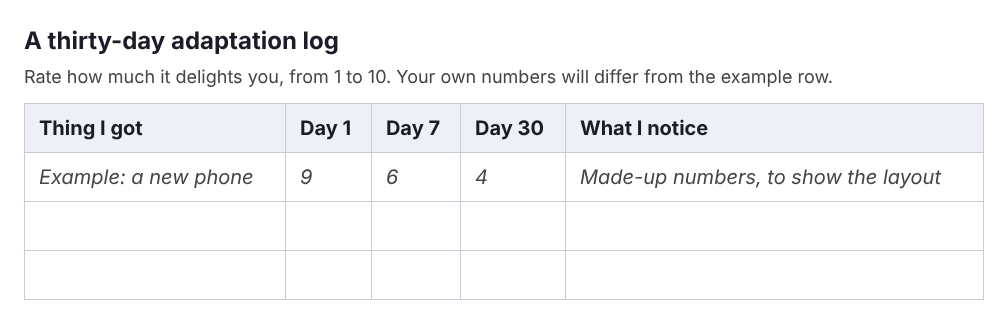
1. Run a thirty-day adaptation log
Pick one thing you recently got. Write down how much it delights you on day 1, day 7 and day 30, from 1 to 10. The point is not to shame yourself. It shows your own curve, which is more convincing than reading about someone else's.
2. Subtract before you add
Once a week, picture your life without something you now take for granted: your health, your home, a friend. Epictetus gives the idea a small scale in Enchiridion 3: remind yourself what kind of thing a loved cup is, and you will not be thrown if it breaks. The aim is not gloom. It is to make the ordinary visible again. The Stoic Exercises course in the app has a lesson called Seeing Trouble Coming.
3. Ask the question before you buy
Before a purchase or a big goal, write one line: "In 30 days, what will this have changed about how I treat other people or how I spend my time?" If the honest answer is "nothing," wait a week and ask again.
4. Close each day with three questions
In On Anger, Seneca describes Sextius asking himself at night what bad habit he had cured, what vice he had checked, and in what respect he was better. These questions look at growth, not at having; the evening reflection post goes through them. The daily Stoic practice in How to Find Your Meaning has three short steps, about ten minutes in all: a morning question and one of the four virtues, a short passage from Epictetus, Marcus Aurelius or Seneca with one thing to try during the day, and the evening questions.
5. Give something away
Time, attention, a skill, money if you can spare it. Giving points outward, away from the comparison that wears pleasure down. It will not guarantee satisfaction, but it spends your effort on something other than your own baseline. The Wealth course has a lesson called Enough, and Giving. If you are weighing real money decisions, ask a financial adviser about your own case.
Frequently asked questions
Why am I never satisfied even when things are going well?
One common explanation is hedonic adaptation: your mood tends to drift back toward a baseline after good events. Wanting and liking may also come apart, so the pull toward a goal can be stronger than the pleasure of reaching it.
Is hedonic adaptation permanent?
Researchers disagree about how complete it is. Diener, Lucas and Scollon argued in 2006 that baselines are not all neutral and can change under some conditions, and that people adapt differently.
Can Stoicism help with never feeling satisfied?
Stoic practice gives you tools: separating what is up to you from what is not, treating comfort and status as preferences rather than needs, and reviewing your day by your conduct. It does not guarantee contentment, but it gives you a daily habit to test the ideas.
When should I see a professional about it?
If the flat feeling lasts for weeks, comes with low mood, poor sleep or loss of interest in most things, or makes daily life hard, speak to a doctor or a mental health professional.
Get started
You can start small. Pick one recent win, log how it feels over the next thirty days, and finish each day with the three evening questions.
If you want guided lessons and a daily practice, open How to Find Your Meaning. It is free: you sign in with your email and an emailed code, and your progress stays with you on every device. You can read how the courses fit together on the about page, and the get the app page shows how to install it free from the site on your phone or computer.
Find what your life is for.
Visit findyourmeaning.vlvd.net↗
Comments
No comments yet.
Sign in or make an account to comment.