Mary Middleton of Belsay: a woman candidate in 1924
Mary Middleton of Belsay was a widow from a Northumberland castle family who stood for Parliament in October 1924, in a seat almost everyone knew she would lose. English Heritage tells her story on its Belsay pages: how the war opened public work to her, how she became one of 41 women candidates that year, and why her defeat still counted as a result.
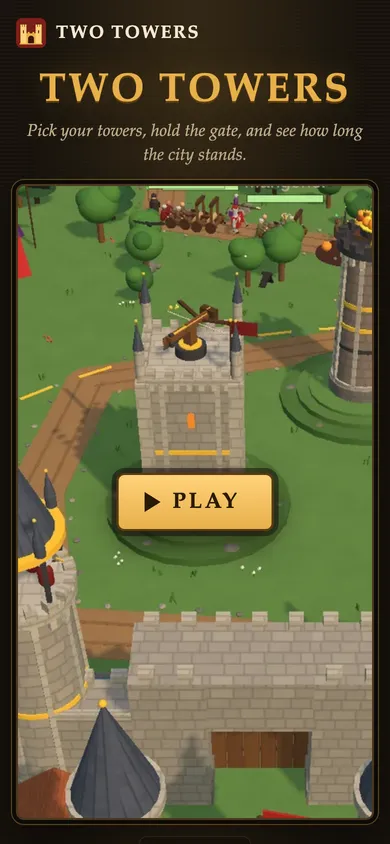
If stories of people holding ground against long odds draw you in, Two Towers lets you hold a castle gate yourself: a free tower defense game in your browser where the stages never end and you play to see how long you last.
Belsay: a castle family with a duty to serve
Belsay sits in Northumberland's border country, and the Middleton family has lived there almost continuously since the 13th century. English Heritage's history of Belsay says they are first recorded there in 1270. In the late 14th century they built the great fortified tower that still dominates the castle, one of the best-surviving pele towers, the kind of tall stone tower rich border families raised to defend themselves. You can read how such towers were lived in, floor by floor, in our post on tower house castles.
The family later added a mansion wing in 1614, and on Christmas Day 1817 they moved out of the castle into Sir Charles Monck's new Greek Revival hall nearby. That hall is where Mary lived a century later.
The castle also handed down a habit. English Heritage says that for centuries local service and politics had been the duties of the Baronets of Belsay. Sir Arthur Middleton had been MP for the City of Durham, and Sir Charles Monck MP for Northumberland. The next man in line was expected to carry it on.
A widow takes her husband's place
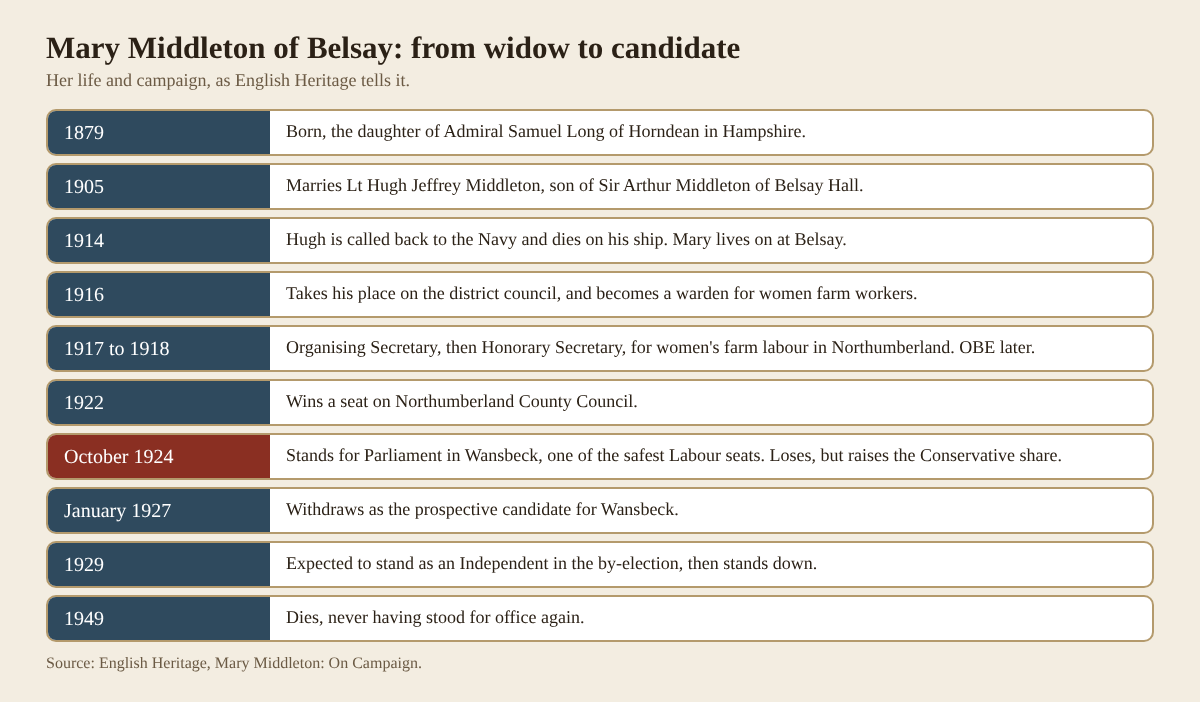
Mary was born in 1879, the daughter of Admiral Samuel Long of Horndean in Hampshire. In 1905 she married Lt Hugh Jeffrey Middleton, a naval officer and the son of Sir Arthur. They had four children: John, Kitty, Stephen and Lawrence.
Hugh had retired from the Navy in 1909. When the First World War began he was called back into service, and he died on his ship. Mary stayed at Belsay with the children for the next 20 years.
Hugh would have been expected to continue the family's tradition of service. So in 1916 Mary took his vacant place on the district council. At the time, women qualified for local office only under certain conditions, and in her case it was her status as a widow.
She did not stop there. She sat on Northumberland's Education Committee, led the county's Federation of Women's Institutes and its executive committee, and was County Commissioner for Girl Guides. In 1922 she won a seat on Northumberland County Council, pointing to her local patronage and public service as proof she could do the work.
War work on Northumberland's farms
English Heritage says Mary's local service was typical of women who hoped for a political career in the early 1920s. The war is what opened new doors.
In 1916 she became a warden in the Northumberland Guild of War Agricultural Workers, one of many groups set up to fill farm jobs while men were at the front. She ran a network that placed, trained and watched over women working on farms across the county. Country Life called her "a spirited worker and good organiser".
When the Ministry of Agriculture took formal charge of farm labour in 1917, Mary became Organising Secretary for the Northumberland Board of Agriculture. The board had to train women for farm work in about a month and then find them places. By 1918 she was Honorary Secretary of the Northumberland Woman's County Agricultural Committee, and she was sent to advise the founders of a similar scheme in Scotland. She later joined the Council of Agriculture for England and received the OBE.
The first women to stand for Parliament
On 21 November 1918 the Parliament (Qualification of Women) Act let women over 21 stand for Parliament. Earlier that year, women over 30 who met a property qualification had won the vote.
English Heritage explains that women were mostly picked for seats they could not win, often at the last minute when no suitable man came forward. That left them little time to "nurse" the seat: to turn up at local events and give to local causes between elections.
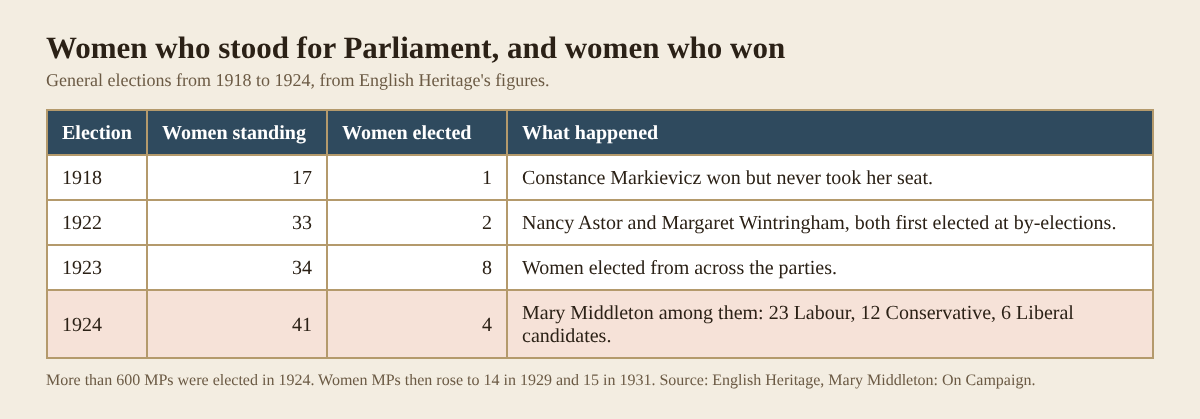
Of 17 women who stood in 1918, only Constance Markievicz of Sinn Fein won, and she never took her seat. Nancy Astor became the first woman to sit in the Commons after a by-election in 1919, and Margaret Wintringham joined her in 1921. Mabel Philipson won Berwick-upon-Tweed in 1923. All three took seats their husbands had held before them, which shows how much family ties counted.
Wansbeck, 1924: a hopeless seat
In the 1924 General Election Mary was one of 41 women candidates: 23 Labour, 12 Conservative and 6 Liberal.
Her seat was Wansbeck in Northumberland, a rural area with large mining communities. Mary stood as a Conservative against Labour's George Warne, who had worked as a miner from the age of 12. Warne had beaten her party's last candidate by 4,452 votes in 1923, and Wansbeck was counted among the safest Labour seats in the country. Even the chair of the local Unionist association called her "a very brave woman" for standing.
Campaigns then ran on public meetings, which suited her. She had years of speaking at party events and fundraisers, opening schools and presiding over flower shows and sports days. Newspapers reported her speeches widely and called her a "racy" speaker. She followed her party's line, opposing Labour's trade treaty with the Soviet Union and arguing that new markets in the Empire, not Russia, would deal with unemployment. Five days before polling day she asked women to vote for her whatever their party, saying women had never had such a chance.
How Mary Middleton of Belsay lost, and what she won
As expected, Mary lost. But she greatly increased her party's share of the vote, a blow to Labour's confidence in a seat it thought was easy. Meeting Warne later in the House of Commons, she said: "I think he thought I was a ghost come to turn him out."
Her party was pleased and adopted her at once for the next election. In January 1927 she withdrew; one newspaper reported that she found singing and music more worthwhile than politics, but her real reason is unknown. In 1929 she was expected to stand as an Independent in a Wansbeck by-election, then stood down. When she tried to return in the late 1930s, she was passed over for a candidate described as a "man's man". She never stood again, and she died in 1949.
English Heritage's point is that candidates like her still mattered. Women MPs grew from 4 in 1924 to 14 in 1929 and 15 in 1931, and in 1929 Margaret Bondfield became the first woman in the Cabinet. In the North East, Ellen Wilkinson won Middlesbrough East in 1924, and Irene Ward won in 1931 and served 38 years. The 1928 Equal Franchise Act finally gave women the vote at 21, on the same terms as men. Mary's story sits beside other women of castle families English Heritage writes about, such as Lady Anne Clifford and Isabella de Fortibus.
Read any early candidate with four questions
Here is a short method you can follow with Mary's story, then use on any candidate you read about.
- How did she get in the door? For Mary, her husband's council seat, which she could fill as a widow in 1916.
- What did she run before she ran for office? A county network placing women on farms, which earned her the OBE and a name as an organiser.
- What seat was she given? Wansbeck, a Labour stronghold won by 4,452 votes the year before. Note it before you judge the result.
- What did the loss change? A larger share for her party, an offer to stand again, and one more woman on a national platform.
The same habit helps in Two Towers, where the title screen says it plainly: "Two towers. One gate. Hold it as long as you can." There is no final stage, so you measure a run by how far it got, not by a win. When the gate falls, the game says which attacker did most of it ("The gate fell mostly to" and its share of the damage). Read that line like question four: what changed, and what to do next run. The game's own tip is a good start: "Spend your gold on Damage between stages, and Reinforce the gate."
Frequently asked questions
Who was Mary Middleton of Belsay?
Mary Katherine Middleton (1879 to 1949) was the widow of Lt Hugh Middleton of the Belsay family in Northumberland. She served on local councils, ran women's farm labour in the county during the First World War, and stood for Parliament in 1924.
Did Mary Middleton win her election?
No. She lost Wansbeck in 1924 to Labour's George Warne in one of the safest Labour seats in the country. She did greatly raise the Conservative share of the vote there.
How many women stood for Parliament in 1924?
English Heritage counts 41 women candidates in the 1924 General Election: 23 Labour, 12 Conservative and 6 Liberal. Four women MPs sat after that election.
What is Belsay Castle?
It is the Middleton family's late 14th-century pele tower in Northumberland, later given a mansion wing in 1614. The family moved to the new hall beside it in 1817, and English Heritage now looks after the castle, hall and gardens.
Get started
Mary stood her ground in a seat she could not win. In Two Towers you hold a gate against stages that never end, and every run is a chance to last a little longer. Play Two Towers: it is free and plays in your browser on a computer or a phone.
Defend the castle gate, stage after stage.
Visit twotowers.vlvd.net↗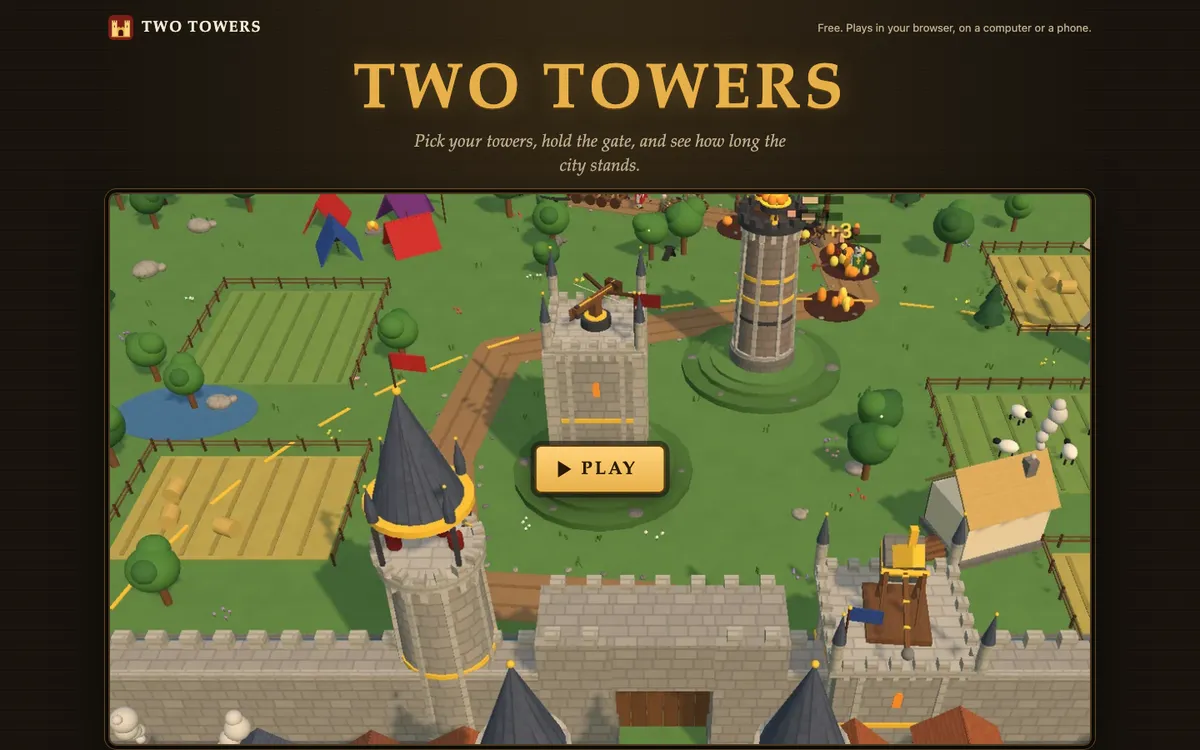
Comments
No comments yet.