Norham Castle: the Tweed fortress the Scots besieged nine times
Norham Castle stands beside the River Tweed, on the border between England and Scotland. For 450 years it was one of the great English strongholds on the river, and English Heritage's history of Norham counts nine Scottish sieges, four of which took the castle. This post follows those sieges in order and asks what kept a border castle standing for so long.
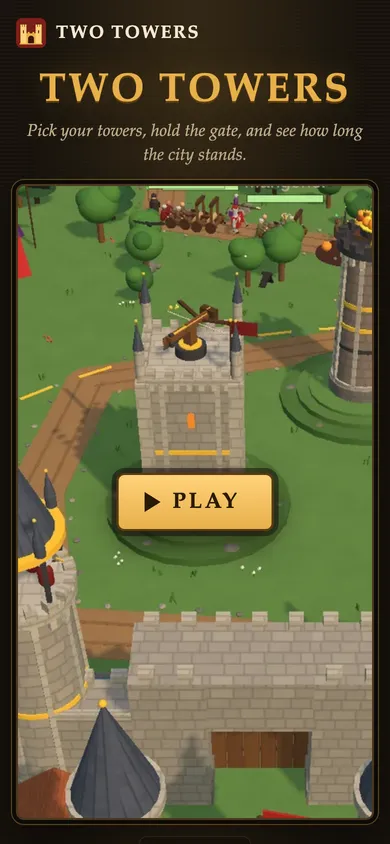
If you want to hold a gate of your own against wave after wave, Two Towers is a free tower defense game in your browser where every stage comes stronger than the last and there is no final stage.
Why Norham Castle mattered on the Tweed
The castle was founded by Ranulph Flambard, Bishop of Durham from 1099 to 1128. The bishops of Durham had near-kingly powers in the north, and in return they kept order along the border.
The border could be wild and lawless, and it sometimes broke into open war. In wartime Norham's English garrison guarded the Tweed fords, an easy crossing point into England. With the castles of Berwick and Wark nearby, Norham was a key part of the defences of the eastern border.
That is the first thing to understand about Norham. It was not built to be lived in quietly. It was built to stand in the way.
A great tower and a 40-day siege in 1215
Henry II saw how much the castle mattered. He ordered Hugh du Puiset, Bishop of Durham from 1153, to rebuild it, and Puiset did so on a grand scale. He raised a great tower on the site of Flambard's first two-storey hall, to give the castle high-status rooms.
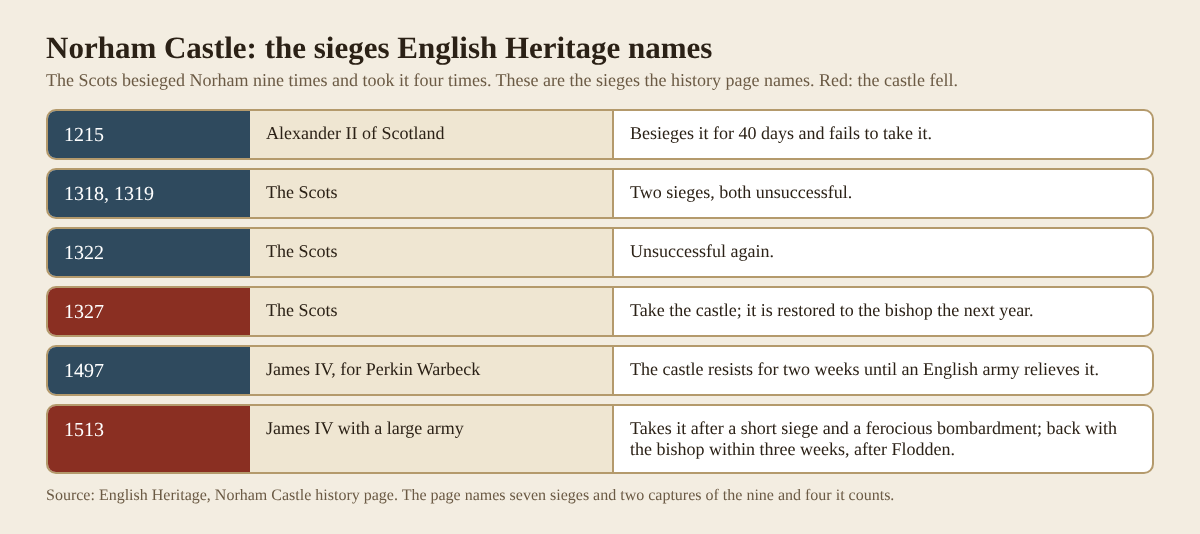
Between 1208 and 1212 King John spent large sums on Norham too. The money was tested in 1215, when Alexander II of Scotland besieged the castle for 40 days and failed to take it. Peace between England and Scotland was signed at Norham itself in 1219, and it held along the border for most of the 13th century.
The Great Cause: a king's judgment at Norham
The most famous day in Norham's history was not a siege. In May 1291 Bishop Anthony Beck hosted Edward I at the castle while the king judged between 13 people who claimed the Scottish throne. This was the Great Cause.
Edward chose John Baliol in 1292, at Berwick Castle. Three days later Baliol paid homage to Edward in the hall at Norham. Edward's claim to be overlord of Scotland led to long years of war on the border, and Norham was in the middle of it.
Besieged in 1318, 1319 and 1322, taken in 1327
The Scots besieged Norham in 1318, again in 1319 and again in 1322. Each time it held. In 1327 they finally took it, but it went back to the bishop the following year.
Around 1422 the great tower was rebuilt as a rectangular tower of five storeys, much as its ruin stands today. Then came a time of relative peace, until a Scottish king came to the Tweed with a pretender at his side.
1497 and 1513: a relief army, then the guns
In 1497 James IV of Scotland besieged Norham in support of Perkin Warbeck, who claimed the English throne. The castle held for two weeks, long enough for an English army to arrive and relieve it. Holding out until help came was the whole plan, and it worked. Our post on the relief army in a siege has more sieges that turned on it.
In 1513 James IV came back with a large army and took Norham after a short siege. The Scottish bombardment did great damage. Yet in less than three weeks the castle was the bishop's again, because the English beat the Scots at the Battle of Flodden nearby. The Scots took Etal Castle in 1513 too, which our Etal Castle post follows.
Norham Castle rebuilt for artillery
Norham was too important to leave broken, so rebuilding began almost at once. This time English military engineers turned it into an artillery fortress, where the garrison could fire back with great force from covered positions.
They rebuilt the wall of the outer ward and packed earth around its lower courses, to make it stronger and to soak up incoming shot. They built gun towers and arched gun positions. The guns of 1513 had done great damage, so the new wall was made to absorb the blows. Our post on what a bombard was explains the kind of guns that forced this change.
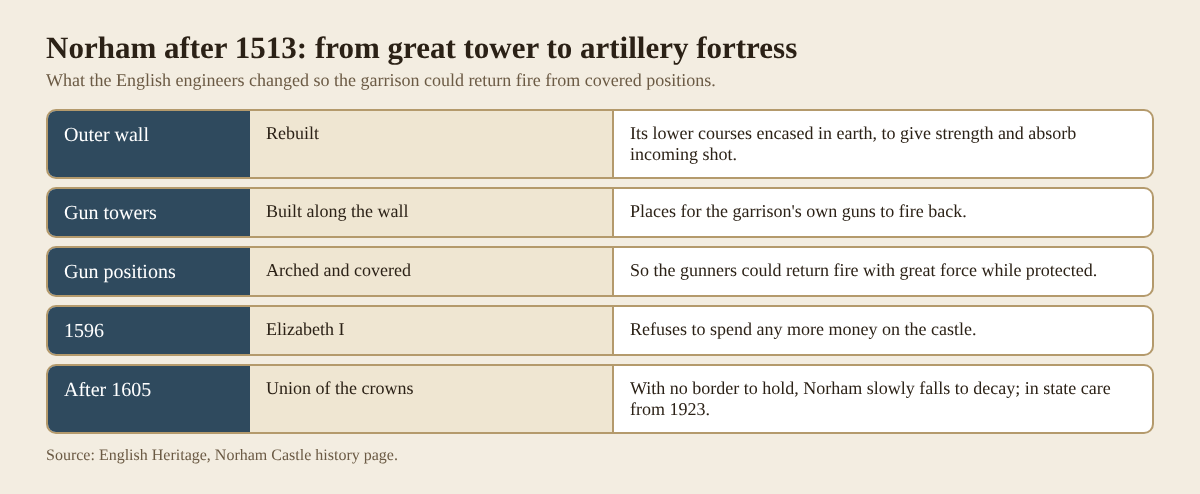
The castle was kept up for most of the 16th century. In 1596 Elizabeth I refused to spend any more money on it, and after the crowns of England and Scotland were united in 1605 it slowly decayed. With no border war left to fight, the castle had lost its reason to exist. The ruins passed through many hands until 1923, when they were placed in the care of the state.
A worked example: hold the gate the Norham way
Norham's story has one lesson that runs through all nine sieges: a castle that must hold again and again has to be repaired and strengthened between attacks. In Two Towers the gate faces the same thing, with no final stage. Here is a plan built only from what the game says, one step for each part of Norham's story.
- Pick a strong pair. Puiset's great tower was rebuilt again and again. Choose your two gate towers on the title screen from the Archer Tower, Trebuchet, Ballista and Fire Tower. Against heavy attackers a Ballista is a good start, since its bolt goes through a line of attackers and ignores armor.
- Spend between attacks. Norham was rebuilt after almost every siege. The game's own advice is: "Spend your gold on Damage between stages, and Reinforce the gate."
- Answer the rams. The game says: "Rams hit the gate hardest: Reinforce the gate, and use Ballista bolts that ignore armor."
- Answer the stone-throwers from range. Norham's walls were built to soak up shot. In the game: "Mangonels throw stones from far off: a hill tower with Range reaches them." The first hill tower costs 150 gold and the second 300.
- Stop the tall threats early. "Siege towers let a crew out at the wall: stop them early with a Ballista and Damage."
Then play stage by stage and note what reached the gate. Like the bishops of Durham, you are not trying to win once. You are trying to still be standing next time. The gate post covers when to repair and when to reinforce.
Frequently asked questions
How many times was Norham Castle besieged?
English Heritage says the Scots besieged it nine times and took it on four occasions. The sieges it names are 1215, 1318, 1319, 1322, 1327, 1497 and 1513.
Who built Norham Castle?
Ranulph Flambard, Bishop of Durham from 1099 to 1128, founded it. Hugh du Puiset rebuilt it on Henry II's orders and raised the great tower.
What happened at Norham Castle in 1513?
James IV of Scotland took it after a short siege and a heavy bombardment. It was back with the Bishop of Durham in less than three weeks, after the English won at Flodden.
Why did Norham Castle fall into ruin?
Elizabeth I refused to pay for it in 1596, and after the crowns were united in 1605 there was no border to defend. It slowly decayed until the state took it into care in 1923.
Get started
Norham held the Tweed because it was rebuilt and made stronger after every blow. To try holding a gate that never stops being attacked, play Two Towers: pick your two towers, reinforce the gate between stages and see how many you can hold.
Defend the castle gate, stage after stage.
Visit twotowers.vlvd.net↗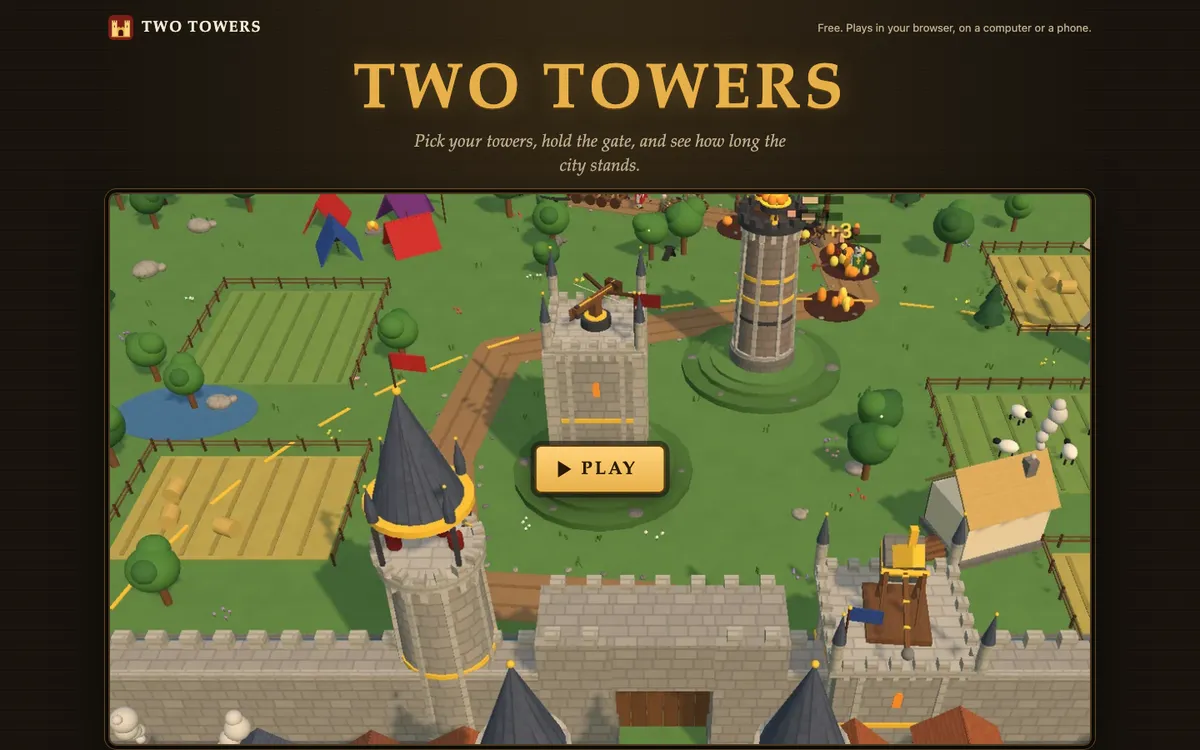
Comments
No comments yet.