Etal Castle: a border castle the Scots took in 1513
Etal Castle stands in north Northumberland, a few miles from the Scottish border, and it is small: a tower house, a gatehouse and a ring of wall. English Heritage calls it a fine example of a small castle close to the border, in a region where raiding and warfare were common. In 1513 the Scots took it, and the English got it back soon afterwards.
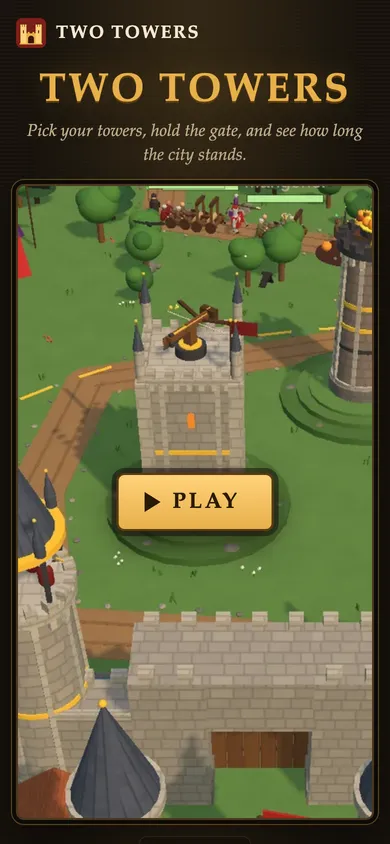
If you like working out why a defence holds or fails, Two Towers is a free browser game where you pick the two towers that guard a gate and spend gold on upgrades between stages.
The border that Etal had to guard
The land around Etal is known as the Borders. English Heritage says that through the Middle Ages it was a dangerous and lawless frontier, prone to raiding and plundering by armed groups. After 1100 the Norman rulers of England set up baronies in the north: large tracts of land given to a warrior lord, who split them into manors governed by knights loyal to him. In return the baron and his knights defended the border and served the king when bigger expeditions were needed.
In 1249 Henry III of England and Alexander III of Scotland agreed on buffer zones along the whole border. On each side they were called the East, Middle and West Marches, and each had a warden answerable to a Lord Warden for that country. A special system of law, March Law, tried to keep control and settle disputes. It did not work well enough, because raiding, feuding and killing stayed commonplace.
The Manners family and the Heron feud
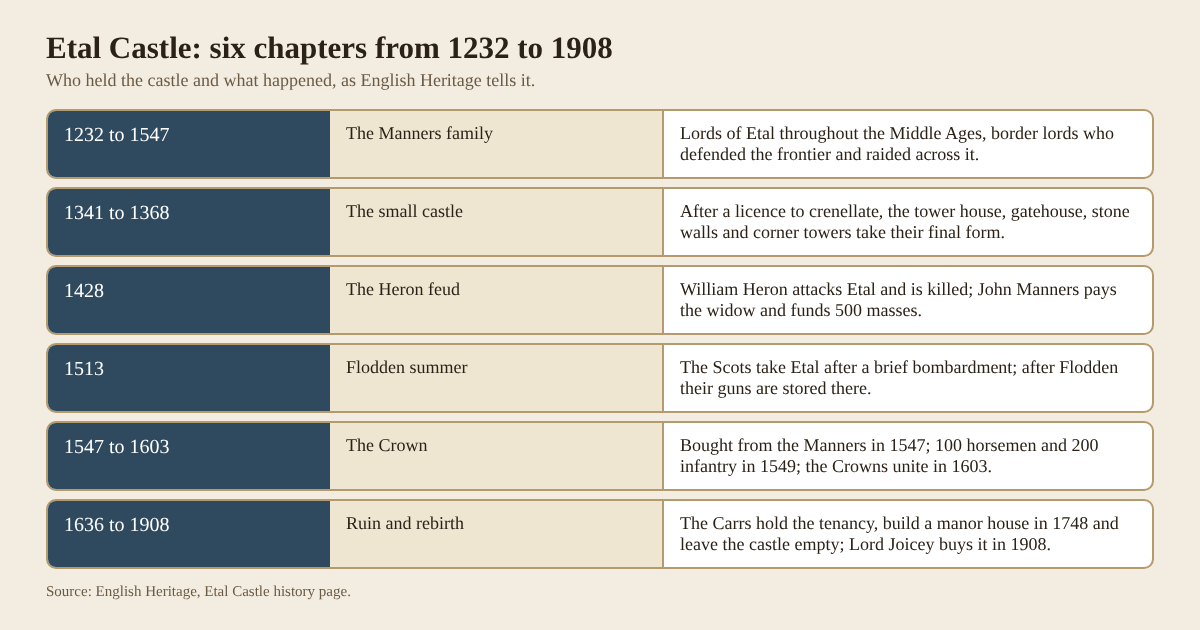
Etal belonged to the barony of Wooler, made for Robert de Muschamp in 1107. By 1232, and possibly by 1180, Robert Manners owned it, and his descendants were lords of Etal throughout the Middle Ages. English Heritage calls them typical border lords: important in regional affairs, they defended the border, launched raids across it and negotiated peace when that suited. Sir Robert Manners fought at the Battle of Neville's Cross on 17 October 1346, where an invading Scottish army that had reached Durham was beaten. A later Robert Manners fought beside Henry Percy, 3rd Earl of Northumberland, in the Wars of the Roses, and both died at Towton in 1461. For another Northumberland fortress of a border family, see the Dunstanburgh Castle post.
The feud of 1428. Feuds between local families could be as violent as the wars with Scotland. In the early 15th century John Manners fell out with the Heron family of the nearby manor of Ford. In 1428 William Heron led an armed group to Etal, fighting broke out, and William and one of his men were killed. John Manners was blamed and brought to trial. He argued that William had attacked Etal and that he was not personally responsible, and the court accepted that. The law still made him pay William's widow a large sum and fund a priest to say 500 masses for William's soul. The feud carried on until John died in 1438.
How Etal Castle grew after 1341
Nothing is known about the buildings at Etal in the 12th and 13th centuries. There may have been a timber hall in an earthwork enclosure with a palisade, which the Borders call a barmkin. Etal was described as a fortalice, a minor fortification, in 1355, and as a castle in 1368. In 1341 Edward III gave a licence to crenellate, a permit to fortify, and English Heritage thinks the small castle we see today took its final form between 1341 and 1368, with the tower house, gatehouse, stone walls and corner towers.
The work was Sir Robert Manners and his son John's. The top floor of the tower house was added to lower storeys, so the licence may have paid for strengthening a building that stood before 1341. When Sir Robert died in 1354 his estate at Etal included a corn mill, a fulling mill for wool, lime kilns and coal mines, and he had paid for a chantry at Etal Chapel, where a priest prayed for his soul.
Inside the gatehouse and the tower house
The gatehouse is two storeys high, though its two flanking towers had three. The gateway may have had a drawbridge and a projecting timber hoard, a fighting gallery, both long gone. Behind the drawbridge came a portcullis and the gate passage, with a doorway on each side into a guardroom. Upstairs, one large room held the winch that worked the drawbridge and portcullis, and its elaborate window tracery suggests it may also have served as a chapel. The castle gatehouse post explains why this was a castle's strongest part.
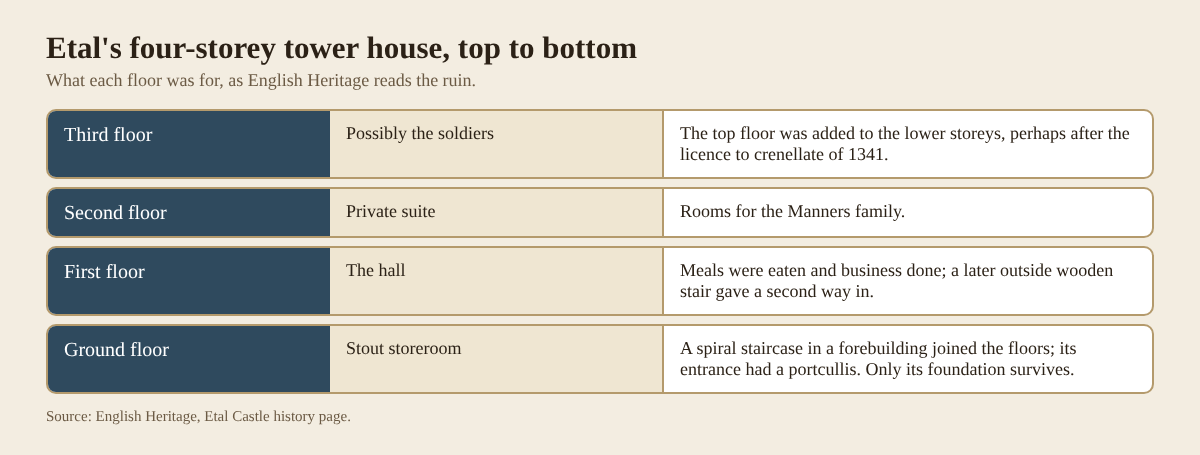
The four-storey tower house was the family's home, with a spiral staircase in a forebuilding, of which only the foundation survives. The ground floor was a stout storeroom. The first floor was the hall, where meals were eaten and business done. The second floor held a private suite for the Manners family, and the third was possibly for the castle's soldiers. A later door at first-floor level, with an outside wooden stair, made it easier to reach the hall. For more on this kind of building, see the tower house post.
1513: why Etal gave up so quickly
In the summer of 1513 James IV of Scotland brought a large army south to support his ally Louis XII of France, while Henry VIII was away fighting in France. The Scots crossed the border, which the river Tweed defines, and took several castles, including Norham, Ford and Etal. English Heritage says Etal was probably at least partly damaged by a brief bombardment.
The reason it fell so fast is in the wall. Most of the curtain wall has gone, but a good stretch survives on the south side. English Heritage says it was meant to deter raiding parties and was never strong enough to resist guns, and that it would have crumbled under gunfire once cannon became common in the later 14th century. The garrison surrendered to the Scottish army quickly for that reason. A wall built for raiders could not face a siege gun.
The Scots did not keep Etal for long. On 9 September 1513 the two armies met near Branxton, about 4 miles away. The English won crushingly, and James IV and many Scottish lords were killed. Afterwards the Scots' impressive guns were towed to Etal Castle and stored there for a while before going south to London.
From border post to ruin
George Manners inherited the Ros estate and chose to live at Helmsley Castle in Yorkshire, so Etal was left to a constable. In 1535 the constable, Henry Collingwood, kept 30 horsemen there, but by 1541 the castle was in disrepair. The Crown still thought it mattered for the border and in 1547 bought it from the Manners, who had held it for more than 300 years. In 1549, during the war called the Rough Wooing, 100 horsemen and 200 infantry were at Etal.
The union of the English and Scottish Crowns in 1603 made James VI of Scotland king of England too, and the need for a chain of border fortresses faded. Etal became a neglected, old-fashioned place. In 1636 a Scot, Robert Carr, took the tenancy, and the family kept it until the early 19th century. By then it was an abandoned ruin, because the Carrs had built a comfortable manor house at the other end of the village in 1748. James Joicey, a coal-mining magnate, bought it in 1908, and with the Ford estate it is still in the Joicey family.
A worked example: learning Etal's lesson in Two Towers
Etal's lesson is that a defence is only as good as its reach against what the enemy brings. A wall for raiders failed against guns. You can test the same idea in Two Towers with a plan that uses only what the game says.
- Read the game's warnings. Its tips say: "Archers shoot the gate from the road: buy Range so your towers reach them before they stop." and "Crossbowmen shoot from afar: Range upgrades and a Trebuchet reach them."
- Pick for reach. Choose an Archer Tower for one side of the gate and a Trebuchet for the other.
- Spend early gold on Range. Buy Range upgrades for both towers before you spend on anything else, so your towers reach the attackers who stop short of the gate.
- Add a hill tower. The first costs 150 gold, and it can be any of the four kinds. A second Trebuchet there adds reach, and you can place a second hill tower for 300 gold when you can afford it.
- Learn from a loss. If the gate falls, the game says "The gate fell mostly to" one kind of attacker and gives the share of the damage it did. Plan the next game around that attacker, as the English learned from 1513.
The game's general tip also applies: "Spend your gold on Damage between stages, and Reinforce the gate." Between stages you can repair or reinforce the gate too, so see the gate post for when to choose each.
Frequently asked questions
Where is Etal Castle?
In north Northumberland, close to the border with Scotland. English Heritage says it stood by a ford over the river Till, in the region known as the Borders.
Who built Etal Castle?
The Manners family. English Heritage says the small castle took its final form between 1341 and 1368, the work of Sir Robert Manners and his son John.
Did the Scots capture Etal Castle?
Yes, in 1513, during James IV's invasion. The garrison surrendered quickly, and the English recovered the castle soon after the Scottish defeat at Flodden.
Why did Etal Castle fall into ruin?
After the Crowns of England and Scotland united in 1603, the border fortresses were no longer needed. Etal was rented out, then abandoned as a ruin by the early 19th century.
Get started
Etal shows what happens when a wall cannot reach the threat. To test your own defence, play Two Towers: pick your two towers, spend on Range and see how long your gate holds.
Defend the castle gate, stage after stage.
Visit twotowers.vlvd.net↗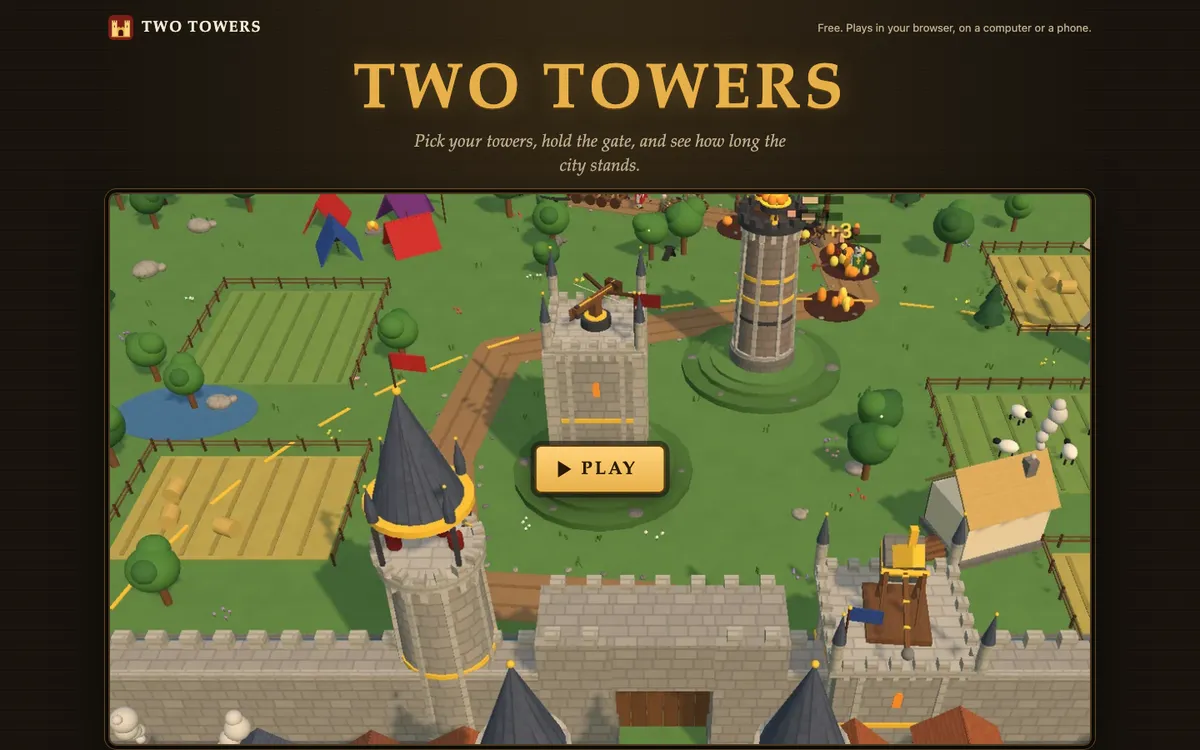
Comments
No comments yet.
Sign in or make an account to comment.