Okehampton Castle: the Courtenay earls and a Devon deer park
Okehampton Castle stands over a valley on the northern edge of Dartmoor in Devon. It began as a Norman earth and timber castle soon after 1066, and in the early 14th century Hugh Courtenay II rebuilt it as a luxury retreat for hunting in the deer park beside it. After 1538, when a later Courtenay was beheaded for treason, it was abandoned.
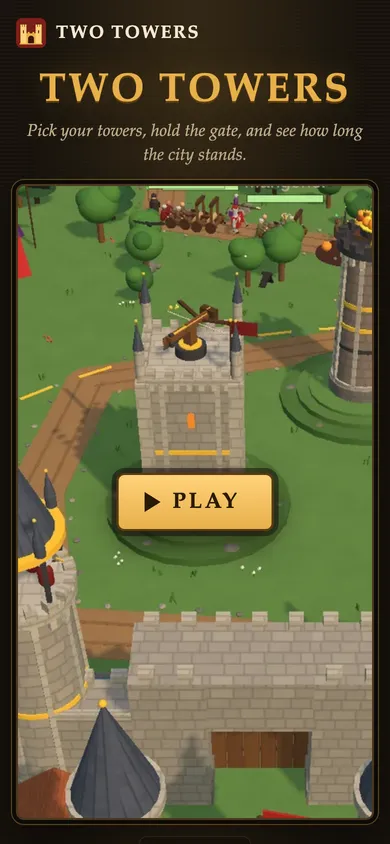
If you like seeing how a castle stacked one defence behind another, Two Towers is a free browser game where you pick the two towers that guard a city gate and decide how to spend your gold on it.
Okehampton Castle and the Norman conquest of Devon
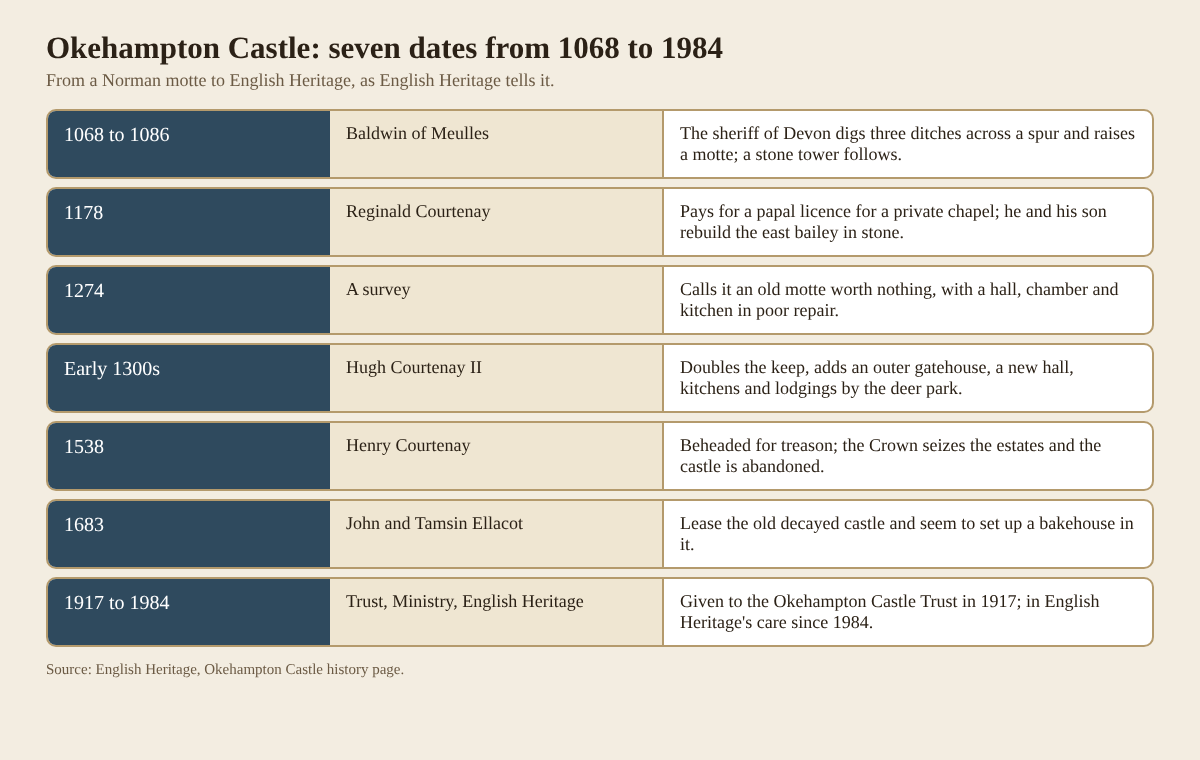
The castle starts with a siege. In 1068 William the Conqueror captured Exeter after a siege and gave the city to a Norman commander, Baldwin of Meulles, whom he made sheriff of Devon. Baldwin oversaw the building of the royal castle at Exeter. English Heritage says that at some point between 1068 and 1086 he also built a castle of his own on one of his new estates, outside the village of Okehampton, 25 miles from Exeter.
He chose a spur of high ground beside the West Okement river. His workers dug three ditches across the spur and piled up the spoil into a motte, an earthen mound. The river and a stream beside it served as a moat on two sides, and there were two baileys, one on each side of the motte. Either Baldwin or his son Richard, who died in 1137, then put a stone tower on top. The motte and bailey post explains how this kind of castle worked.
The Courtenays take Okehampton
About a century later the castle passed to another Norman family. Reginald Courtenay, who died in 1190, married Baldwin's great-great-niece Hawisia, and the Courtenays went on to hold the castle for nearly four centuries. In 1178 Reginald paid for a papal licence to have a private chapel there. Digs show that he and his son Robert rebuilt the east bailey in stone, with a new gatehouse and a range of buildings along the north side.
That work did not last well. A survey of 1274 described the site as "an old motte that is worth nothing", with a hall, chamber and kitchen in poor repair beyond it. The castle you see today took shape only in the early 14th century.
Hugh Courtenay's hunting retreat
Hugh Courtenay II was born in 1276 and inherited the barony of Okehampton, castle included, in 1292. He came of age in 1297 and fought in Edward I's campaigns in Scotland until 1308. In the first decade of the 14th century he, his mother Eleanor and his wife Agnes set about rebuilding both their castles, at Tiverton and Okehampton. Tiverton stayed their main base. Okehampton became a place to enjoy.
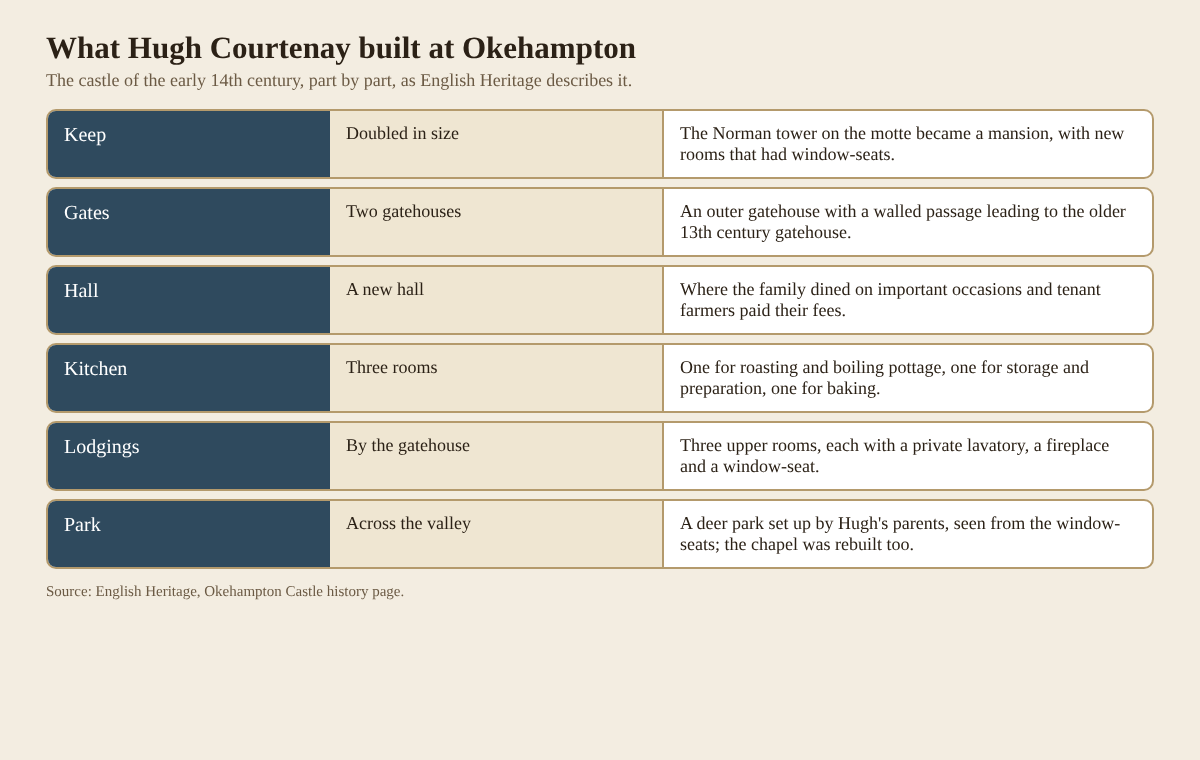
The Courtenays doubled the footprint of the Norman keep, turning it from a tower into a mansion. They repaired the 13th century bailey walls and gatehouse and added an outer gatehouse, with a walled passage that led to the old one. Inside the bailey they built a new hall, where they dined on important occasions and where tenant farmers came to pay their fees. Beyond it stood a detached kitchen of three rooms: one for roasting meat and boiling pottage, one for storage and preparation, and one for baking bread and pies. The castle kitchens post shows how such a kitchen fed a household.
Hugh also built a new lodging suite by the gatehouse. Its three upper rooms each had a private lavatory, a fireplace and a window-seat, as did the new rooms in the keep. From those seats you could watch the hunting in the deer park that Hugh's parents had set up across the valley. The chapel was rebuilt too, and some of its walls still stand almost to roof height.
The Courtenay earls and the fall of 1538
Hugh had inherited the earldom of Devon in 1293 through his great-grandmother, but he only gained the formal title of Earl of Devon in 1335. The family's luck ran out in the Wars of the Roses. Between 1461 and 1471 the three male Courtenay heirs all lost their lives on the losing Lancastrian side, and the last medieval earl, John Courtenay, died in battle at Tewkesbury in 1471.
In 1511 the young Henry VIII gave the title to distant cousins. The third of the new earls, Henry Courtenay, was the king's cousin, friend and hunting companion. But he favoured traditional religion and opposed the closure of the monasteries. In 1538 the king heard of an "Exeter Conspiracy" in which Courtenay and Reginald Pole were said to be plotting against him. Courtenay was arrested, tried for treason and beheaded at the Tower of London in December 1538. The Crown seized most of his lands and castles, and Okehampton was left empty.
From ruin to bakehouse to English Heritage
In 1544 Henry VIII leased, then granted, the hunting park to Sir Peter Carew, a soldier and distant relative of the Courtenays. He did not own the castle, but English Heritage thinks he probably began stripping it of anything valuable, such as the Beer stone columns of the gatehouse. With the lead gone from the roofs, the buildings quickly decayed. Unlike many castles, Okehampton played no part in the Civil Wars of the 1640s. In 1683 John Ellacot, a future mayor of Okehampton, and his wife Tamsin seem to have set up a bakehouse in the "old decayed castle", with an oven in the western lodging.
By the 18th century the ruin drew artists: Samuel and Nathaniel Buck drew it in 1734, and JMW Turner sketched it in 1814. A Devon ghost song, "My Lady's Coach", tells of a Lady Howard riding nightly in a ghostly coach from Okehampton Castle to Launceston Castle; English Heritage links her to Mary Fitz, who lived from 1596 to 1671. Sydney Simmons bought the site in 1911 and gave the restored castle to the Okehampton Castle Trust in 1917. It passed to the state in 1967, digs began in 1972, and English Heritage has cared for it since 1984. The Launceston Castle post tells the story of the other end of that ghostly ride.
A worked example: Okehampton's layers as a Two Towers plan
Hugh Courtenay put an outer gatehouse and a walled passage in front of an older gate, so an attacker had to get through one defence after another. You can build the same layers in Two Towers, using only what the game itself tells you.
- Pick two towers for the gate. The Archer Tower, Trebuchet, Ballista and Fire Tower each answer a different kind of attacker, so choose two that differ.
- Reach them early. The game's tip says: "Archers shoot the gate from the road: buy Range so your towers reach them before they stop."
- Add a layer on the road. Another tip says: "Raise barricades to slow them down." A slower attacker spends longer under your towers.
- Strengthen the last layer. The general tip is "Spend your gold on Damage between stages, and Reinforce the gate."
- Buy the hills when you can. The first hill tower costs 150 gold and the second 300, and any of the four kinds can go there.
Play a few stages and watch where the attackers stop. The gate post has more on when to repair and when to reinforce.
Frequently asked questions
Who built Okehampton Castle?
Baldwin of Meulles, the Norman sheriff of Devon, built the first castle between 1068 and 1086. Hugh Courtenay II rebuilt most of what you see today in the early 14th century.
Why was Okehampton Castle abandoned?
Henry Courtenay was beheaded for treason in December 1538 and the Crown seized most of his lands. The castle was left empty, and later stripped of its valuable materials.
Was Okehampton Castle used in the Civil War?
No. English Heritage says that, unlike many medieval castles, it was not pressed into use in the Civil Wars of the 1640s.
What was the deer park at Okehampton for?
Hunting. Hugh Courtenay's parents set it up across the valley, and the window-seats of the new lodgings looked out over it.
Get started
Okehampton shows that one gate is stronger with another in front of it. To try that layering yourself, play Two Towers: pick your two towers, slow the road and see how long your gate holds.
Defend the castle gate, stage after stage.
Visit twotowers.vlvd.net↗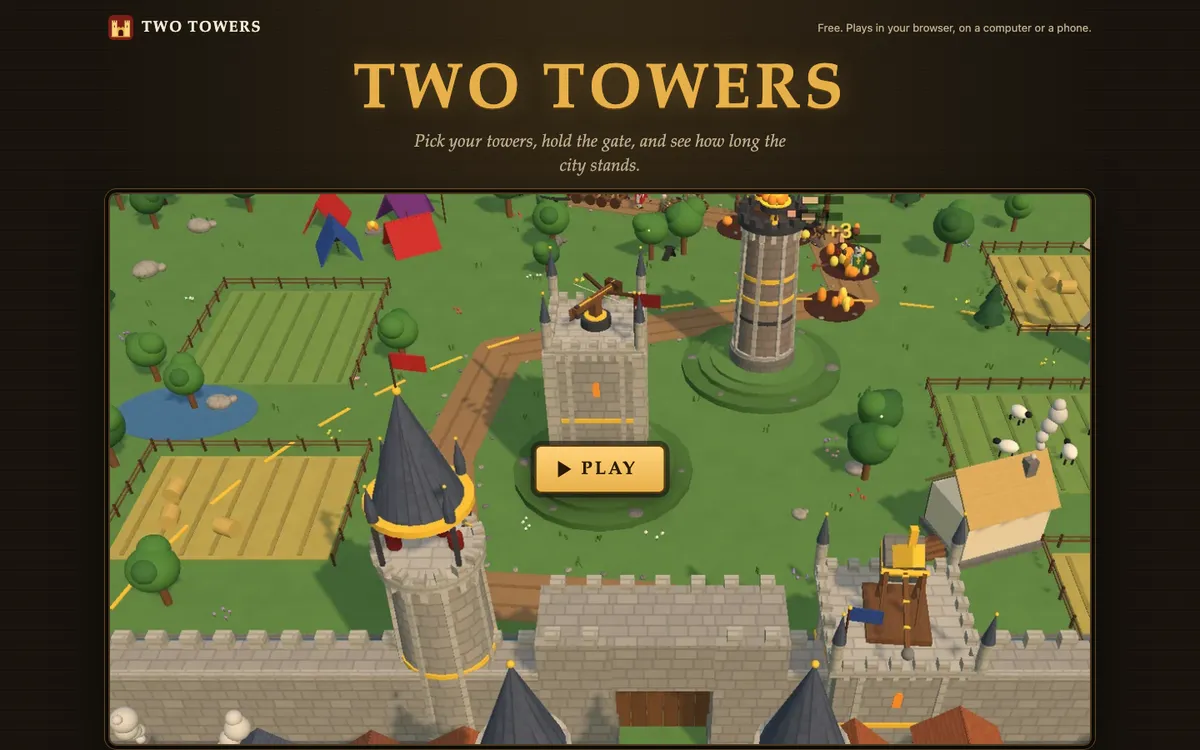
Comments
No comments yet.