Plato's Philosopher King: Why the Republic Wants One
Plato's philosopher king is the ruler of the ideal city in the Republic: a person educated to know what is good, who governs the city because the law requires it, not because they want power. The idea is simple to state and hard to defend, and this guide sets out both sides. You will see where the ruler sits in Plato's three-class city, why Socrates insists the philosophers must be forced to rule, and the main objections scholars still argue over.
If you want to learn this with questions that check you, Learn 100 Influential People teaches Plato in its Greek Thinkers course, in short lessons that list their sources and set out where researchers disagree.
What is Plato's philosopher king?
The Republic opens with a question about justice. In Book One, Socrates argues that a ruler's task is to benefit the people ruled, not to profit from them. The rest of the dialogue tries to show what a just person and a just city look like, and why the just life is better.
To do that, Socrates builds cities in words. The ruler who emerges at the top of the best one is what readers call the philosopher king. Plato's own phrase is closer to "philosopher-rulers", and they need not be kings in our sense, or even men. What makes them rulers is what they know and how they were raised, not their birth.
The core claim has two parts. First, the rulers must know what goodness is. Second, they must not want to rule. Each part answers a different danger: rulers who mean well but do not know, and rulers who know but use power for themselves.
The three cities of the Republic
The Stanford Encyclopedia of Philosophy's entry on Plato's ethics and politics in the Republic points out that the dialogue sketches three cities, not one:
- The first city (369b to 372e) meets basic needs. It has no provision for war and no division into classes.
- The "fevered city", or "city of luxuries" (372e), adds wants beyond need. Socrates later purifies it of its luxuries (399e).
- Kallipolis, the "beautiful city" (527c2), is that purified city. It has three classes: ruling guardians, auxiliary guardians, and producers.
At 543c to d, Glaucon notes a further step: a three-class city whose rulers are not philosophers is different from one whose rulers are. The philosopher king is the answer to who should sit in the top class.
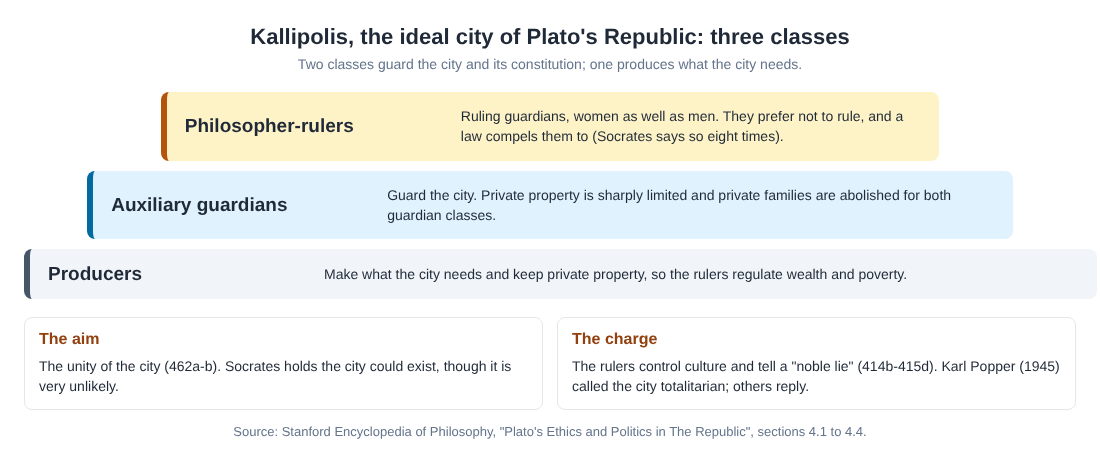
The three classes of Kallipolis, from the Stanford Encyclopedia of Philosophy's account.
Why the rulers must be philosophers
For Plato, goodness is tied to unity. The Stanford entry notes that Socrates says a virtuous person makes himself a unity (443c to e) and that a city is made good by being made a unity (462a to b). The form of the good, the thing the philosopher comes to grasp, stays a shadowy presence in the dialogue, behind its three famous images: the Sun, the Line and the Cave.
So the argument runs like this. A city is good when it is one, not split by factions. Someone who understands what goodness is can see what makes the city one. That understanding is what philosophy trains. Therefore the people who rule best are those who have studied what is good, and the philosophers are those people.
Training matters as much as knowledge. Books Two and Three describe the education of the guardians, best known for its censored reading list: young guardians are not shown bad pictures of gods and humans. Socrates is optimistic about the result. A well-trained guardian will "praise fine things, be pleased by them, receive them into his soul", and come to hate what is shameful.
The reluctant ruler: compelled to rule
Here is the part that surprises most readers. Socrates says eight times that the philosophers in the ideal city will have to be compelled to rule (the Stanford entry lists them: 473d4, 500d4, 519e4, 520a8, 520e2, 521b7, 539e3, 540b5). They would rather keep doing philosophy.
Scholars read this compulsion in two ways:
- Justice compels them. Ruling is what justice demands of people with their knowledge, so they rule.
- A law compels them. Socrates himself suggests the compulsion comes from a law requiring those educated as philosophers to rule. On this reading (E. Brown 2000), their justice makes them obey the law, and the law justly makes them rule.
Either way, the reluctance is the point. Socrates holds that philosophers are the best rulers because they prefer not to rule even while they are ruling (520e to 521b). People who want power fight over it. People who do not want it have no reason to bend the city to their own ends.
Could the ideal city exist?
Readers disagree on whether Plato meant Kallipolis as a plan or a thought experiment.
A model to judge by. Some readers think Socrates sketches the city as a warning against utopian politics, or as a picture of the good soul. They point to 472b to 473b, where Socrates says the ideal lets us judge how close we come to it, and 592a to b, where he says it can serve as a model whether or not it ever exists.
A real possibility. Others point to the many passages where Socrates insists the city could exist (450c to d, 456b to c, 473c, 499b to d, 502a to c, 540d to e). The Stanford entry's own reading is that the city means something to us even if it never exists, but that it could exist. It adds that this is very unlikely, because philosophy is in disrepute and the philosophical nature is easily corrupted, so philosophers rarely gain power and rulers rarely become philosophers.
Objections: property, family, women and the noble lie
Plato's city has drawn criticism since his own student. Here are the main lines, each with its reply.
Shared property and family. Both guardian classes give up private families, and their private property is sharply limited (415d to 417b), on the proverb that "friends possess everything in common" (423e6 to 424a2). The producers keep private property. Starting with Aristotle (Politics II 1 to 5), critics have argued that communism of any extent has no place in an ideal community, and Aristotle was also unsure how far it was meant to reach (1264a11 to 22). For more on how the two thinkers part ways, see Plato vs Aristotle compared.
Women as rulers. Socrates insists women be fully educated and allowed the highest offices, and argues that female philosopher-rulers are as happy as human beings can be. The best reason to doubt Plato's feminism, the Stanford entry says, is his disparaging remarks about women elsewhere; some scholars (Vlastos 1989) separate his view of women around him from his view of what women could be.
Totalitarianism. Karl Popper, in 1945, charged that the rulers aim at the unity of the city as a whole, regardless of what individual citizens want. The rulers also control culture and tell a "noble lie" (414b to 415d) to convince citizens of their unequal standing. Against Popper, Vlastos (1977) read the city's good as nothing more than the good of all its citizens added together. Many scholars now take a mixed view (Morrison 2001): the city's good and each citizen's good are separate things, which Plato thinks coincide, though only with the help of propaganda.
Study it in 20 minutes
Here is one way to make the idea stick, using the facts above.
- Draw the three classes from memory, then add one line under each: who rules, who guards, who produces, and who keeps private property.
- Write the two-part claim in your own words: rulers must know the good, and must not want to rule. Add the reason for each.
- Argue both sides of one objection. Spend five minutes as Popper, then five as Vlastos, using only what the text says.
- Compare with another answer to who should rule, such as the one in Locke vs Rousseau on the social contract.
Then test yourself a day later. If you can still explain why reluctance makes a good ruler, you have the heart of the argument.
Frequently asked questions
Who is the philosopher king in Plato's Republic?
The philosopher king is the ruling class of Kallipolis, the Republic's ideal city: guardians educated to know what is good, who rule because they are compelled to. They can be women as well as men.
Why do the philosophers have to be forced to rule?
They would rather do philosophy, and Socrates thinks that makes them the best rulers, since they have no wish to use power for themselves. Scholars read the force as either justice itself or a just law that requires them to rule.
Did Plato think the ideal city could really exist?
Socrates says it could, though it is very unlikely, and that it is useful as a model either way. Readers still disagree on whether it is a plan or a picture of the good soul.
Why do critics call Plato's Republic totalitarian?
Karl Popper argued that its rulers aim at the unity of the city regardless of individual citizens, and they control culture with a "noble lie". Other scholars reply that Plato thinks the city's good and the citizens' good coincide.
Get started
Plato is one of six people in The Greek Thinkers, with Socrates, Aristotle, Euclid, Archimedes and Hippocrates; if you want the teacher behind him, read Socrates vs Plato. The lessons ask you to choose, put in order, match, sort and estimate a number, every attempt is graded, and you can retake a lesson for a better grade. Questions from lessons you finish come back later, up to 5 a day. You sign in with your email and an emailed sign-in code, and accounts are for people aged 13 and over.
Start Learn 100 Influential People: short hands-on lessons on the people who shaped history, with every side of the debate and the sources to read next.
100 people who shaped history, from Moses to the web.
Visit influentialpeople.vlvd.net↗


Comments
No comments yet.