Qin Shi Huang, the First Emperor of China: What He Built
Qin Shi Huang was the first emperor of a unified China. He took the title in 221 BCE, after his state of Qin had beaten the six other Warring States, and he ruled until his death in 210 BCE. This post covers who he was, how he won, what he built and what it cost, using World History Encyclopedia's article on him, and it says where the evidence comes from writers who disliked him.
If you would rather learn this as a short lesson, Learn 100 Influential People puts Qin Shi Huang in its Empire Builders course next to Cyrus, Alexander, Caesar and Genghis Khan, in lessons of about 9 minutes with questions that check what you remember.
Who was Qin Shi Huang?
"Shi Huangdi" means "First Emperor" and is a title, not a name. World History Encyclopedia gives his lifespan as about 259 to 210 BCE and says he was born Ying Zheng, also called Zhao Zheng, in the state of Qin. The Qin dynasty he founded (221 to 206 BCE) gave its name to China.
His birth is already a debate. The historian Sima Qian (about 145 to 86 BCE) wrote that the king, Zhuangxiang, was not his real father, and that the wealthy merchant Lu Buwei, who had brought his mother Zhao Ji to the king, was. World History Encyclopedia notes that Sima Qian was hostile to Shi Huangdi, as almost all later writers are, so the claim is often disputed. Keep that in mind: most of what we read about him was written by people who did not like him.
He took the throne at 12 or 13. Lu Buwei ruled as regent, then a man called Lao Ai led a revolt in 238 BCE. The king's army beat it, Lao Ai was executed, and Lu Buwei took poison. The king then made his close associate Li Siu prime minister and ruled Qin fully himself.
How Qin won: the Warring States and Legalism
China was then split into seven states, Chu, Han, Qi, Qin, Wei, Yan and Zhao, and the Zhou rulers in Luoyang could no longer govern them. None of the seven could gain the upper hand over the others for long.
World History Encyclopedia ties Qin's success to Shang Yang (died 338 BCE), who developed Legalism and argued for total war. Before his reforms, it says, war was treated as a noble's game with rules, and a general was expected to treat a beaten enemy with honour. Qin dropped those rules. After its win over Zhao at Changping in 260 BCE it made little more progress for a while, but under the king the six other states fell quickly.
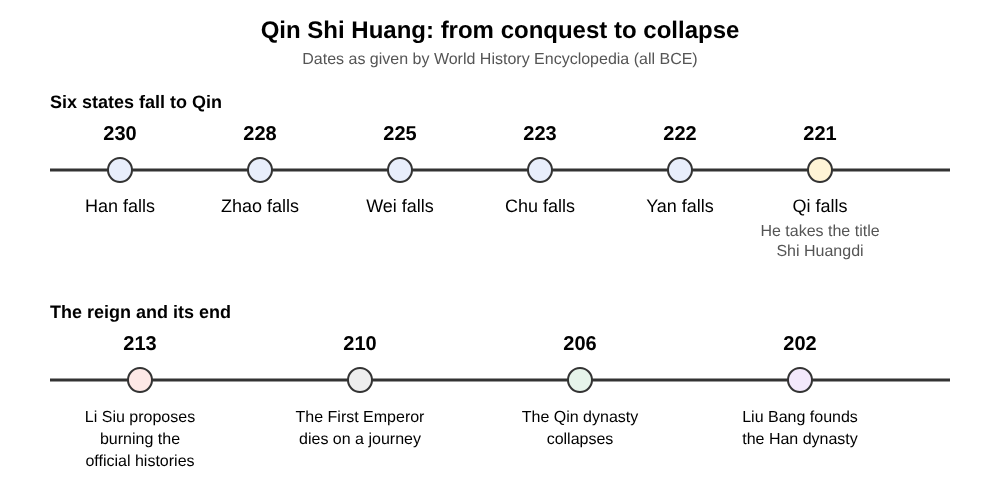
As the diagram shows, the last state, Qi, fell in 221 BCE. He then claimed the Mandate of Heaven, the idea that Heaven gave a ruler the right to rule, from the Zhou and proclaimed himself First Emperor.
What he built
With Li Siu he set out to base society "not, as heretofore, upon custom and local autonomy, but upon explicit law and a powerful central government", in the words the encyclopedia quotes from the historian Will Durant. Durant's list of what followed is a good summary:
- simpler official ceremonies and a state coinage;
- most of the old feudal estates divided up;
- peasants owning the land they worked;
- great highways running out from the capital;
- in Durant's phrase, "He encouraged science and discouraged letters".
The encyclopedia adds three projects. The walls that once enclosed the old states were torn down and the Great Wall was begun from their ruins, as the northern boundary against nomad raiders. The Lingqu Canal was built in the south to help transport and trade. And the weapons of the beaten states were melted down and made into works of art. The encyclopedia calls him the emperor who started the Great Wall and an early version of the Grand Canal, which is a fair reminder that these were early versions, begun in his reign, not the finished works people picture today.
It describes the early Qin government as working to improve people's lives. That did not last.
The book burning and what it cost
In 213 BCE, according to the encyclopedia, Li Siu was tired of Confucian scholars criticizing the regime by comparing it to the "golden age" of earlier dynasties. He proposed that the official histories, except the Memoirs of Qin, be burnt, and that anyone hiding other works be made to hand them over to be burnt. The period is known as the Burning of the Books and the Burying of Philosophers.
The sources also record criticism from inside the family. His own son Fusu pointed out that the emperor kept copies of the same books in his private library that he denied to everyone else. Durant, quoted by the encyclopedia, judges the policy a failure: its only lasting result was to give the banned writings "an aroma of sanctity" and to make him unpopular with Chinese historians, who for generations, he says, showed their opinion by befouling his grave.
That last point matters for how you read the whole story. If the people who wrote the history were the people he had silenced, their account needs care. For a method, see the post on how to analyze a written document in history.
His tomb, his death and the fall of Qin
The encyclopedia says he survived several assassination attempts and slept with a sword across his knees, telling no one which of his many palaces he would sleep in. He became obsessed with death and looked for elixirs of immortality. When those failed he ordered a palace built as his tomb, with an army of over 8,000 armed terracotta warriors to guard him. It describes the tomb as extravagant, said to be a vision of heaven, and buried and booby-trapped to stop looters.
He died in 210 BCE on a trip to find the elixir of life. Some sources say he was poisoned by what he took for the elixir. Li Siu hid his death, changed the will so that a young son, Hu-Hai, who took the name Qin Er Shi, would inherit, and had the body carried back to the capital in a caravan of dead fish to hide the smell.
The new emperor reigned poorly for three years. Li Siu was executed, Zhao Gao forced the emperor to kill himself, and the nephew who followed had Zhao Gao executed. With the government in disarray and no capable heir, the country rose in rebellion and the dynasty collapsed. A civil war between Chu and Han, from 206 to 202 BCE, ended at the Battle of Gaixia. Liu Bang then took the throne name Emperor Gaozu and founded the Han dynasty, which ruled from 202 BCE to 220 CE.
For a contrast with another empire builder, see Cyrus the Great and the Persian Empire, and for a Chinese thinker's view of rule, Confucius vs Laozi.
A worked example: weigh a hostile source
Take one claim from this post, that Lu Buwei was the First Emperor's real father, and test it in four steps:
- Who says it? Sima Qian, writing after the dynasty had fallen, according to the encyclopedia.
- What is his stance? The encyclopedia says he was hostile to Shi Huangdi, as almost all later writers are.
- What could colour it? A writer who dislikes a ruler may be glad to repeat a story that makes his rule look illegitimate. That is a reason for care, not proof that it is false.
- What do you do? Report it as a claim, not a fact, and say it is often disputed, as the encyclopedia does.
You can run the same four steps on the stories of the fish caravan or the poisoned elixir, which the encyclopedia also reports with "some sources indicate" for the poisoning. The method is the same one you would use on any single source.
Frequently asked questions
Who was Qin Shi Huang?
He was the king of Qin who defeated the other six Warring States and in 221 BCE became the first emperor of a unified China. He ruled until his death in 210 BCE.
Did Qin Shi Huang build the Great Wall?
World History Encyclopedia says he initiated it, beginning the wall from the ruins of the old states' walls as a northern boundary. The wall was begun in his reign, not finished then.
What happened in the Burning of the Books?
In 213 BCE his minister Li Siu proposed burning the official histories except the Memoirs of Qin and making people hand over other works. The period is called the Burning of the Books and the Burying of Philosophers.
What is the terracotta army?
It is the army of over 8,000 armed terracotta warriors that the encyclopedia says he commissioned to guard him in the afterlife.
Why did the Qin dynasty fall?
After his death in 210 BCE a weak and poorly chosen heir, court killings and rebellion ended the dynasty. The Han dynasty followed in 202 BCE.
Get started
If you want more than a summary, Qin Shi Huang sits in the Empire Builders course, one of 15 courses made of short lessons. You read, study the diagrams, try a hands-on activity and answer questions. Every lesson lists its sources, and cards set out where researchers disagree, which matters for a figure the sources mostly judged harshly.
You sign in with your email and an emailed sign-in code. It is a web app, so you can open it in a browser.
Start Learn 100 Influential People: short hands-on lessons on the people who shaped history, with every side of the debate and the sources to read next.
100 people who shaped history, from Moses to the web.
Visit influentialpeople.vlvd.net↗


Comments
No comments yet.
Sign in or make an account to comment.