Revenue Per Employee for AI Startups: Formula and Levers
Revenue per employee for AI startups is your annual revenue divided by the number of full-time people it takes to earn it. It is a quick measure of leverage: how much the business brings in for each person on the team. AI tools let small teams do work that once needed whole departments, so founders watch this number closely. A high figure only means something if margins and the team's health hold up too.
Age of AI Entrepreneur teaches you how to build, launch and grow a business with AI in short hands-on lessons that list their sources. This post covers one metric in depth. For the wider picture, the Scaling an AI Company course has three lessons: The Economics of AI Companies, Tiny Teams, Huge Leverage, and Your Roadmap: From First Project to Company. Sign in with your email and an emailed code to open the course.
What revenue per employee for AI startups measures and how to calculate it
The formula is simple. Take revenue for a period, annualize it, and divide by average full-time-equivalent (FTE) headcount for the same period.
- Revenue: money you earned from customers, not money you raised.
- Annualize: multiply monthly revenue by 12, or use the last 12 months if you have them.
- FTE: a full-time person counts as 1. Someone working half time counts as 0.5.
Here is a made-up example. Your startup earns $40,000 in a month. You have four full-time people and two contractors who each work half time. That is 5 FTE. Annualized revenue is $480,000. Divide by 5 and you get $96,000 per employee.
Write your definition down and keep it. If you count contractors one month and skip them the next, the trend line becomes noise.
Why the metric matters more for AI companies than for classic SaaS
Classic software often has low cost per extra customer once the product is built. AI products are different. Every request to a model costs money, so serving one more customer has a real price. That changes how you read revenue per employee.
Two things happen at once. AI lets a small team handle support, writing, coding and operations, which pushes revenue per employee up. But model costs can eat into the margin on that revenue. A team of three bringing in a lot of revenue looks great until you see that most of it goes to inference bills.
So track a second number next to it: gross profit per employee. That is revenue minus the direct cost of delivering the product (model calls, hosting, payment fees), divided by FTE. If revenue per employee climbs while gross profit per employee stays flat, you are growing your vendor's business more than your own. What a healthy margin looks like is covered in AI startup gross margin. The lesson on Revenue, Costs and Unit Economics in Business Basics for Builders walks through the cost side.
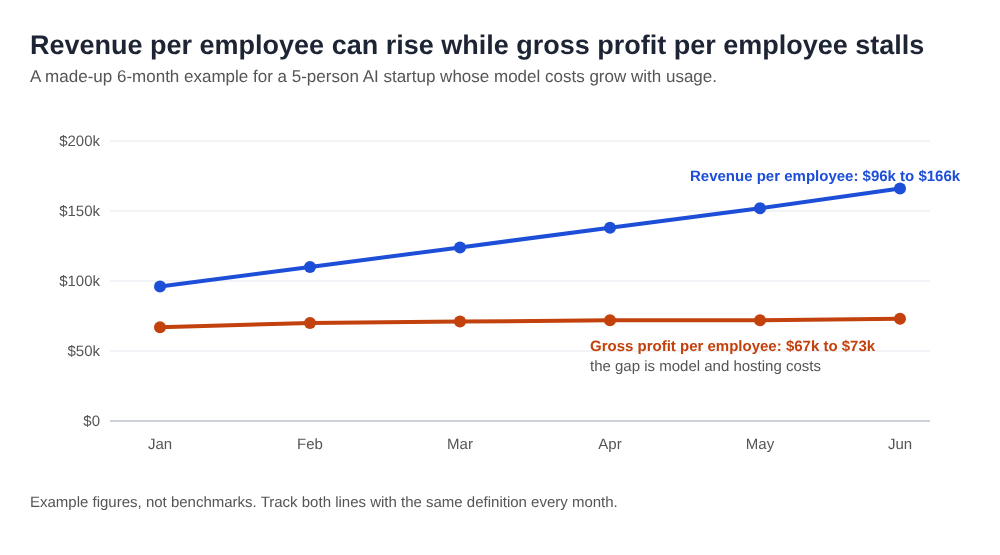
Example figures, not benchmarks: the gap between the two lines is model and hosting costs.
How AI-native startups compare with traditional software companies
You will see headlines about tiny AI teams reaching large revenue. Treat those figures with care before you compare yourself to them. Many are self-reported. Some annualize a single strong month. Some count only full-time staff and leave out a large contractor bench. Some report bookings instead of revenue.
A fair comparison needs the same definition on both sides. Before you use any outside number as a benchmark, check four things:
- Is it revenue earned, or annual recurring revenue projected from one month?
- Does the headcount include contractors and outsourced work?
- What stage was the company at, and how old is the number?
- Who published it, and do they have a reason to make it look big?
The most useful benchmark is usually your own past. Is the number higher than six months ago, with the same definition? That tells you more than a figure from a company with a different product, market and accounting.
Five levers that raise revenue per employee without burning out the team
You can raise the ratio by growing revenue or by keeping headcount flat. The trap is doing it by making people work longer. That shows up as a good number and a team that quits. These levers work on the system instead.
1. Price on the value you deliver
If your product saves a customer ten hours a week, a price set by the cost of tokens leaves money on the table. Raising price adds revenue with no new hires. The Pricing AI Products lesson in Launch, Price and Get Paid covers how to think about this.
2. Automate one boring workflow at a time
Pick the task your team repeats most. Map it first: who supplies the input, what the steps are, who uses the output. The guide on tasks to automate with AI shows how to pick the first one. Then automate the most predictable step. A prompt you might start with:
Here are 20 support tickets from last week. Group them by cause. For each group, draft a reply template and list the facts a person must check before sending it.
Keep a person on the check step until you trust the output.
3. Choose a workflow before an agent
A fixed sequence of steps is easier to test and cheaper to run than an agent that decides its own path. Use agents where the task truly varies. The Agents and Automation course has a lesson on Workflows Versus Agents and another on why agents fail.
4. Cut rework with evals
Hidden labor kills this metric. If someone on your team quietly fixes bad AI outputs every day, that is a job you did not plan for. Build a small eval set of real inputs with known good answers and run it every time you change a prompt or model. The Evals: Shipping AI That Works course shows how to build one.
5. Pick distribution that does not scale with headcount
Some channels need a person per deal. Others, like useful content, integrations or referrals, keep working without new hires. Lean toward the second kind as you grow, and keep the high-touch channel for your largest customers.
Alongside each lever, track hours worked. If revenue per employee rises and weekly hours rise with it, you did not gain leverage. You borrowed it from your team.
When a low number is fine and when it is a warning sign
A low or falling number is not always bad. It is fine when:
- You are pre-revenue or just launched, and the team is building.
- You hired ahead of a launch you have good evidence for.
- You are doing research-heavy work where revenue comes later by design.
It is a warning sign when:
- Headcount grows for three months while revenue stays flat.
- New hires mostly do manual work the product was supposed to handle.
- Revenue per employee rises but gross profit per employee falls, which points to model costs outrunning price.
- The number only looks good because you moved staff to contractors you no longer count.
How to track revenue per employee monthly as you scale
A spreadsheet is enough. Add one row per month with these columns:
- Month
- Revenue earned that month
- Annualized revenue (month times 12)
- Average FTE for the month, contractors included at their share of full time
- Revenue per FTE
- Direct costs (model calls, hosting, payment fees)
- Gross profit per FTE
- Hours the team spent on manual fixes or repeat tasks
Single months jump around, so add a column with the average of the last three months. Look at that line, not the monthly spikes. Once a quarter, review which lever moved the number and write one sentence about why.
When you hire, write down what you expect the new person to change, and count the full cost of the hire, as in the true cost of hiring an employee. More customers handled? Faster delivery? Then check the sheet three months later. This keeps hiring tied to results instead of to how busy everyone feels.
Frequently asked questions
What is a good revenue per employee for an early startup?
There is no single good number, because stage, market and margins vary so much. For an early startup, a rising trend under a fixed definition matters more than any outside figure. Check gross profit per employee too, since AI model costs can hide behind a strong top line.
Should contractors and freelancers count as employees?
Yes, count them as full-time equivalents based on the hours they work for you. Leaving them out makes the number look better than the business really is. Whatever you choose, apply it the same way every month.
Can AI automation really replace a new hire?
Sometimes it can take over a specific, repetitive part of a role, such as sorting support tickets or drafting first versions. It rarely replaces judgment, customer relationships or the person who checks outputs. Map the work first, automate one step, and measure the hours saved before you decide not to hire.
How often should a founder recalculate revenue per employee?
Calculate it every month and read a three-month average to smooth out spikes. Review the trend once a quarter, and after any hire or big pricing change.
Get started: learn to scale an AI company with a tiny team
Revenue per employee is one number in a bigger set of choices about margins, team size and growth. The Scaling an AI Company course covers the economics of AI companies, how tiny teams get leverage, and a roadmap from first project to company. Lessons run about 9 minutes, with questions you sort, match and estimate, and the sources listed so you can read further. Sign in with your email and an emailed code to open it.
Start Age of AI Entrepreneur: short hands-on lessons on how to build a business in the age of AI, with every side of the debate and the sources to read next.
Building a business in the age of AI, from a first project to a company.
Visit aientrepreneur.vlvd.net↗

Comments
No comments yet.