Rousseau's Emile: his ideas on education, explained
Rousseau's Emile argues that a child is born good and that education should follow the child's own growth: protect that goodness, let the child learn from things and their consequences, and hold back books, lectures and moral talk until he can use them. Jean-Jacques Rousseau published it in 1762 and made his case by raising an imaginary boy, Emile, under a single tutor.
If you want Rousseau beside the people he argued with, Learn 100 Influential People teaches him in its course Power, Reason and Rights with Locke, Kant and Wollstonecraft, in short hands-on lessons that set out every side of the debate and list their sources.
What Rousseau's Emile argues
In Barbara Foxley's translation, on Project Gutenberg, Book I opens: "God makes all things good; man meddles with them and they become evil."
If the child starts out good, the teacher's first job is to keep the damage out. The Stanford Encyclopedia of Philosophy's entry on Rousseau describes the scheme as protecting the child's natural goodness through stages, apart from "the domineering wills of others".
Rousseau tests the idea on paper. "I have therefore decided to take an imaginary pupil," he writes. The tutor has full charge: "He must honour his parents, but he must obey me."
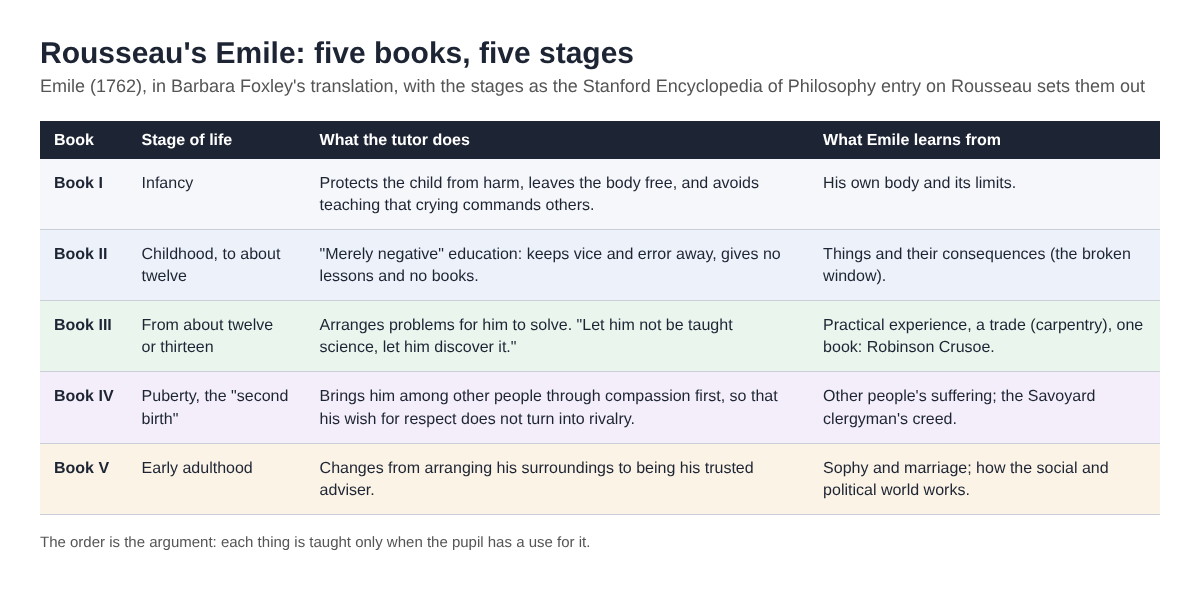
The five books: the stages of Emile's education
- Book I, infancy. Rousseau attacks swaddling and wants the baby free to move. His worry, the Stanford entry says, is a baby who learns from crying that human relations are about domination and subordination.
- Book II, childhood to about twelve. No lessons and no books: "Reading is the curse of childhood", and "Emile, at twelve years old, will hardly know what a book is."
- Book III, from about twelve or thirteen. The child's strength now grows "far more rapidly than his needs", and the spare energy goes into learning. The rule: "Let him not be taught science, let him discover it." Emile learns a trade, carpentry, and the first book he reads is Robinson Crusoe.
- Book IV, puberty. Rousseau calls it "the second birth". Emile starts to care how others see him. The tutor brings him to other people through compassion first, so that his need for respect does not turn into rivalry. This book also holds the Savoyard clergyman's creed on religion and conscience.
- Book V, early adulthood. Emile meets Sophy, the woman he will marry. The tutor stops arranging his world and becomes his trusted adviser.
Negative education: how the method works
Rousseau's definition: "The education of the earliest years should be merely negative. It consists, not in teaching virtue or truth, but in preserving the heart from vice and from the spirit of error."
The method rests on one distinction. "There are two kinds of dependence: dependence on things, which is the work of nature; and dependence on men, which is the work of society." Dependence on things, he says, "does no injury to liberty and begets no vices". A child refused by a person learns to fight that person's will. A child stopped by a fact has nobody to fight.
So the tutor swaps commands for consequences. Rousseau's own case: the boy breaks the windows of his room. "Let the wind blow upon him night and day, and do not be afraid of his catching cold." The cold does the explaining.
Here he answers John Locke, whose chief maxim he gives as "Reason with children". Rousseau rejects it: reason is "the last and choicest growth", so you cannot train a small child with it. Both men trusted experience, as the post on Locke's tabula rasa explains, but not on when reasoning should start.
A worked example: the forest lesson, step by step
Book III shows the method on one problem: finding south without a compass.
- The refusal. A lesson notes that the forest lies north of the town of Montmorency. Emile asks, "What is the use of that?" The tutor drops the lesson.
- The setup. Next morning he proposes a walk before breakfast. They climb into the forest and get lost.
- The need. By noon they are hot, tired and hungry, and Emile is in tears.
- The questions. The tutor asks the time (noon) and recalls where the forest lay. Emile works out that Montmorency must be "South of the forest", and that at midday you find north "by the direction of the shadows".
- The discovery. South is opposite the shadows. Emile walks that way, spots the town and concludes, "Astronomy is some use after all."
Emile has used one fact about the sun to get his lunch, and Rousseau expects that he "will certainly never forget this day's lesson as long as he lives". The tutor must not state the moral: Emile may think it, "provided I do not say it myself". Rousseau's rule: "Teach by doing whenever you can, and only fall back upon words when doing is out of the question."
Now read the scene again. Rousseau tells you the town was "hidden from our view by a mere thicket". The tutor was never lost.
The distinction most readers miss: free does not mean left alone
People often take negative education to mean letting the child do as he likes. The book says the opposite. The Stanford entry describes the programme, up to adolescence, as "a sequence of manipulations of the environment by the tutor": the child is not told what to think, but the setting in which he draws his own conclusions "has been carefully arranged".
Rousseau says so in Book II: "let him always think he is master while you are really master. There is no subjection so complete as that which preserves the forms of freedom; it is thus that the will itself is taken captive."
Like the tutor, the Stanford entry adds, the lawgiver of The Social Contract gives his charges "the illusion of free choice without its substance", and many critics see both figures in a sinister light. The post on Rousseau's general will takes up that side.
A second mistake is to read Emile as a plan for schools. It is one pupil with one private tutor. Rousseau wrote about educating citizens in other works, the Discourse on Political Economy and Considerations on the Government of Poland.
The strongest objections: Sophy, Wollstonecraft and Rousseau's own children
Sophy. Book V educates the girl on a different principle. "Woman is specially made for man's delight," Rousseau writes, and "a woman's education must therefore be planned in relation to man." Emile is shielded from other people's opinion. Sophy is trained to live by it.
Wollstonecraft's reply. In *A Vindication of the Rights of Woman* (1792), Mary Wollstonecraft grants that the girl's character is "a captivating one, though it appears to me grossly unnatural", and attacks "the principles on which her education was built". Women should gain human virtues "by the SAME means as men", not be raised as "a fanciful kind of HALF being, one of Rousseau's wild chimeras". Her aim: "I do not wish them to have power over men; but over themselves." The post on Wollstonecraft's Vindication has her full argument.
His own children. By Rousseau's own account, Thérèse Levasseur bore him five children, and all five were left at the foundling hospital, which the Stanford entry calls "an almost certain sentence of death in eighteenth-century France". Voltaire later used this against him. Whether a fact about the author weakens the book's argument is for you to judge.
What happened in 1762, and what is still unsettled
Emile and The Social Contract both appeared in 1762. The Stanford entry records that Emile was condemned in Paris and both books in Geneva for religious heterodoxy, and Rousseau had to flee to escape arrest. Legend has it that the only time Immanuel Kant, author of the categorical imperative, forgot his daily walk was when he was reading it.
Two questions remain open. The first is whether the wish for other people's respect, which Rousseau calls amour propre, is simply a vice. Readings built on his Discourse on Inequality often treat it as wholly negative. More recent readings of Emile (the Stanford entry cites Dent 1988 and Neuhouser 2008) find a more balanced view possible, with pushback from McLendon (2019).
The second is whether this education fits Emile for public life. In Book I Rousseau says that when he meets a person truly at one with himself, "it will be time enough to decide whether he is a man or a citizen, or how he contrives to be both".
Frequently asked questions
What is the main idea of Rousseau's Emile?
Children are born good, and education should protect that goodness and follow the child's growth. The pupil learns from experience arranged by a tutor, not from lectures.
What does Rousseau mean by negative education?
In the early years the tutor does not teach virtue or truth directly. He keeps vice and error away and lets things and their consequences do the teaching.
Why was Emile condemned in 1762?
For religious heterodoxy, the Stanford Encyclopedia of Philosophy records: in Paris, and in Geneva together with The Social Contract. Rousseau fled to escape arrest.
What did Mary Wollstonecraft object to in Emile?
Sophy's education in Book V, planned "in relation to man". She argued that women should gain the same virtues by the same means as men.
Get started: learn Rousseau and the people who answered him
Rousseau sits in the advanced course Power, Reason and Rights, alongside Machiavelli, Hobbes, Descartes, Locke, Kant and Wollstonecraft.
Each lesson takes about 9 minutes: you read, study diagrams and do a hands-on activity, then questions check you. Questions from lessons you finish come back later, spaced out, up to 5 a day. Debate cards show where researchers disagree, and each lesson lists its sources. You sign in with your email and an emailed sign-in code. Read more on the about page.
Start Learn 100 Influential People: short hands-on lessons on the people who shaped history, with every side of the debate and the sources to read next.
100 people who shaped history, from Moses to the web.
Visit influentialpeople.vlvd.net↗
Comments
No comments yet.