Locke's tabula rasa: the mind as a blank slate, explained
Locke's tabula rasa is the claim that the mind starts as a blank slate: you are born with no ideas at all, and experience writes every one of them. In An Essay Concerning Human Understanding (1689), John Locke asked you to picture the newborn mind as "white paper, void of all characters, without any ideas," and answered how it gets filled "in one word, from EXPERIENCE." This post explains what he meant, how his argument works step by step, and how his critics pushed back.
If you want to study Locke beside the thinkers he argued with, Learn 100 Influential People teaches him in short hands-on lessons that set out every side of the debate and list the sources, so you can read the Essay yourself.
What Locke meant by tabula rasa
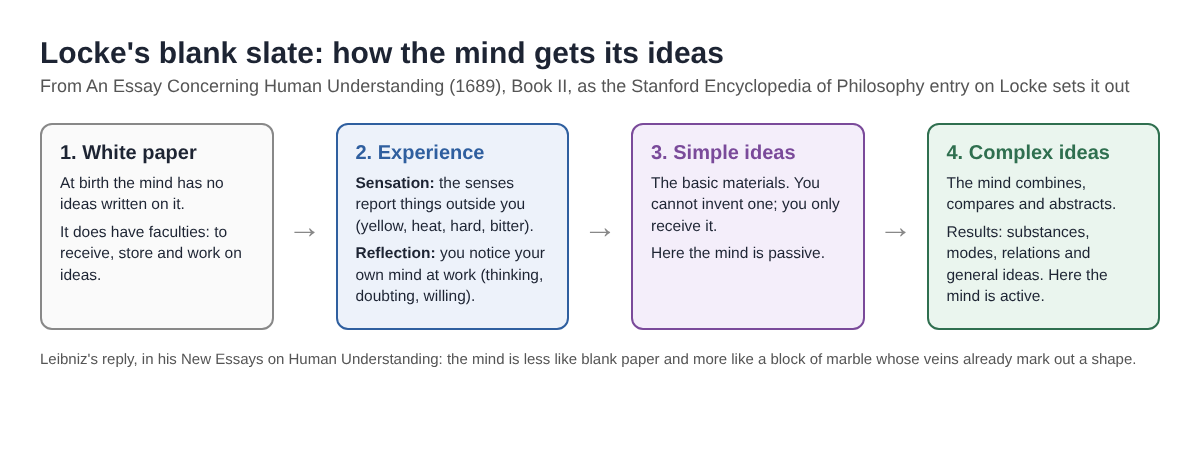
Be precise about what Locke denied. He did not say you are born with no abilities. The Stanford Encyclopedia of Philosophy's entry on Locke puts it plainly: the mind may be a blank slate in regard to content, but Locke thinks we are born with faculties to receive ideas and to work on them once we have them.
So the slate is blank, but the hand that writes is built in. You can perceive, remember, compare and combine from the start. What you lack at birth are ideas, which for Locke means anything the mind is thinking about.
That distinction matters, because many attacks on the blank slate aim at a cruder version than the one Locke held.
Where the blank slate came from
The quarrel is far older than Locke. The Stanford entry on the history of the innateness debate calls Plato the first great nativist: in the Meno, a slave boy seems to recall geometry he was never taught. On the other side it traces a line back to Anaxagoras, for whom the world has to press itself on an unformed mind. That image, the entry says, becomes the tabula rasa of 17th century empiricism.
Locke came to it from science as much as philosophy. At Oxford he found the Aristotelian philosophy he was taught of little use. He learned atomism from Robert Boyle, and Locke, Boyle and Newton were all early members of the Royal Society. The Essay brings that habit of mind to knowledge itself: start from observation, and see how far it gets you.
Locke's case against innate ideas
Book I of the Essay attacks the view that some truths are stamped on the mind from birth. Locke takes on innate principles of logic, innate moral principles, and innate ideas of God, identity and impossibility.
His main argument, from universal assent, runs like this:
- If a truth such as "What is, is" were innate, every human mind would hold it.
- Young children have not the least thought of it.
- So it is not in every mind.
- To say it is there but unnoticed makes no sense to Locke, since being in the mind means being perceived.
In his own words: "It seems to me a near Contradiction to say that there are truths imprinted on the Soul, which it perceives or understands not."
Defenders answered that innate truths sit in the mind as dispositions, waiting to be noticed. Locke attacked that reply too. If "innate" only means "the mind is able to learn it," then every truth anyone ever learns would count as innate, and the word stops doing any work.
Sensation and reflection: how experience writes on the slate
Book II gives the positive account. Experience comes in two kinds.
- Sensation: your senses report on things outside you. Locke's examples are yellow, white, heat, cold, soft, hard, bitter and sweet.
- Reflection: the mind notices its own workings. This is how you get ideas of thinking, doubting and willing.
Reflection is easy to miss and it does a lot of work. It lets Locke explain ideas about the mind without any innate stock. You know what doubt is because you have watched yourself doubt.
Locke reaches for other images too. In Book I the senses "furnish the yet empty cabinet." In Book II the understanding is like "a closet wholly shut from light, with only some little openings" that let in pictures of things outside. The point is the same each time: everything in the mind came in from somewhere.
Simple and complex ideas: building knowledge step by step
Locke splits ideas into two kinds. Simple ideas are the basic materials. You cannot create one; you can only get it from experience. Here the mind is passive.
Complex ideas are built by the mind, which is active here. It combines simple ideas, sets two ideas side by side to see their relation, and abstracts general ideas by leaving out the details of time and place. Locke's example is gold: your idea of it bundles its colour and weight with powers such as being melted and being dissolved in aqua regia.
You can test the theory yourself. Try this short exercise:
- Pick a complex idea, such as unicorn.
- List its parts: a horse's shape, white, a single horn.
- Ask where each part came from. You have seen horses, white things and horns.
- Now try a harder one: justice or infinity. Can you trace every part back to sensation or reflection?
Step four is where the arguments start. Locke ties infinity to number, to which "we can add for ever." Whether endless adding ever gives you a real idea of the infinite is one of the places readers push back.
Critics and rivals: Leibniz, Kant and Chomsky
Gottfried Leibniz wrote a full reply, the New Essays on Human Understanding. Against blank paper he set a block of marble whose veins already mark out the shape of Hercules. The veins do not carve the statue, but they decide what can be carved. His sharper point: experience only ever shows you particular cases, yet some of what you know is general and even necessary. Where does that come from, if not from the mind itself?
For a while Locke's side won. The innateness entry says the Lockean approach "carried the day," and innateness was written off as a backward view.
Immanuel Kant took a third path in answer to Hume. He argued that the structure of experience comes from our own nature: we bring the order to what we perceive. You can follow that thread in Kant vs Hume on cause and habit.
Noam Chomsky brought innateness back in the 20th century, arguing that findings in linguistics favour nativism over empiricism. The debate is live again in philosophy and science, and each side has serious defenders. Most now argue about how much each side contributes, not whether one of them contributes nothing.
Why Locke's tabula rasa still matters
Education. If the mind starts blank, upbringing carries enormous weight. Locke's Some Thoughts Concerning Education (1693) collected advice he had given his friend Edward Clarke since 1684 on raising Clarke's son and daughters.
Politics. Many readers link the blank slate to Locke's Two Treatises of Government and its picture of people as free and equal by nature, though how tightly the two works connect is argued over. Compare his politics with a rival's in Locke vs Rousseau on the social contract.
Philosophy. The Essay is a founding text of empiricism, so it is the other half of every rationalist argument you will meet. Read it against Descartes vs Locke on reason and experience, then follow empiricism to its hardest test in Hume's problem of induction.
A good study workflow: read Book II, chapter 1 of the Essay. Write one sentence summing up Locke's view and one for Leibniz's marble reply. Then trace three complex ideas back to experience, and note exactly where you get stuck.
Frequently asked questions
Did Locke use the phrase tabula rasa in the Essay?
The English text says "white paper, void of all characters." Tabula rasa, Latin for a scraped tablet, is the label scholars use for that view, as the Stanford Encyclopedia does.
Did Locke think babies are born with no abilities?
No. He held that the mind has no ideas at birth but does have faculties to receive, store and work on ideas once experience supplies them.
How is tabula rasa different from rationalism?
Locke's empiricism says all ideas come from experience. Rationalists such as Descartes and Leibniz held that some ideas or truths come from the mind itself, not from the senses.
Is the blank slate theory accepted today?
It is still debated. Since Chomsky's work in linguistics, innateness is again argued over in philosophy and science, and most of the argument is about the balance between built-in structure and learning.
Get started: learn Locke and his rivals
Locke sits in the advanced course Power, Reason and Rights, alongside Machiavelli, Hobbes, Descartes, Rousseau, Kant and Wollstonecraft. That puts the blank slate right next to the views that challenged it.
Each lesson takes about 9 minutes. You read, study diagrams and do a hands-on activity. Then questions check you: choose, put in order, match, sort and estimate a number. Every attempt is graded, and you can retake a lesson any time for a better grade. Questions from lessons you finish come back later, spaced out, up to 5 a day. Debate cards show where researchers disagree, and each lesson lists its sources. You sign in with your email and an emailed sign-in code. Read more on the about page.
Start Learn 100 Influential People: short hands-on lessons on the people who shaped history, with every side of the debate and the sources to read next.
100 people who shaped history, from Moses to the web.
Visit influentialpeople.vlvd.net↗
Comments
No comments yet.