Rousseau's general will: what it means and why it is debated
Rousseau's general will is the shared will of a people's citizens, taken as a whole, aimed at their common interest. In The Social Contract (1762) Jean-Jacques Rousseau argued that a state is legitimate only if the general will guides it: laws must come from all citizens and apply to all of them, and a citizen who obeys such laws obeys only himself, so he stays free. It is debated because Rousseau never pinned down where the general will is found, and because he wrote that anyone who refuses to obey it can be "forced to be free". This guide explains the idea in plain words, from the text itself and the Stanford Encyclopedia of Philosophy, and sets out each reading fairly.
If you want to study Rousseau beside Hobbes, Locke and Kant, Learn 100 Influential People has short hands-on lessons on the people who shaped history, with cards that set out where researchers disagree and the sources for every lesson.
Rousseau's general will in one paragraph
Rousseau (born in Geneva in 1712, died in 1778) set himself one question: how can people live under the authority of a state and still be as free as before? The Stanford Encyclopedia of Philosophy entry on Rousseau calls this, for him, the fundamental question of politics. His answer is the general will: "the collective will of the citizen body taken as a whole." It is the source of law, and it is willed by each citizen. So when you obey the law, you obey your own will. That is the whole promise of the book in three sentences.
Why Rousseau thought the state needed it
Rousseau's earlier Discourse on Inequality tells a story of how people came to depend on each other, fell into constant conflict, and then agreed, out of fear, to set up laws and a state. The Stanford entry sums up his verdict on that state: it would be a class state, guided by the common interest of the rich and imposing subordination on the poor and weak, who agreed to it because fear of war stopped them seeing how it would disadvantage them.
The Social Contract is his alternative. It opens with the famous line, in G. D. H. Cole's translation: "Man is born free; and everywhere he is in chains." In the legitimate state he describes, each person keeps the protection of the common force while remaining, as he puts it, as free as before. The general will is the device meant to make that possible.
General will vs will of all: the key distinction
Book 2, chapter 3 of The Social Contract, in Cole's translation on Project Gutenberg, draws the line most readers miss:
"There is often a great deal of difference between the will of all and the general will; the latter considers only the common interest, while the former takes private interest into account, and is no more than a sum of particular wills."
So the general will is not simply whatever the majority wants. Rousseau adds that if citizens vote with adequate information and no factions, the "pluses and minuses" of private interest cancel out, and the general will remains. Factions spoil this: a big group voting as one turns many small differences into one large private interest.
He also says the general will must be general twice over. It must come from all and apply to all. The Stanford entry spells out the formal side: a law cannot name particular individuals, and it must apply to everyone in the state.
A worked example: test a law the way Rousseau would
Take a town deciding on a rule that every new building must have a ramp for wheelchairs. Run it through four questions that come straight from the text.
- Does it come from all? Did the citizens as a whole decide it, or did one group impose it? Rousseau wanted the people themselves to make the law, not representatives acting in their name.
- Does it apply to all? The rule binds every new building, not one named owner. It passes the generality test.
- Did people ask the right question? A builder who votes "no, it costs me money" is voicing a private will. A builder who asks "is this good for every citizen, me included?" is voicing the general will.
- Were factions in play? If the builders' guild voted as a bloc, Rousseau would worry that its one large interest replaced many private ones.
The point of the exercise is not that ramps are right. It is that Rousseau judges a law by where it comes from and how general it is, not only by how many votes it got. Try the same four questions on any law in the news.
Why it is debated: three readings of the general will
The Stanford entry says Rousseau's account is "marked by unclarities and ambiguities" that have drawn commentators since it first appeared. It names three readings, and all three find support in his text.
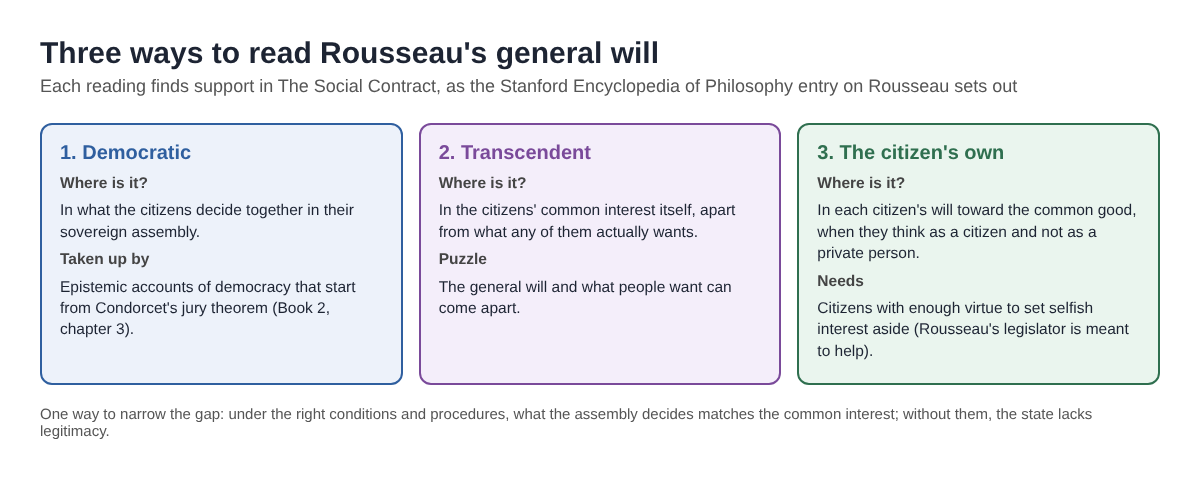
- Democratic: the general will is simply what the citizens decide together in their sovereign assembly.
- Transcendent: it is the citizens' common interest itself, which exists apart from what any of them actually wants.
- The citizen's own: it is each citizen's will toward the common good.
One way to bring the first two together, the entry suggests, is to read Rousseau as saying that under the right conditions and procedures, citizens will agree on laws that match their common interest, and that where those conditions are missing, the state lacks legitimacy. On that reading, almost no real state would pass.
A second puzzle is how the general will emerges at all. Sometimes Rousseau tells a procedural story in which self-interest, under the right constraints, is enough. Elsewhere he says citizens need virtue first, and he brings in a "legislator" who inspires a new people to see themselves as one. The entry notes that many critics see this figure, like the tutor in Emile, "in a somewhat sinister light."
Forced to be free: the line behind the sharpest criticism
In Book 1, chapter 7, Rousseau writes that whoever refuses to obey the general will "shall be compelled to do so by the whole body. This means nothing less than that he will be forced to be free; for this is the condition which, by giving each citizen to his country, secures him against all personal dependence."
Read one way, this is a point about the rule of law: the law protects each citizen from depending on any other person's will, the way a slave or a serf does. The Stanford entry calls this "republican freedom" and finds it implicit in exactly this passage. Read another way, it hands whoever claims to speak for the general will a license to coerce and call it freedom.
Both readings have followers. The entry notes that Rousseau has inspired liberal theories, communitarian ideas, civic republicanism and theories of deliberative and participatory democracy, while hostile writers have portrayed him as a source for the more authoritarian sides of the French Revolution, and through them for aspects of fascism and communism. A fair answer sets out both and lets the text decide.
Where the general will went next
The phrase entered law within a generation. Article 6 of the Declaration of the Rights of Man and of the Citizen (1789) begins: "Law is the expression of the general will." Notice what it adds: every citizen may take part "personally, or through his representative", a step Rousseau resisted, since he held that sovereignty cannot be represented.
Its deepest philosophical heir was Kant. The Stanford entry says the third formulation of Kant's categorical imperative, the kingdom of ends, recalls Rousseau's discussion of the general will. In the twentieth century, John Rawls described his two principles of justice as an effort to "spell out the content of the general will."
Rousseau also makes more sense beside his neighbours. Hobbes thought a single sovereign could act in the people's name (see Hobbes' state of nature), which Rousseau rejected. For how his contract differs from Locke's, read Locke vs Rousseau.
Frequently asked questions
What is the general will in simple terms?
It is the will of all the citizens taken together, aimed at their common interest rather than each person's private interest. For Rousseau, laws are legitimate only when they come from it and apply equally to everyone.
Is the general will the same as majority rule?
No. Rousseau separates the general will from the "will of all", which is just a sum of private wishes. A vote shows the general will only when citizens ask what serves everyone and no faction dominates.
What does "forced to be free" mean?
It comes from Book 1, chapter 7 of The Social Contract: a citizen who refuses to obey the general will can be made to obey, which Rousseau says protects him from depending on any other person. Critics read it as a license for coercion; defenders read it as the rule of law.
Who was influenced by Rousseau's general will?
The French Declaration of 1789 calls law "the expression of the general will". Kant's kingdom of ends recalls it, and John Rawls said his principles of justice try to spell out its content.
Get started
Rousseau is one of seven thinkers in Power, Reason and Rights, an Advanced course on Learn 100 Influential People, with Machiavelli, Hobbes, Descartes, Locke, Kant and Wollstonecraft. Lessons take about 9 minutes, 38 cards set out where researchers disagree, and every lesson lists its sources, so you can read The Social Contract yourself. Questions from lessons you finish come back later, spaced out, up to 5 a day. You sign in with your email and an emailed code.
Start Learn 100 Influential People: short hands-on lessons on the people who shaped history, with every side of the debate and the sources to read next.
100 people who shaped history, from Moses to the web.
Visit influentialpeople.vlvd.net↗


Comments
No comments yet.