Security champions program: a six-step OWASP playbook
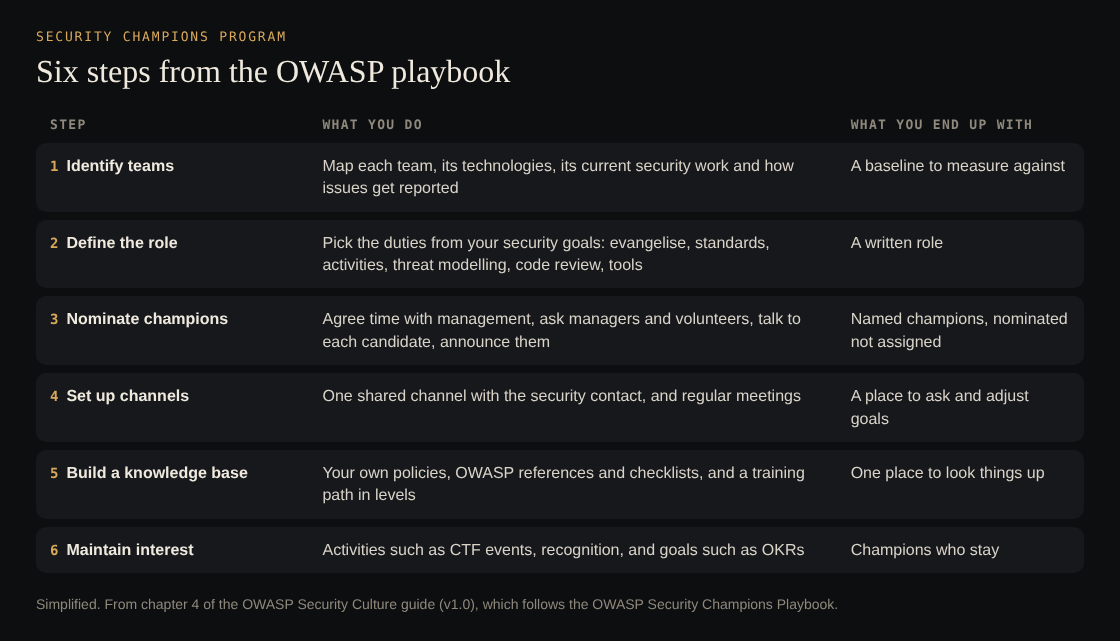
A security champions program puts one developer in each team in charge of security questions for that team, with a named contact in the security team behind them. OWASP's Security Culture guide gives a six-step playbook for starting one: identify the teams, define the role, nominate champions, set up communication channels, build a knowledge base, and keep the champions interested. This post walks through each step and ends with a small pilot you can copy.
Champions need real findings to work on, and whitehatstoic tests web apps and AI systems for weak spots, with a written report and fixes and a retest after fixes, which gives a new champion a first backlog grounded in your own code.
What a security champions program is
The Security Champions chapter of the OWASP Security Culture guide starts from a plain problem: security people do not scale across many development teams. A security team of a few people cannot sit in every planning meeting or read every pull request.
A champion is a member of the team, usually a developer, though OWASP says the role can also go to someone in operations or QA. The champion is the single point of contact for security in that team, and talks to a member of the security team for guidance. Because the champion knows the team's code and habits, they can present security in a way that fits how the team actually works.
OWASP treats champions as a key part of improving application security maturity, and points to OWASP SAMM as one of the maturity frameworks that refers to them. It also gives two pieces of advice before you start: get management to agree, because the role takes time away from development, and begin with a proof of concept of one or two champions before rolling it out to every team.
Steps 1 and 2: map your teams, then write the role
Identify teams. Before you name anyone, write down how each team is built and how it works. OWASP lists four things to record:
- the team's structure, for example 5 engineers, 1 product owner, 1 QA and 1 team lead;
- the technologies it uses, such as its language and framework;
- its current security state, such as code reviews or automated security tests already in place, which becomes your baseline;
- its processes: the channels it uses and how a security issue is reported and assigned.
Define the role. The duties depend on your own security goals, so compare the baseline with what you want to improve. OWASP's list of what the role may include is a menu, not a checklist:
- promote good security practice and raise awareness in the team;
- give input on the organisation's security standards and procedures;
- run activities such as Capture the Flag (CTF) events;
- threat model products at the design stage;
- do secure code reviews and raise risks in the code base;
- run or check automated security scans and help the team use the testing tools.
Pick two or three duties for a first version. A role that asks for everything usually ends up doing none of it well.
Step 3: nominate champions, do not assign them
OWASP is clear that champions should be nominated rather than assigned. Its nomination step has five parts:
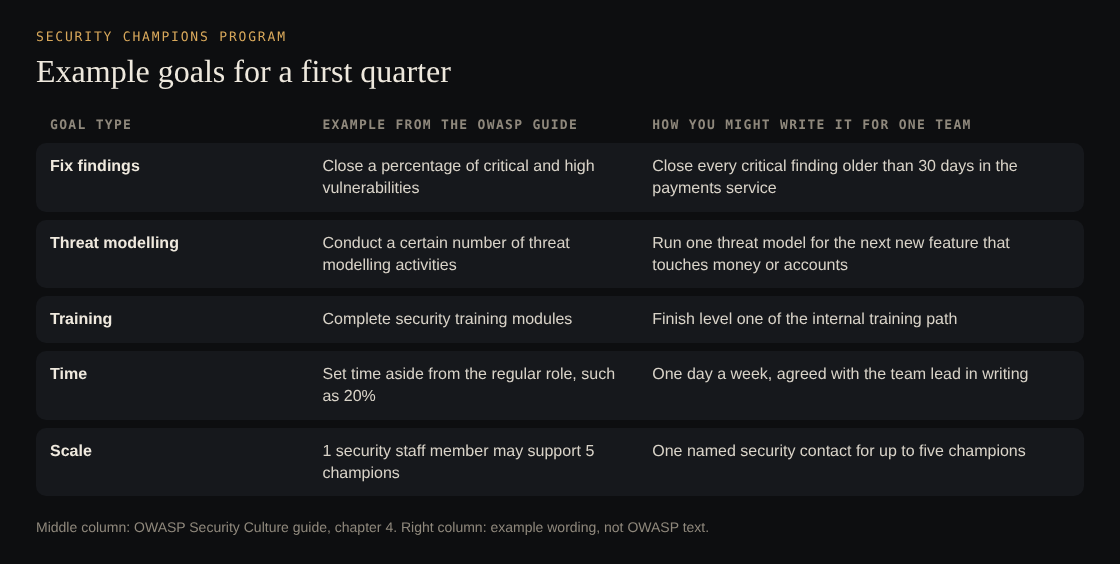
- Management agreement. Agree the duties and the time with management first. OWASP's example is 20% of the person's role.
- Scale. One security staff member may support 5 champions, and each champion supports their own team.
- Match the platform. Add champions by technology, such as frontend, backend or mobile, so their skills fit the work.
- Talk to managers and candidates. Nominations can come from team managers and from an open call. Then talk to each candidate about the role and what they gain from learning application security.
- Announce them. Once champions are chosen, tell the whole organisation about the program and who is in it.
The time agreement matters most. OWASP's argument is that the hours a champion spends on security are worth it when weighed against the cost of security issues found late. If the time is not agreed in advance, it is the first thing a deadline takes away.
Steps 4 and 5: a shared channel and a knowledge base
Communication channels. Give all champions and their security contact one shared place to talk, such as a chat channel or an email group, and hold periodic meetings to discuss problems and adjust goals.
Knowledge base. One place to look things up saves champions from answering the same question from memory. OWASP suggests it holds:
- your own security policies and procedures, such as the password policy, which cryptographic algorithms to use, how to run a code review, or which library to use to escape output;
- reference material such as the OWASP Code Review Guide and the OWASP Cheat Sheets;
- checklists such as the OWASP Top Ten and the OWASP ASVS.
OWASP also suggests a training program in levels, each building on the one before, from broad security topics to specific platforms such as mobile. The format can range from links in the knowledge base to hands-on labs.
Step 6: keep champions interested and measure progress
A program that nobody notices fades. OWASP's last step has three parts.
Activities. Champions can go to conferences together, and they can run CTF events and hackathons. OWASP mentions small game elements, such as a scoreboard at a CTF and prizes like branded clothing or stickers.
Recognition. Share what champions achieve, for example in a regular newsletter. Levels can show each champion's progress, and OWASP notes that some organisations make the champion position formal with their HR department to help people want to join.
Goals. Champions can have security objectives and key results (OKRs). OWASP's examples are closing a percentage of critical and high vulnerabilities, running a number of threat modelling activities, and completing training modules. Maturity levels can mark progress for each champion and for the program as a whole.
The project behind the guide has moved on since then. Its current version introduces SECUR-E, a framework for finding out whether secure practices stall because of capability, opportunity or motivation, and it says its results should never be used for hiring, performance reviews or discipline. That is worth keeping in mind for champions too: measure the program, and do not turn the role into a way to grade people.
A worked example: a pilot for a three-team company
Say you have three product teams: web, API and mobile, and one person who looks after security part time. Following OWASP's advice to start with one or two champions, a first pilot could look like this.
- Map the teams. Write one page per team: who is in it, its stack, whether pull requests get a second reviewer, whether any security scan runs, and where bugs are reported. This is your baseline.
- Write the role. Choose two duties: a short threat model for each new feature that touches sign-in or payments, and a security look at pull requests in those areas.
- Agree the time. Get the time in writing from the engineering lead before you ask anyone, for example 20% as in OWASP's example.
- Nominate two champions. Ask the web and API leads for names, open the call to volunteers, and talk to each candidate. Mobile joins after the pilot.
- Set up the channel. One chat channel with the two champions and the security contact, and a short meeting every two weeks.
- Start the knowledge base. One page with your password policy, how you review code, and links to the OWASP Cheat Sheets and the OWASP Proactive Controls.
- Set goals for the quarter. One threat model per champion, and a clear count of open critical and high findings at the start and the end.
At the end of the quarter, compare the baseline with what changed, keep what worked, and decide whether to add the mobile team. Champions lower risk inside each team; they do not catch every weakness, so outside testing still has a place.
Frequently asked questions
How much time does a security champion need?
OWASP's example is 20% of the person's role. Whatever you choose, agree it with management before you nominate anyone.
How many champions can one security person support?
OWASP's guide says one security staff member may support 5 champions, each of whom supports their own team.
Does a champion have to be a developer?
No. OWASP says a champion may be in a developer, operations or QA role, and should be nominated rather than assigned.
Do security champions replace a security team?
No. Each champion works with a contact in the security team for guidance. The program spreads security work across teams; it does not remove the need for security expertise or testing.
Get started
A security champions program works best when champions start from real findings in your own product. whitehatstoic tests web apps and AI systems for weak spots, covering web app and API review and prompt injection tests, with a written report and fixes and a retest after fixes. It also gives independent advice on teams and change management. Every engagement is scoped after a short call.
Building something that has to be safe? Book a meeting with whitehatstoic: tell us the product, the deadline and your biggest worry, and we reply with a plan.
Build it right. Test it thoroughly. Keep it safe.
Visit whitehatstoic.com↗


Comments
No comments yet.