Stoic Journaling: How to Keep a Journal Like Marcus Aurelius
Stoic journaling is writing a few lines to yourself each day to test your own judgements against Stoic ideas: what was up to you, how you reacted, and what you will do next time. Marcus Aurelius, Epictetus and Seneca all describe a version of it, and you can keep one in five to ten minutes a day. This post shows where the habit comes from, what research on writing does and does not show, and a one-page journal you can start tonight.
If you want the questions to come to you each day, How to Find Your Meaning is a free web app of short lessons on Stoic philosophy with a daily Stoic practice: a morning question, a passage to read during the day and an evening review, with a note for each day kept in one place.
What Stoic journaling is, and where it comes from
The best known Stoic journal is one that was never meant to be read. The Meditations of Marcus Aurelius are notes the emperor wrote during the last years of his military campaigns. The Stanford Encyclopedia of Philosophy's entry on Marcus Aurelius says scholars now generally agree that he wrote "for his own moral improvement", to remind himself of the Stoic ideas he wanted to live by. The title came later: a 10th-century bishop calls the book "the writings to himself".
Marcus was following advice older than him. The same entry notes that Epictetus told his students to write down, and rehearse, the responses they ought to have, so that they would be ready at hand when life demanded them. In the first of his Discourses, after a run of hard cases (prison, exile, death), Epictetus says: "These are the things which philosophers should meditate on, which they should write daily, in which they should exercise themselves."
Seneca adds the evening. In Of Anger, Book III, he writes that "the spirit ought to be brought up for examination daily", and describes the philosopher Sextius asking himself each night: "What bad habit of yours have you cured to-day? what vice have you checked? in what respect are you better?" Seneca says he does the same once the lamp is out, going over everything he said and did.
So Stoic journaling is not a mood diary. It has three jobs: prepare for the day, catch your judgements as they happen, and review the day fairly at night.
What research on writing about your life shows
No study tests Stoic journaling as such. The nearest research is on expressive writing, sometimes called experimental disclosure: people write about personal and meaningful topics for a few sessions, and researchers compare them with people who write about neutral things.
A 2006 meta-analysis by Joanne Frattaroli (PubMed 17073523) pooled 146 randomized studies of this kind. It found a positive and significant average effect, with an effect size of r = .075, and found that the effect varied with how the studies were run. That is a real effect, but a small one.
Read that honestly. It supports the idea that writing about your life can help a little, on average. It does not show that any particular journal will make you calmer or happier, and it says nothing about Stoic ideas themselves. Keep a journal because it helps you think clearly about your day, and treat any other benefit as a bonus. If you are struggling with your mood, a doctor is the right person to ask.
How to keep a Stoic journal: one page, three entries
You do not need a special notebook. One page a day, split into three short entries, matches what the Stoics describe.
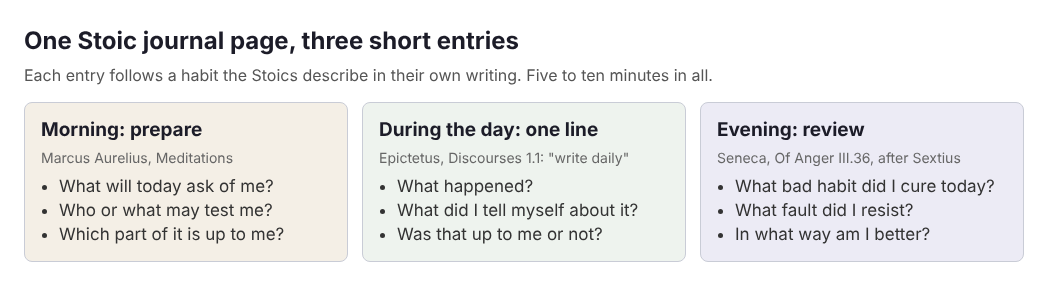
One page, three entries, each from a habit the Stoics describe.
- Morning, two minutes: prepare. Marcus tells himself early in the Meditations: "Betimes in the morning say to thyself, This day I shalt have to do with an idle curious man, with an unthankful man, a railer..." Write what today will ask of you, who or what may test you, and which part of it is up to you. The Stoic morning routine post goes deeper on this step.
- During the day, one line: catch the judgement. When something upsets you, write what happened, what you told yourself about it, and whether it was up to you. This is Epictetus' "write daily" in its smallest form.
- Evening, five minutes: review. Answer Sextius' three questions, then one sentence on what you will do differently tomorrow. The evening reflection questions post covers Seneca's review in full.
The middle entry is the one most people skip, and it is the most Stoic. Epictetus' whole teaching turns on sorting what is up to you from what is not, and a line written in the moment is the best record of which side you were on.
Stoic journaling prompts for the morning and evening
A prompt saves you from staring at an empty page. Pick two in the morning and keep Sextius' three every night. Swap the others as you like.
Morning
- What is the hardest thing I expect to face today?
- Who might test my patience, and how do I want to treat them?
- Which of the four virtues (wisdom, courage, justice, self-control) will I practise today, and where?
- What is one thing today that is fully up to me?
- What am I putting off that I would regret not doing?
Evening
- What bad habit did I cure today?
- What fault did I resist?
- In what way am I better?
- When did I react before I thought, and what was the judgement behind it?
- What did I worry about today that was not up to me?
- What will I do differently tomorrow, in one sentence?
Once a week, answer one slower question: what am I chasing that I would not miss if it were gone? What would I still respect about today in ten years?
A worked example: one evening entry
Here is a real-sized evening entry, so you can see how short it can be:
What fault did I resist? I wanted to send a sharp reply to the email about the late report. I waited an hour and wrote a plain one instead. When did I react before I thought? In traffic. The judgement was "he cut me off on purpose." I have no idea if that is true. Tomorrow, in one sentence: Leave five minutes earlier so traffic is not a reason to be angry.
That takes about four minutes. Notice that the second answer names the judgement, not only the feeling. That is the step Epictetus cared about: in the Handbook he says people are disturbed not by things but by their judgements about things, which the post on "men are disturbed not by things" explains.
Over a week, read the middle lines back. If the same judgement shows up three times ("they are doing this on purpose"), you have found the one to work on.
Common mistakes with a Stoic journal
- Venting instead of sorting. Writing out anger can feel good, but the Stoic step is to ask which part was up to you. Add that question to any entry that is only complaint.
- Writing too much. Long entries are hard to keep up. A few lines a day for a month beat a long entry once.
- Judging yourself harshly. Seneca's review is strict but not cruel. He writes that he can say to himself, "I pardon you this time: see that you never do that anymore." Name the fault, then let it go.
- Only reviewing, never preparing. The evening is easier to keep, but the morning entry is where you decide how you want to act before the day decides for you.
Frequently asked questions
Did Marcus Aurelius keep a journal?
In a sense. The Meditations are private notes he wrote to himself, and scholars generally agree he wrote them for his own moral improvement, not for readers.
How long should a Stoic journal entry be?
A few lines is enough. Two minutes in the morning, one line when something upsets you and five minutes at night make a habit you can keep.
Does journaling really help?
A 2006 meta-analysis of 146 randomized studies found a small positive average effect from writing about personal topics. It did not test Stoic journaling itself, so treat it as modest support, not a promise.
Can I keep a Stoic journal on my phone?
Yes. Paper and phone both work; what matters is that you write at the same times each day and read your entries back once a week.
Get started
Tonight, answer Sextius' three questions in a notebook or your phone, and tomorrow morning write one line about what the day will ask of you. If you want a guided version, How to Find Your Meaning's daily Stoic practice gives you a morning question and a virtue to practise, a short passage from Epictetus, Marcus Aurelius or Seneca, and the evening questions, about ten minutes in all, with notes on each day kept in one place. Its Stoic Exercises course includes the lesson The Morning and Evening Review. Read what the courses cover, or install the app from its site. Every lesson is free with an account, and you sign in with your email and a code sent to you.
Start How to Find Your Meaning: free, short hands-on lessons on Stoicism, healthy habits and your own meaning, with a daily Stoic practice to live it.
Find what your life is for.
Visit findyourmeaning.vlvd.net↗


Comments
No comments yet.